RACH Profiles · Technology
Brewster Kahle: Building a Library for a Vanishing Web
From switches and lights to networked search, a book-making van, and the unfinished work of preserving public memory.
- Focus
- Digital preservation, information access, and public-library infrastructure.
- Evidence boundary
- Preservation achievements do not imply complete coverage, legal approval of every practice, or endorsement of every proposal.
The library in the back of a van
In September 2002, Brewster Kahle arrived at a school in East Palo Alto with a van that could make books. Richard Koman, reporting for Salon from the trip, described children watching downloaded texts become printed, bound objects. The equipment included a satellite dish, a printer, a binding machine, and a paper cutter. A digital library was being demonstrated through something a child could hold.2
The work was shared. Koman credited Mary Austin and Internet Archive employees with preparing public-domain texts and covers, and identified Michael Hart's Project Gutenberg as an important predecessor. The bookmobile did not create those books or invent the desire to circulate them. It assembled existing work into a practical encounter between a reader and a text.2
That encounter offers a way into Kahle's life. His central project is often described in gigantic units: pages, collections, storage. But the useful unit is smaller. Someone wants to read, check, remember, or make something. The question is whether the necessary material is still there—and whether that person can reach it.
Before the library, switches and lights
Kahle's early attraction was to computers rather than to a librarian's career. In a 2011 interview with Akio Nakamata for Magazine Kō, he recalled a friend assembling a machine from switches, lights, and wire when he was around fourteen or fifteen. Entering ones and zeros helped him understand prime numbers. He described growing up around New York and discovering the possibilities of computing at school.3
He also resisted a neat retrospective picture of the young book lover destined to build a library. In that interview, he said he had spent more time making things than reading. His interest in libraries initially came through an engineer's question about what computers could accomplish. These are public recollections, not independently observed childhood scenes.3
The distinction matters. A biography can make a mature purpose seem inevitable by planting it in every childhood detail. Kahle's account instead leaves room for uncertainty: skill arrived before a settled use for it. Knowing how to build a machine did not, by itself, answer what would make the machine worth building.
MIT and the scale of a problem
Kahle earned his bachelor's degree at the Massachusetts Institute of Technology in 1982. The biographical note accompanying his 1997 Scientific American article identifies him as a principal designer of the Connection Machine, the parallel computer produced by Thinking Machines. The Computer History Museum's 2026 recognition places Marvin Minsky and Danny Hillis among his formative MIT influences and describes his lead-engineering work at the company.4, 5
Parallel computing divides work among many processing elements. For a reader imagining a searchable library, the relevance is straightforward: collecting information is not enough if searching it takes too long. This explanation is not a claim that the Connection Machine was built solely for the future Internet Archive. It locates Kahle's later ambitions within a practical engineering apprenticeship.
The museum's account connects that apprenticeship to the challenge of handling large collections. Yet the path from powerful hardware to public access required more than speed. Different computers needed ways to exchange requests and results. Publishers needed usable tools. Readers needed an interface. The next chapter moved from a machine's capabilities toward relationships among machines and people.
Making distant information searchable
Wide Area Information Servers, or WAIS, addressed that next problem. Its original technical record says development began in October 1989 and an Internet release followed in April 1991. A client could send a request to a server holding an information collection; the server could return relevant results. The architecture separated the user-facing program, server, database, and communications protocol.6
The 1994 informational memo describing the system carries eight names: Margaret St. Pierre, Jim Fullton, Kevin Gamiel, Jonathan Goldman, Kahle, John Kunze, Harry Morris, and François Schiettecatte. It also acknowledges a wider community of libraries, developers, publishers, agencies, schools, and users. This was collaborative infrastructure, not an isolated inventor's trick.6
One feature allowed a user to select material and ask for similar documents. The promise was not merely a directory of things that existed, but a way of pursuing an interest across a network. The memo is careful about its own status: it supplies information rather than declaring an Internet standard. That modest distinction is part of an honest history of how useful systems grow.
The search request was also a confidence
In February 1992, Kahle wrote an essay on the ethics of digital librarianship. He republished it in 2024, explaining that it had accompanied WAIS distributions. The essay noticed something a technically successful search system could make easy to overlook: a server operator might learn a great deal about a stranger from the questions they asked and the documents they chose.7
Kahle treated those traces as a responsibility. He argued that users might become less willing to explore unfamiliar subjects if they felt watched, and urged operators to represent their services accurately and protect patrons. His proposed rules were an early position, not proof that every later system bearing his influence fulfilled them.7
This gives the career a second thread alongside preservation. Keeping published material available and protecting a reader's private inquiry are different obligations. Sometimes they pull in different directions. RACH's reading is that a useful digital library has to take both seriously: the survival of a document should not require turning everyone who consults it into a public record.
A commercial route to a public institution
The 1997 Scientific American biography dates WAIS, Inc., the business created to commercialize the software, to 1992. That distinction prevents a common chronological shortcut: the start of a technical project and the formation of a company are not necessarily the same event. AOL acquired the company in 1995; the Computer History Museum records Alexa Internet's founding the following year and its acquisition by Amazon in 1999.4, 5
Bruce Gilliat belongs in that business story. Contemporary reporting identified him alongside Kahle as an Alexa cofounder. Alexa developed web-navigation and information services; this earlier enterprise should not be confused with Amazon's later voice assistant.8
In 1996, Kahle also founded the nonprofit Internet Archive. NISO's professional profile identifies him as its founder and digital librarian, the role also stated on his authentic public professional account today.1, 33
The commercial and public-service chapters therefore overlap. RACH does not infer a personal fortune or a precise funding total from acquisition headlines. The significant biographical shift is visible without those estimates: Kahle's work came to include an institution whose central purpose was continued public access, not simply a product transaction.
The web needed a memory
The problem the Archive addressed was not hypothetical. In a study published in 2024, Pew Research Center sampled pages from Common Crawl's 2013–2023 collections and checked whether they remained accessible. Thirty-eight percent of the sampled 2013 pages were no longer available a decade later. That is a finding about a defined sample and period, not a current count of everything lost from the web.9
A preserved page can keep an old statement or reference inspectable after the original disappears. But an archive is not an omniscient recording. The Library of Congress warns researchers that replayed sites can be incomplete and that navigation may sometimes take them out of an archive and back onto the live web.10
Those limitations do not cancel the value of preservation; they describe how to use it honestly. A date-stamped capture is evidence of what was captured, not a guarantee about every version or every missing component. Kahle's achievement is best understood as making more of the past available for examination, rather than as having saved the whole Internet without gaps.
Other people's collections changed the library
Expanding beyond websites meant collaborating with people who already knew particular kinds of material. Rick Prelinger had been collecting advertising, educational, industrial, and other ephemeral films since 1983. His own account dates the partnership to put a subset online through the Internet Archive to 2000. The collecting knowledge came before the digital platform.11
Writing for the Museum of the Moving Image in 2011, Leo Goldsmith traced Prelinger's experiments with making films available for others to use, including an earlier CD-ROM collection. That history places the Archive within a broader movement to let audiences do more than passively watch cultural artifacts.12
The difference is important for credit. Kahle did not create the films, assemble every collection, or determine every future use. Hosting, digitization, curation, and creative reuse are connected but distinct contributions. A filmmaker can supply historical knowledge; an engineer can help distribute files; a teacher or artist can discover an unexpected purpose for them. The public benefit comes from those efforts meeting. A founder-centered biography should make that chain visible, not shorten it to a single name.
A catalog—and the people who kept it alive
Open Library extended the ambition into book discovery. Its institutional history describes a project conceived around 2006 as a catalog for every published book. A catalog record is not the same as an unrestricted digital copy; the aspiration to describe books must be distinguished from the permissions governing access to their contents.13
The same history identifies Aaron Swartz as a cofounder and preserves a less glamorous chapter. After a grant-funded period, the project lacked full-time staff and was considered for closure. It credits Jessamyn West, Giovanni Damiola, and Brenton Cheng with sustaining it in 2015, followed by a renewed volunteer community under new leadership.13
This is an instructive interruption to a smooth story of expansion. A promising service can become precarious without disappearing immediately. Keeping it available may depend on maintenance that rarely attracts the attention given to a launch. RACH's editorial judgment is that these contributors are central to the achievement, not supporting characters added for courtesy. The existence of a founder's vision does not relieve a biography of explaining who made continuity possible.
What preservation looks like in Iowa
A university's own record offers a more concrete measure of the Archive's usefulness than a sweeping claim about saving civilization. The University of Iowa Libraries says it began a web-archiving program with Archive-It in 2006. Its collections include university projects, women's archives, writing-program material, and selected state-government sites.14
One collection preserves pages created after Iowa's 2008 flood: photographs, recovery information, financial-aid material, and changes to classes and activities. These are not interchangeable files. Together they can help a later researcher reconstruct how an institution and its community responded to disruption.14
The evidence also clarifies the division of labor. Internet Archive technology supports preservation, while local librarians choose and interpret material within their collecting responsibilities. The service does not eliminate professional judgment; it gives that judgment another means of expression. Kahle's contribution is partly the development of infrastructure through which other institutions can pursue their own purposes. That is a different kind of influence from owning every collection or deciding what everyone ought to remember.
When protecting a reader became a legal fight
The privacy question became concrete in 2007, when the FBI served a National Security Letter on the Archive seeking information about a user. According to the ACLU's public case account, an accompanying gag order prevented Kahle from discussing the matter with the rest of the board. The ACLU and Electronic Frontier Foundation challenged the demand under seal.15
The FBI withdrew the letter in an April 2008 settlement, and the restrictions were relaxed sufficiently for the challenge to become public. Wired independently reported the withdrawal. This was a particular demand resolved through a settlement, not a judgment abolishing every National Security Letter or a basis for speculating about the user's identity.15, 16
The episode makes the 1992 essay more than an interesting early statement. A library's commitments can be tested when disclosure is demanded, and defending them takes legal expertise and institutional effort. Counsel deserve credit alongside the client. The public record supports a story about resisting that request; it does not license an invented account of private conversations, fear, or motives behind closed doors.
Remembering the people who do the remembering
At the Archive, a different kind of preservation took shape in clay. Sculptor Nuala Creed describes how Kahle commissioned portraits of staff members who had given at least three years of service after seeing China's terracotta warriors. Her Ceramic Archivists include custodians, book scanners, and programmers as well as more widely recognized figures.17
Creed's account emphasizes individual objects, clothing, gestures, and interests. These are her artworks, not merely an unusual decorating decision by a technology founder. The project gives physical form to the claim that a digital institution is made by people whose labor and personalities cannot be represented by a storage total.17
For RACH, the sculptures make a useful counterweight to the lone-founder narrative. Recognition often concentrates on a person whose name is easy to remember while the work requires a much larger circle. An artwork does not prove that an organization treats everyone fairly, and this profile does not present it as an employment audit. It does show a deliberate attempt to include everyday contributors in the institution's public memory.
Preservation met a very physical danger
In November 2013, fire damaged the Archive's San Francisco scanning center. Kahle's updated account reported no injuries, destroyed equipment, and the loss of roughly twenty boxes of books and film. Some material was irreplaceable; much had already been digitized. He identified the loss of physical material as the most painful part of the damage.18
The same account credited the fire department and the staff who restored operations. It reported that scanning employees resumed work with repurposed equipment within forty-eight hours and explained that digital copies were held in multiple locations. Those timings are the organization's report, not independently timed observations by RACH.18
The incident complicates any suggestion that moving culture online makes it immaterial. Books still have to be handled, cameras and lights maintained, buildings powered, and staff given somewhere to work. A digital copy may preserve readable content without replacing the original object's every quality. The response illustrates the practical value of redundancy, but also its limits: a backup is part of preservation, not a promise that nothing meaningful can ever be lost.
A public purpose did not settle the copyright question
The Archive's book-lending practices produced a major legal defeat. In September 2024, the Second Circuit affirmed judgment for four publishers in Hachette Book Group v. Internet Archive. The appeal concerned scanning copyrighted books and distributing full digital copies without permission, including under a one-copy-to-one-loan arrangement. The court rejected the fair-use defense.19
One detail deserves precision: the appellate court disagreed with the lower court's characterization of the use as commercial. It nevertheless found the use nontransformative and concluded that the defense failed. Nonprofit status and free access were not enough to establish fair use in this case. The ruling concerned the challenged book practices, not a declaration that every Archive collection or activity was unlawful.19
The Authors Guild supported the publishers, arguing that unauthorized copies competed with licensed editions and threatened authors' compensation. That is a substantive competing interest, not an obstacle a recognition profile should dismiss. Readers benefit from access, while creators also have an interest in being paid for work. RACH does not treat Kahle's mission as an answer that makes that conflict disappear.20
Losing a case, continuing a mission
In December 2024, the Archive announced that it would not seek Supreme Court review. Chris Freeland's statement expressed disagreement with the appellate opinion while committing to honor the agreement to remove books from lending at member publishers' requests. It also said the organization would continue advocating for libraries' ability to own, preserve, and lend digital books.21
A separate copyright case concerned the Great 78 record-digitization project. In September 2025, the Archive announced a confidential resolution of all claims. Bloomberg Law reported the parties' joint settlement notice. The available announcement does not disclose the terms; this profile therefore draws no conclusion about payment, admissions, or a judicial endorsement of the project.22, 23
These outcomes belong in the life story because building an institution includes decisions that do not prevail. They also need to remain separate. A court's rejection of a defense is not the same event as a confidential settlement. Neither can responsibly be rewritten into a simple narrative of persecution or vindication. Recognition here concerns demonstrated contributions while leaving room for serious disagreement about particular methods.
A library also has to stay available
In 2024, cyberattacks exposed another vulnerability. SecurityWeek reported a breach involving usernames, email addresses, and password hashes associated with as many as thirty-one million users, alongside disruption and subsequent problems during recovery. The reporting also included Kahle's acknowledgment that cybersecurity required greater attention. This account does not assign responsibility to an attacker or make a new allegation about an individual employee.24
The Archive's own October service-update page, revised in November, listed functions returning online, including the Wayback Machine, Open Library, and access to several media collections. That historical recovery record is evidence of restoration work, not a certification of present-day security.25
For a preservation institution, reliability and privacy cannot be optional additions to the mission. People may depend on both the collection and the handling of their accounts. RACH's assessment is that admiration should include this operational burden rather than treating attacks only as proof of an organization's importance. A meaningful account must acknowledge the users affected, the work of recovery teams, and the limits of what public reporting can establish.
Collective memory at a change of government
The End of Term Web Archive shows another application of the same infrastructure. The collaborative project documents U.S. government websites around presidential transitions, with collections for 2008, 2012, 2016, 2020, and 2024. Its purpose is to retain records that may change or disappear as administrations turn over.26
The project's site explains how material can be consulted through the Wayback Machine and describes additional access through Webrecorder's work. It does not claim a perfect capture of every government service. Files, interactive pages, selection decisions, and replay tools present different preservation problems.26
The Library of Congress separately documents that its holdings include government content collected by the Internet Archive in 1996–2001. That is a concrete institutional use of the early collecting effort, extending beyond the Archive's own presentation of its achievements.10
The human value is the possibility of comparison: what a public institution said or published at one time can be set beside a later version. A preserved document is not automatically accurate, and access alone does not resolve a political dispute. It can, however, leave people with more evidence on which to disagree.
The scholarship waiting on the shelves
In October 2024, Leiden University Libraries announced that the Internet Archive would take over a large collection of foreign dissertations. The university explained that the works had arrived through an exchange program, had not been cataloged on arrival, and occupied space needed for new acquisitions. The originating universities still held their own copies and had not wanted the Leiden copies returned.27
That account is more useful than a dramatic rescue story suggesting every dissertation would otherwise vanish forever. The transfer addressed the future of this particular collection and its accessibility. Preservation, cataloging, digitization, and legal online availability remain different steps; an agreement to take custody is not proof that every work is already searchable and readable online.27
For Kahle's larger project, the episode returns to a recurring difficulty: material can exist yet remain hard to discover. A library of everything would need more than room for boxes or files. It would need descriptions, usable identifiers, maintained systems, and people who understand the collections. The less glamorous work of finding out what is present can be as important as obtaining it.
What they are working on now — September 24, 2026
Kahle's latest accessible work continues this emphasis on distributed preservation. On September 13, his blog published an essay about dissertation exchange and Internet Archive Europe's ambitions. It credits both Kahle and Claude. RACH uses the post to identify a stated area of interest, not to validate its AI-assisted historical assertions or to announce that a comprehensive new service is complete.28, 35
IFLA's September 22 report on his Futures Club appearance describes advocacy for libraries' roles in collecting, preserving, lending, and sharing resources. It discusses the Our Future Memory campaign, Democracy's Library, and alternatives to concentrating digital infrastructure in a few large platforms. September 22 is the report's publication date; this profile does not assume it was the date of the talk. These are proposals and institutional positions, not independently measured outcomes.29
The immediate work also includes keeping existing systems running. An August 17 Archive update described recovery from a damaged power feed and credited utility crews and infrastructure staff working overnight. Its account placed the return of fans, network equipment, and servers at the center of restoring access. Public memory depends on this work as surely as on a new collection announcement.30
A September 15 update acknowledged a more recent access problem: protections against heavy automated traffic were sometimes blocking real readers. The Archive said it was working to reduce those errors. This is an unresolved service issue in the latest official account, not a claim that access has become universally reliable.36
On September 10, the organization also announced IMLS funding for ATLAS, a state- and local-government preservation program with the Council of State Archivists. Its two-year plan includes training and services for one hundred institutions, an access portal, and shared resources. Those are announced targets, not verified completed benefits or a personal achievement attributable to Kahle alone.37
Kahle's authentic Mastodon profile and recent public posts were checked through its public API. His September 12 post expressed appreciation for engineers behind compact storage. His blog and institutional records, rather than social enthusiasm alone, supply the current-project evidence. Open Library's 2026 history page also describes an organizational focus on retaining and involving patrons; it is a team priority, not a claim that Kahle personally leads each implementation.13, 33, 35
A trillion pages is not the final measure
The Archive celebrated one trillion preserved web pages in October 2025. That is its reported milestone, not one trillion unique websites and not proof that every page can be replayed completely. The distinction is easy to lose when a number becomes the headline.32
In Harrison Mooney's April 2026 Tyee interview, Kahle emphasized the value of comparing sources and described a preference for many organizations being able to use new technologies, including AI. He argued for investment in an open digital ecosystem rather than dependence on a few powerful providers. Those are his positions, not neutral descriptions of every publisher or technology company.31
The enduring question is what a collection enables beyond its own expansion. Can a student find a reference? Can a community examine its recorded past? Can a researcher distinguish an old claim from a revision? This profile has pointed to particular collections and institutions rather than attempting to calculate a universal benefit. Scale matters because it widens possibilities; the possibilities become contributions when real people can use the material responsibly.
Why RACH recognizes Brewster Kahle
RACH recognizes Kahle for helping build practical infrastructure for finding, preserving, and consulting knowledge, and for sustaining a public-library ambition across several generations of technology. The basis is visible work: technical records, preserved collections, partner institutions' use, and services maintained by a large community. It is not a claim that he single-handedly saved the web.
The recognition includes the collaborators who make the story intelligible: WAIS coauthors, Bruce Gilliat, Mary Austin, collection creators such as Rick Prelinger, library partners, Open Library maintainers, scanning staff, engineers, and the people who create the works being preserved. Nuala Creed's portraits offer a particularly memorable reminder that the infrastructure has human authors.
This is critical recognition. The book-lending defeat, confidential music-case settlement, privacy responsibilities, and operational failures remain part of the record. None should be erased to make an inspiring ending. Nor should they erase the demonstrated value of making more sources available for independent examination.
The young computer builder's question has become an institutional one: what can technology make possible for other people? Kahle's answer remains unfinished. Its strongest achievement is not having completed a universal library, but helping create places where many others can continue the work.
Methodology, disclosure, and corrections
This independent public-record biography was researched, drafted, and internally checked with AI assistance for RACH under standing publication authorization. RACH did not interview or contact Kahle, colleagues, critics, or representatives. It does not claim a separate human legal review. Previously published recollections and the parties' public positions are attributed; RACH's interpretation is not a reported event or an invented private motive.
Personal publications, institutional records, public talks and interviews, technical records, and the authentic Mastodon profile were checked September 24, 2026. The Archive's legacy biography endpoint returned a JavaScript shell; current role verification instead uses the authenticated professional account, NISO, and IFLA. New AI-assisted essays are evidence of stated interests, not independent historical authority. No claim is made to have checked inaccessible private feeds or every publication. The legal discussion reports public outcomes and responses; it is not legal advice or a claim that settlement terms are known.
Recognition is an editorial judgment, not a formal award, partnership, sponsorship, or endorsement. No payment, interview, or endorsement was arranged with the subject. Internal selection scores and business relevance are not part of the public recognition rationale.
Send documented corrections to info@rachorg.org. Material revisions will be dated. Narrative word count excludes navigation, citations, methodology, and sources.
Sources
- Brewster Kahle — professional profile, NISO. Role checked September 24, 2026; undated collection totals are not used.
- Riding along with the Internet Bookmobile, Richard Koman, Salon. October 9, 2002. Contemporary reporting from the trip.
- An interview with Brewster Kahle on the future of books, Akio Nakamata, Magazine Kō. September 12, 2011. Public recollections; Japanese text paraphrased in English.
- Brewster Kahle — 2026 Fellow, Computer History Museum. Award record and early engineering career; checked September 24, 2026.
- Preserving the Internet, Brewster Kahle, Scientific American. March 1997. Accessible author biography establishes education and company chronology; not a claim to have read a longer paywalled article.
- RFC 1625: WAIS over Z39.50-1988, Margaret St. Pierre and seven coauthors, RFC Editor. June 1994. Original informational technical record, not itself an Internet standard.
- Ethics of Digital Librarianship (1992), Brewster Kahle. February 1992 essay republished March 23, 2024.
- Archiving the Internet: Brewster Kahle makes digital snapshots of Web, CT Insider / San Francisco Chronicle archive. Contemporary 1998 reporting and identification of Alexa cofounder Bruce Gilliat.
- When Online Content Disappears, Athena Chapekis and colleagues, Pew Research Center. May 17, 2024; historical sample, not a September 2026 measurement.
- Tips on Searching the Web Archive, Library of Congress. Primary institutional record of imported Archive government captures and replay limitations.
- Rick Prelinger — biography and collections, Rick Prelinger. Collection creator's account; consulted September 24, 2026.
- Recycling Programs, Leo Goldsmith, Museum of the Moving Image. August 17, 2011. Independent discussion of access and reuse.
- History, Open Library. Project's own institutional history, including periods without full-time staff and 2026 priorities.
- The University of Iowa in the Internet Archive, University of Iowa Libraries. Partner's primary account of its program and collections.
- Internet Archive's NSL Challenge, American Civil Liberties Union. 2008 account by counsel, with linked settlement and withdrawal records; advocacy character retained.
- FBI Targets Internet Archive With Secret National Security Letter, Loses, Wired. May 2008 independent corroboration of the withdrawn demand.
- Ceramic Archivists, Nuala Creed. Artist's project account. No undated sculpture total or tour schedule asserted as current.
- Fire Update: Lost Many Cameras, 20 Boxes. No One Hurt., Brewster Kahle, Internet Archive. November 2013 incident and updated recovery account.
- Hachette Book Group, Inc. v. Internet Archive, No. 23-1260, U.S. Court of Appeals for the Second Circuit, via Justia. September 4, 2024. The opinion text, not the site's inaccurate commerciality summary, controls.
- Authors Guild Applauds Final Court Decision, Authors Guild. September statement updated December 4, 2024. Rights-holder advocacy perspective.
- End of Hachette v. Internet Archive, Chris Freeland, Internet Archive. December 4, 2024. Archive's public response and decision not to seek Supreme Court review.
- An Update on the Great 78s Lawsuit, Internet Archive. September 15, 2025. Confidential resolution announced; terms not disclosed.
- Sony, Universal Music Settle Internet Archive Copyright Suit, Aruni Soni, Bloomberg Law. September 15, 2025. Accessible reporting confirms joint settlement notice; subscriber-only remainder not relied upon.
- Internet Archive Hacked Again During Service Restoration Efforts, Eduard Kovacs, SecurityWeek. October 21, 2024. Independent reporting; no attacker attribution adopted.
- Internet Archive Services Update, Chris Freeland, Internet Archive. October 28, updated November 13, 2024. Historical recovery list, not current security certification.
- End of Term Web Archive, End of Term project. Collaborative project's scope and access documentation.
- The Internet Archive takes over foreign dissertations from UBL, Leiden University Libraries. October 2024. Donor institution's explanation of collection transfer.
- The Great European Thesis Exchange, Brewster Kahle and Claude. September 13, 2026. Used only to identify stated current interests and plans; AI-assisted historical assertions are not evidence here.
- Futures Club #4: Brewster Kahle: Dive In, IFLA. Report published September 22, 2026; publication date is not assumed to be the talk date.
- Service Restored from Overnight Power Outage, Internet Archive. August 17, 2026. First-party operational account.
- Brewster Kahle Is a Creative Force, Harrison Mooney, The Tyee. April 10, 2026 interview. Opinions attributed; no reuse of its photographs or incorrect website/page shorthand.
- Celebrating 1 Trillion Web Pages Archived, Internet Archive. Organization's October 22, 2025 milestone celebration; not a count of unique websites or proof of complete coverage.
- Public professional profile and posts, Brewster Kahle, Mastodon. Account authenticated through personal blog and reciprocal verified links. Public API checked September 24, 2026.
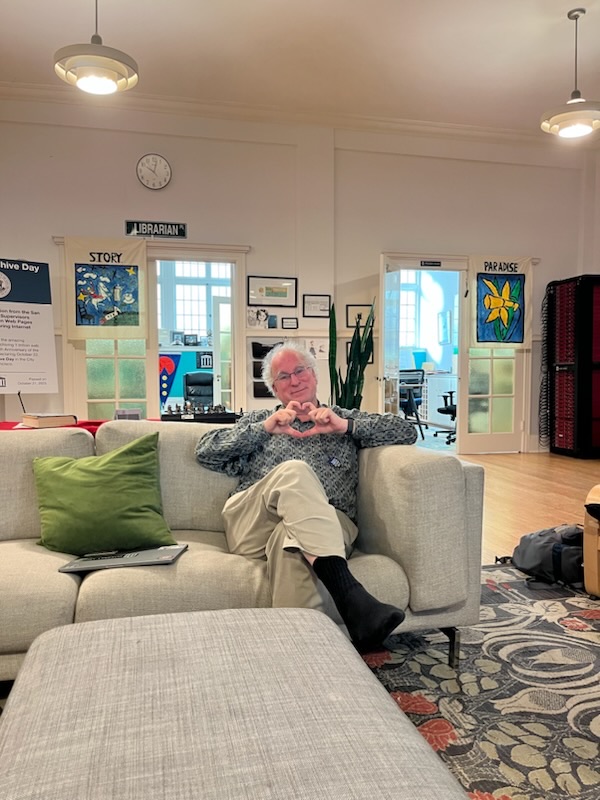
- Brewster Kahle hand heart 2025 02.jpg, Crunchydillpickle, Wikimedia Commons. Own-work photograph, October 24, 2025; explicit copyright-holder release under CC BY-SA 4.0.
- Brewster Kahle — author archive, Brewster Kahle. Personal publication listing checked September 24, 2026. AI assistance is explicitly disclosed on some essays.
- An Update on Wayback Machine Access, Internet Archive. September 15, 2026. Official acknowledgment of automated-traffic restrictions and false positives.
- Internet Archive Receives IMLS Grant to Expand Access to Local and State Government Information, Internet Archive. September 10, 2026. First-party announcement; program targets are not completed outcomes.