
RACH Profiles · Longevity and Biotechnology
David Sinclair: A Life Spent Questioning Aging
From a failed aquaculture venture to yeast genetics, disputed breakthroughs, and an early human eye trial: a life at the boundary between scientific possibility and proof.
- Current roles
- Professor of Genetics, Harvard Medical School; Chairman and Co-Founder, Life Biosciences.128
- Research focus
- Aging biology, epigenetic regulation, cellular reprogramming, and measurement.
- Evidence boundary
- Laboratory discoveries and experimental therapies are not proven reversal of human aging.
A question that would not leave
Before David Sinclair became a public face of longevity science, he tried raising abalone and shrimp. The venture did not work out. Returning to Sydney, he took a laboratory job with geneticist Ian Dawes—and discovered that the indoor life he had wanted to escape could offer a different kind of freedom: asking questions whose answers nobody knew.2
That detour is a useful starting point for a career often told backward, from Harvard, biotechnology companies, and predictions about the future. Sinclair did not arrive with a treatment for aging. He became a scientist through the narrower discipline of studying yeast, then spent decades trying to connect molecular experiments to one of the largest human concerns. Along the way, his willingness to think beyond conventional boundaries became both a strength and a source of serious controversy.
Today the distinction between those two sides matters more than ever. His research has helped open questions about cellular maintenance and reprogramming. His public claims have also prompted scientists to ask whether possibility is being presented as accomplishment. This is a biography of that tension: a researcher who wants medicine to intervene earlier in biological decline, and a body of work that must be judged experiment by experiment, not by the scale of its ambition.
Sydney, family, and the meaning of growing old
In a 2018 interview with The Monthly, Sinclair traced his preoccupation with aging to his grandmother Vera. She had fled Hungary after the failed 1956 uprising and settled in Australia with her son, Sinclair's father. Growing up in St Ives, Sydney, he knew her as an unconventional, lively presence. According to his recollection, she called him Professor David long before he had earned the title. Her later decline made aging personal rather than abstract.3
The story is a recollection, not a scene RACH witnessed. Its importance is not that it proves a scientific theory. It helps explain the question he repeatedly brings to science: could people retain more of their capacities as they grow older? Vera's influence is part of the public account he has given of his motivation, not evidence that any intervention can deliver the future he imagines.
Another interview-based profile, Catherine Elton's 2019 account in Boston magazine, described his biochemist parents and his early understanding that all living things die. It also captured a later change in perspective: rather than assuming that major advances would arrive too late for his generation, Sinclair began to think that he could help pursue them. Elton's reporting offers a portrait of ambition taking shape, while also recording the skepticism that would follow his career.4
Learning to discover, rather than follow instructions
At the University of New South Wales, Sinclair's route into research was practical before it was philosophical. After his undergraduate studies and unsuccessful aquaculture venture, working with Dawes led him toward a doctorate. The university's account describes his search for genes involved in the yeast glycine-cleavage system, part of cellular metabolism. Sinclair remembered the contrast between prescribed student exercises and genuine research: the latter could reveal something not already known. Harvard's biography records completion of his molecular-genetics PhD in 1995.12
There is a difference between wanting a discovery and learning how to recognize one. Doctoral work supplied the patient, technical counterpart to his expansive interests. A gene had to be located and its role investigated; curiosity needed a tractable problem. In retrospect, the continuity is striking. Yeast would remain central when his subject changed from metabolic regulation to aging, allowing a very large question to be approached in a system small enough to manipulate.
Sinclair next worked with Leonard Guarente at MIT. The move placed him inside an existing research effort, not at the solitary origin of aging biology. That context is essential to his story. A postdoctoral researcher can make an important contribution precisely because mentors and colleagues have built the methods, questions, and experimental community within which a new result becomes possible.1
Aging, counted in yeast divisions
In 1997, Sinclair and Guarente published a Cell paper connecting aging in budding yeast to extrachromosomal ribosomal DNA circles. These were pieces of DNA outside the chromosomes that could accumulate in mother cells. The study proposed a mechanism by which an identifiable cellular process could limit replicative lifespan. It was a concrete experimental contribution to a question that can otherwise seem too broad to investigate.5
MIT's contemporary account explained the work as part of a sequence of investigations, including studies of the yeast gene SGS1 and changes in the nucleolus. The attraction of yeast was not that it was a miniature human. Researchers could observe divisions and manipulate genes, then ask whether a change altered cellular survival. The model provided leverage, while leaving the difficult question of relevance to more complex organisms open.6
The result did not discover a universal cause of human aging. Its significance was methodological as well as biological: decline could be broken into mechanisms and tested. That habit would carry through Sinclair's later work. The promise lay in moving from a description—cells become old—to interventions that might reveal why. The danger, which would become clearer as his audience grew, was allowing an answer in one model to sound like an answer for everyone.
Harvard and the attraction of a molecule
Sinclair moved to Harvard Medical School in 1999. His early research there focused on sirtuins, a family of enzymes associated with cellular regulation and metabolism. The institutional move expanded his role from an individual investigator within a mentor's laboratory to someone responsible for a research program and its trainees. The faculty biography still identifies him as a professor in Harvard's Department of Genetics; older elapsed-time language on that page should not be mistaken for a fresh career update.1
In 2003, a team led in the author list by Konrad Howitz reported that small molecules could activate sirtuins and extend yeast lifespan under the conditions studied. Resveratrol became the best-known compound in that work. The author list also included Kevin Bitterman, Haim Cohen, Dudley Lamming, Siva Lavu, Jason Wood, and other collaborators. The achievement was shared between people bringing different tools to the same biological question.7
A compound offers an especially compelling bridge between basic science and medicine. Unlike an observation that only explains a phenomenon, it suggests something one might administer. But that bridge consists of separate tests: what a compound does in an assay, whether it reaches relevant tissues, whether it changes disease, and whether the benefit outweighs harm. Resveratrol's public story would repeatedly compress those steps. Its scientific story would force them apart again.
What the mice actually showed
The 2006 mouse study made the resveratrol story much larger. Joseph Baur, Kevin Pearson, Rafael de Cabo, Sinclair, and a broad team reported improved health measures and survival in middle-aged mice receiving a high-calorie diet with resveratrol, compared with mice on the high-calorie diet alone. The diet condition is not a footnote. It defines what the result supports: a benefit in that experimental setting, not proof that the compound extends normal human life.8
A later study made the distinction sharper. Its 2008 title explicitly separated delayed age-related deterioration from extended lifespan. The investigators reported benefits on some measures without establishing lifespan extension in normally fed mice. Read together, the studies tell a more useful story than a simple breakthrough slogan. Health measures, survival under a harmful dietary condition, and maximum longevity are different outcomes. A positive finding on one does not automatically supply the others.9
These distinctions are part of Sinclair's biography because they shaped the meaning of his success. The experiments generated hypotheses and drew attention to potentially modifiable pathways. They did not deliver an anti-aging prescription. Recognizing the contribution requires keeping the animal, comparison group, and measured outcome in view—even when the much shorter public version is easier to remember.
Sirtris, money, and the assay dispute
The commercial chapter grew alongside the scientific one. Sinclair's disclosure record dates his Sirtris involvement from 2004. In June 2008, GlaxoSmithKline acquired the company; its annual report recorded a £376 million cash consideration. The buyer described a strategy of developing medicines for diseases associated with aging through sirtuin activation. This was an investment in a therapeutic hypothesis and a development team, not confirmation that aging had been treated.1025
Meanwhile, other researchers challenged a crucial link in the explanation. A 2010 paper by Michelle Pacholec and colleagues reported that resveratrol and several proposed activators did not directly activate SIRT1 in the assays they examined. The dispute concerned experimental substrates and what the observed signal actually meant. If an assay depends on an artificial component, it may not demonstrate the same behavior with the enzyme's natural targets.11
Sinclair's side did not simply abandon the mechanism. In 2013, Basil Hubbard and collaborators published evidence for allosteric SIRT1 activation, with particular features of the substrate affecting the response. That work argued for a more conditional mechanism rather than a universal on-switch. Fair reporting needs both the challenge and the response: the record is not accurately summarized as either uninterrupted vindication or a single experiment that settled everything.12
TIME later reported that GSK dropped the project, while Sinclair continued to defend the findings.27 Commercial disappointment and mechanistic debate are different judgments. A program can fail to yield the hoped-for product without making every associated observation worthless; equally, interesting biology cannot be counted as a clinical success because a company once attracted a major acquisition.
The next question: cellular communication
Another line of work examined NAD, a molecule involved in cellular metabolism, and communication between the nucleus and mitochondria. In a 2013 Cell paper, Ana Gomes and colleagues, including Sinclair, connected declining NAD levels to disrupted regulation of mitochondrial function. Their experiments included restoration of certain mitochondrial measures in old mice after raising NAD. The result suggested that at least some measured changes could be reversible in the model rather than permanently fixed.13
The collaborators matter here too. The paper brought together researchers working on metabolism, physiology, and molecular regulation across institutions. Such work is not adequately described as one person discovering a youth molecule. It is a collection of experiments attempting to connect chemical state, gene regulation, and tissue behavior. Each connection has its own assumptions and tests.
NAD research also illustrates the gulf between a useful mechanism and consumer inference. A substance's importance to normal biology does not establish that taking more of a precursor produces longer or healthier life. This profile does not recommend supplements, reproduce Sinclair's personal regimen, or treat a molecular change as a medical outcome. His contribution belongs in the history of the research; the decision about any treatment belongs to a separate body of clinical evidence.
A scientist becomes a public narrator
In September 2019, Atria published Lifespan: Why We Age—and Why We Don't Have To, written with Matthew D. LaPlante. Its title made the provocation unmistakable. The book invited a general audience to consider aging as something biology might alter, rather than only a background condition to be accepted. LaPlante's role deserves explicit credit: making a scientific argument readable for a broad public is itself collaborative work.14
The move from papers to popular narrative changes the audience's expectations. A laboratory reader may instinctively ask about controls, sample sizes, and competing mechanisms. A reader confronting illness in a family may hear a promise. Sinclair's career occupies that difficult space, where an explanation can inspire support for research while also encouraging more certainty than the experiments warrant.
Elton's contemporary profile captured both his ability to generate new research directions and colleagues' concern about his public claims. Her interviews described an energetic MIT postdoc and recorded Shin-ichiro Imai's assessment of his talent for recognizing promising concepts. Those observations help explain his influence without settling whether any particular assertion is correct. Being persuasive and being right remain separate achievements.4
Reprogramming was not a solitary invention
The later direction of Sinclair's work rests on discoveries made by others. John Gurdon's nuclear-transfer experiments and Shinya Yamanaka's work on induced pluripotent stem cells changed the understanding of cellular identity. The 2012 Nobel Prize recognized their demonstration that mature cells could be reprogrammed to a less specialized state. Yamanaka's small set of transcription factors offered researchers a powerful experimental tool, developed through the work of his laboratory and collaborators.15
The longevity question was related but different: could one recover useful functions without erasing the identity that makes a cell useful in the first place? An eye needs functioning retinal cells, not simply cells that have become less specialized. Reprogramming therefore introduces a problem of control as well as possibility.
In 2016, Alejandro Ocampo, Juan Carlos Izpisua Belmonte, and colleagues reported benefits from partial reprogramming in mice, including extended lifespan in a premature-aging model and improved recovery in other experiments. That was important prior work, not a Sinclair discovery. It helped establish an experimental direction that many groups would pursue. The model and intervention remain essential qualifications; results in a progeria model do not establish ordinary human rejuvenation.16
A focused test in the eye
The 2020 Nature paper on vision was a defining contribution from Sinclair and a large collaborating team. Yuancheng Lu led the author list; Benedikt Brommer, Xiao Tian, Anitha Krishnan, and Margarita Meer were among the principal contributors. The work involved expertise from researchers including Zhigang He, Bruce Ksander, and Meredith Gregory-Ksander. The team used three reprogramming factors—OCT4, SOX2, and KLF4, collectively OSK—in mouse retinal cells and reported benefits involving regeneration and visual function.17
Independent reporting by Nature's Heidi Ledford treated the findings as a promising new route while emphasizing the distance to safe human application. The experiments were not simply a claim that cells looked younger on a molecular test; they included functional observations in mice. Yet an animal eye remains an experimental model. Delivery, dosing, durability, and safety in people require their own evidence.18
For the biography, the eye marks a narrowing of the ambition into an identifiable clinical problem. A field often discussed in terms of decades added to life was pursuing damaged vision. That is a meaningful change in the question being asked. A future intervention need not solve all aging to matter profoundly, but its value must be established in the people and condition for which it is intended.
An information theory—and a published challenge
In 2023, Jae-Hyun Yang, Motoshi Hayano, Sinclair, and a large team published experiments presented as support for an information theory of aging. Their central proposal concerns deterioration in the regulation of genetic information, not merely changes to DNA sequence. Using an engineered mouse system, they investigated whether induced DNA damage and repair could produce age-associated changes, and whether reprogramming could alter selected molecular measures. These are the authors' interpretation and experimental findings, not a settled general explanation of human aging.19
James Timmons and Charles Brenner challenged the inference in a 2024 Cell letter, arguing that the study did not establish the proposed theory and raising alternative explanations involving damage and cell loss. Yang, Hayano, Luis Rajman, and Sinclair published a response in the same issue. Both sides disclosed commercial interests. The existence of those interests does not decide the biological question, but readers should not have to assume that only one side has them.2021
The paper also has a February 2024 erratum. RACH verified the correction and response records but could not retrieve their full texts during reporting, so this profile does not claim to adjudicate the detailed dispute or the effect of every correction. The defensible conclusion is narrower: this is an influential, contested research program. It is not evidence that human aging has been reversed.22
Chemistry, clocks, and what a measurement means
A separate 2023 study pursued chemical rather than genetic reprogramming. Yang, Christopher Petty, Thomas Dixon-McDougall, and colleagues reported that combinations of compounds changed selected features of cultured cells, including gene-expression-based age measures and a test of separation between nuclear and cytoplasmic contents. Sinclair was a coauthor. The experiments provided a screening approach and candidate combinations for further investigation. They did not demonstrate that swallowing a chemical mixture rejuvenates a person.23
Measurement itself became another contribution. Patrick Griffin, Alice Kane, Alexandre Trapp, and collaborators including Sinclair developed TIME-seq, published in 2024, to reduce the cost and labor involved in DNA-methylation measurements used for epigenetic clocks. They evaluated the method in mouse samples and developed a human blood clock. Such tools can make larger studies more feasible, even when they do not constitute an intervention.24
TIME-seq is also a less theatrical example of contribution than the promise of rejuvenation. The researchers tested clocks across more than 1,800 mouse DNA samples, then developed a human blood clock using 1,056 individuals. That effort concerns the infrastructure of discovery: how to compare biological measurements at a scale researchers can afford. Its value need not depend on the strongest version of Sinclair's theory being correct. A useful method can serve investigators who disagree about what ultimately drives aging.24
These projects show why the word aging needs an accompanying definition. A molecular pattern can be an informative marker without being a complete measure of an organism's condition. A treatment could change the marker without delivering the outcome a patient values. The work of building better measurements and the work of validating therapies are complementary, not interchangeable. Sinclair's research spans both, which makes keeping them distinct especially important.
Commercial life and accountability
Sinclair's Harvard-hosted disclosure page lists founder, investment, equity, advisory, board, and intellectual-property interests across multiple businesses. Among the listed active engagements are Life Biosciences, Animal Bioscience, and MetroBiotech-related interests. The page warns that it is informational and may not be exhaustive. It is useful disclosure, not an independently audited account of every current financial relationship. Life Biosciences separately identifies him as chairman and co-founder, alongside fellow co-founder Tristan Edwards.2528
One controversy made the stakes unusually clear. In March 2024, STAT reported criticism of claims associated with an Animal Bioscience dog supplement. The objection was not simply to enthusiasm: the reporting said published evidence did not demonstrate the asserted reversal or slowing of aging in dogs. TIME subsequently reported Sinclair's resignation from a professional group amid the dispute and his explanation that the press release had been poorly written and the statement reworded.2627
That episode belongs in a recognition profile because recognition should not require readers to overlook consequential criticism. Company formation can mobilize people and resources needed to test a discovery. It can also create incentives to communicate certainty early. Disclosure helps make those incentives visible; evidence, transparent endpoints, and correction of overstatement remain the measures of whether the claims deserve trust.
What they are working on now — September 20, 2026
The clearest current clinical development is ER-100. Life Biosciences announced on June 9, 2026 that its first participant had been dosed. National Geographic's August reporting places an initial treatment in April. These dates describe different events: a treatment and a later announcement. Neither should be converted into a claim that new trial results were released this week.3132
The registry, checked directly on September 20, lists NCT07290244 as recruiting, with its last posted update dated May 19, 2026 and no results posted. It describes a Phase 1 safety and tolerability study in adults with open-angle glaucoma or non-arteritic anterior ischemic optic neuropathy. Planned enrollment is 18. The design is non-randomized and open-label, with long-term follow-up. These are sponsor-reported registry details, not a regulatory finding of efficacy.30
Sinclair's 2026 review with Junwon Lee, Minseok Han, Kaixiang Wang, and L. Rainer Butler further explains the ocular focus. It discusses the attraction of localized treatment and measurable eye outcomes, alongside risks including loss of cellular identity and tumor formation. It is a review of mechanisms and translational possibilities, not a report of successful human treatment. The paper also discloses Sinclair's chairmanship and shareholding in Life Biosciences.29
There are also people beyond the inventor whose work will determine what the study teaches. The registry names Sharon Rosenzweig-Lipson as study chair and identifies investigators including Joseph Rizzo at Mass Eye and Ear and Aakriti Shukla at Columbia. Trial participants, clinical staff, and safety reviewers belong in this chapter of the story. Moving an idea into a clinical setting changes both the responsibilities and the people who carry them; it does not make a laboratory's leading figure the sole author of the eventual result.30
The current-work check has limits. The lab's visible publication list starts with 2024 entries, so RACH did not treat it as comprehensive. An ITU event dated June 2026 is explicitly a replay of a July 2025 session. Sinclair's authentic X account, linked by his lab, did not provide readable current posts during this check; no claim here depends on an unseen social update. Freshness requires checking what actually happened, not merely finding a recent date.333436
Why RACH recognizes David Sinclair
RACH stands for Recognizing the Achievements and Contributions to Humanity. Our recognition of Sinclair is for contributions to the investigation of aging: helping identify mechanisms in yeast, contributing to experimental work on cellular regulation and reprogramming, and helping develop tools and teams that make further tests possible. It is not an award for a proven cure, a supplement endorsement, or a claim that his commercial ventures have extended human lifespan.
There is a human contribution in making a hard question experimentally accessible, provided the uncertainty remains visible. The yeast studies, retinal work, and measurement methods offer other researchers something to examine, challenge, and build upon. That is different from a demonstrated benefit in a patient's life. On the evidence reviewed for this profile, RACH cannot credit Sinclair with a proven treatment that reverses human aging.
His laboratory describes training as a central part of its work, spanning molecular biology, computational methods, and animal physiology. Its account of alumni is first-party, but the published author lists independently make the collective nature of the research unmistakable. Recognition belongs with the early-career researchers, senior collaborators, laboratory staff, and institutions behind the papers. The people participating in clinical research also deserve acknowledgment for accepting uncertainty that publicity alone cannot resolve.36
Sinclair's story remains open. The researcher who returned from aquaculture to a yeast laboratory is now associated with a human safety study, but no biography can supply its eventual outcome. The next important chapter will be written in the quality of the evidence: what is measured, what fails, what is corrected, and whether people ultimately benefit. That is a demanding standard. It is also the standard that makes recognition worth offering.
Methodology, disclosure, and corrections
This independent public-record biography was researched, drafted, and internally checked with AI assistance for RACH. It was published under standing authorization from RACH's owner, not after a new subject interview or a claimed human scientific review. RACH did not interview Sinclair, his collaborators, critics, or representatives, and did not request endorsement.
Current institutional profiles, company pages, research records, a trial registry, and public interview and event records were checked on September 20, 2026. Sources distinguish recollection, author-reported findings, independent reporting, and RACH's editorial interpretation. The full 2024 Cell reply and erratum were inaccessible; their records are linked without a claim that their detailed contents were reviewed. Current X posts were not readable. Neither gap is treated as evidence of absence.
The recognition is an editorial judgment, not an implied partnership, formal scientific award, or endorsement of a company or product. No subject sponsorship or payment was arranged in preparing this article. It offers no medical advice and recommends no supplements, treatments, or trial participation.
Send documented corrections to info@rachorg.org. Material updates will be dated. Word count excludes the byline, navigation, methodology, and source list.
Sources
- David Sinclair — faculty biography, Harvard Medical School. Current genetics appointment and education; the page's elapsed-years wording is stale.
- Professor David Sinclair — PhD stories, UNSW Sydney. University account of aquaculture, Ian Dawes, and doctoral research.
- Can David Sinclair cure old age?, The Monthly. 2018 interview-based profile; family recollections are attributed, not independently observed by RACH.
- Has Harvard's David Sinclair Found the Fountain of Youth?, Boston magazine. Catherine Elton's October 2019 profile and interviews with colleagues.
- Extrachromosomal rDNA circles—a cause of aging in yeast, Cell / PubMed. Sinclair and Guarente, 1997; yeast research, not a human lifespan experiment.
- MIT biologists identify aging mechanism, MIT News. Contemporary institutional account of the yeast work.
- Small molecule activators of sirtuins extend Saccharomyces cerevisiae lifespan, Nature. Howitz and colleagues, 2003; original reported findings, followed by mechanistic dispute.
- Resveratrol improves health and survival of mice on a high-calorie diet, Nature / PubMed. Baur and colleagues, 2006; preserve the high-calorie-diet comparator.
- Resveratrol delays age-related deterioration and mimics transcriptional aspects of dietary restriction without extending life span, Cell Metabolism / PubMed. 2008 study separating functional measures from lifespan.
- Annual Report 2008 — acquisitions, GlaxoSmithKline. Corporate record of the June 2008 Sirtris acquisition.
- SRT1720, SRT2183, SRT1460, and resveratrol are not direct activators of SIRT1, Journal of Biological Chemistry / PubMed. Pacholec and colleagues, 2010; experimental challenge to activation claims.
- Evidence for a common mechanism of SIRT1 regulation by allosteric activators, Science / PubMed. Hubbard and colleagues, 2013; evidence supporting substrate-dependent activation.
- Declining NAD(+) induces a pseudohypoxic state disrupting nuclear-mitochondrial communication during aging, Cell / PubMed. Gomes and colleagues, 2013; mechanistic and mouse findings.
- Lifespan, Simon & Schuster / Atria Books. Publication date, coauthor Matthew D. LaPlante, and the book's stated argument; marketing is not efficacy evidence.
- The 2012 Nobel Prize in Physiology or Medicine — advanced information, NobelPrize.org. Foundational contributions of John Gurdon, Shinya Yamanaka, and their collaborators.
- In Vivo Amelioration of Age-Associated Hallmarks by Partial Reprogramming, Cell / PubMed. Ocampo and colleagues, 2016; premature-aging mouse model and other mouse experiments.
- Reprogramming to recover youthful epigenetic information and restore vision, Nature. Lu and colleagues, 2020; mouse retinal work, authorship, and financial disclosures.
- Reversal of biological clock restores vision in old mice, Nature news. Heidi Ledford's independent account of the 2020 study and translation limits.
- Loss of epigenetic information as a cause of mammalian aging, Cell / PubMed. Yang, Hayano, and colleagues, 2023; read alongside the correction and published debate.
- The information theory of aging has not been tested, Cell / PubMed. Timmons and Brenner, 2024; criticism and declared commercial interests.
- Response to: The information theory of aging has not been tested, Cell / PubMed. Yang, Hayano, Rajman, and Sinclair's 2024 response. Bibliographic record checked; full reply was not accessible during reporting.
- Erratum: Loss of epigenetic information as a cause of mammalian aging, Cell / PubMed. February 2024 correction record. RACH could verify its existence but not retrieve the full correction text.
- Chemically induced reprogramming to reverse cellular aging, Aging. Yang and colleagues, 2023; cultured-cell assays, not a demonstrated human rejuvenation treatment.
- TIME-seq reduces time and cost of DNA methylation measurement for epigenetic clock construction, Nature Aging / PubMed. Griffin and colleagues, 2024; measurement-method contribution.
- David A. Sinclair's Affiliations, Harvard Medical School. Self-disclosure of active and past commercial interests; not an independently audited register.
- Harvard longevity scientist sparks furor with claim about reversing aging in dogs, STAT. Megan Molteni's March 2024 reporting on supplement claims and criticism.
- The Scientific Search for Youth, TIME. Independent reporting including Sinclair's response to the dog-supplement controversy and the Sirtris outcome.
- Co-Founders, Life Biosciences. Current company listing of Sinclair as chairman and co-founder; credits Tristan Edwards.
- Epigenetic reprogramming for ocular aging and disease: Mechanisms, biomarkers, and the road to the clinic, Progress in Retinal and Eye Research. 2026 review by Junwon Lee, Minseok Han, Kaixiang Wang, L. Rainer Butler, and Sinclair; review, not trial results.
- ER-100 Phase 1 study — NCT07290244, ClinicalTrials.gov. Live API also checked September 20, 2026: recruiting; last posted update May 19; no results posted. Sponsor-supplied registry record.
- First participant dosed in Phase 1 ER-100 trial, Life Biosciences. June 9, 2026 company announcement; announcement date is not asserted to be the dosing date.
- Are We on the Brink of Ending Aging?, National Geographic. August 6, 2026 independent report placing an initial treatment in April; article carries correction notes.
- Publications, The Sinclair Lab. Checked September 20, 2026; the visible list begins with 2024 items and is not a complete current bibliography.
- Beyond human — replay, ITU AI for Good. June 15, 2026 listing explicitly identifies a replay of a July 2025 session.
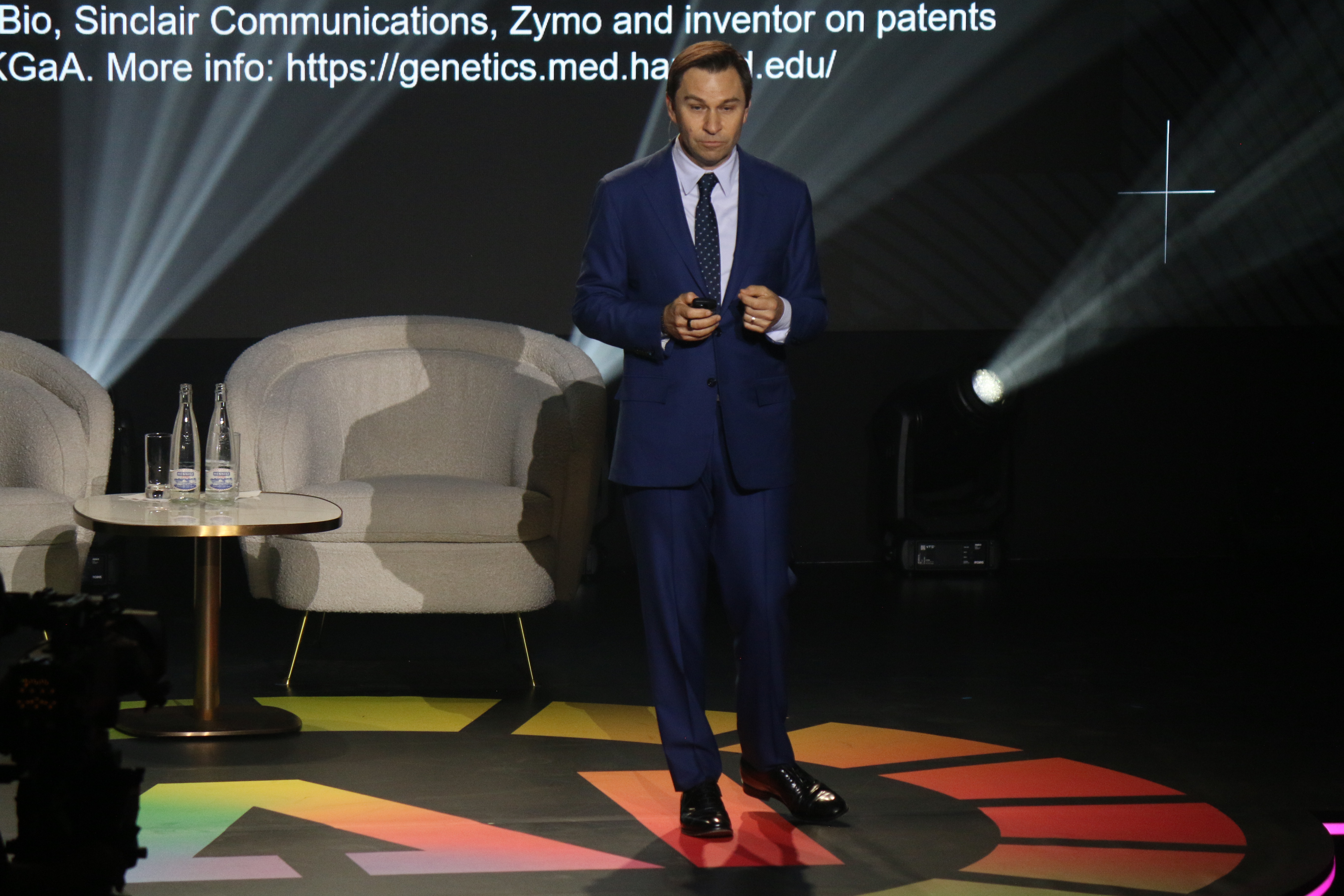
- UN AI for Good Summit 2025 — David Sinclair 02, Xuthoria / Wikimedia Commons. Own-work photograph, July 9, 2025; CC BY-SA 4.0; original file retained.
- Welcome — research and training, The Sinclair Lab. First-party description of research scope and training; not independent impact measurement.