RACH Profiles · Artificial Intelligence
Fei-Fei Li: The Human Work Behind Teaching Machines to See
From a family dry-cleaning shop to ImageNet, wider access to AI, and a new spatial-intelligence chapter—with the collaborators, controversies, and limits kept in view.
- Current roles
- Sequoia Professor of Computer Science, Stanford; Special Advisor on AI to Stanford's president; HAI Founding Director, Senior Fellow, and advisory council co-chair; World Labs co-founder and CEO.29, 32
- Focus
- Computer vision, spatial intelligence, education, and human-centered AI.
- Evidence boundary
- Shared research contributions and educational participation are distinguished from commercial demonstrations and unproven future benefits.
The weekends behind the research
Before Fei-Fei Li ran an artificial-intelligence company, she helped run a dry-cleaning shop. In a 2017 interview with the Paul & Daisy Soros Fellowships, she remembered spending college weekends at the family business in New Jersey. English made her the person who could handle its dealings. The responsibility continued into graduate school; by her account, the business occupied seven years of her life.1
That detail changes the familiar picture of an AI pioneer. Her education was not an escape from ordinary work into a sealed world of ideas. Scientific training and family obligations ran together. Later, when she argued that technology should be judged by its consequences for people, she was speaking from a life that had crossed between institutions with enormous resources and a household trying to make ends meet.
Her biography is also a story about what recognition leaves outside the frame. ImageNet bears the names of researchers, but it depended on annotators. A professor's career rests partly on teachers. A company grows through a team. Li's achievements become more intelligible, not smaller, when those people come into view.
Learning to look
Li was born in Beijing and grew up in Chengdu. Recalling her childhood to Tim Ferriss in December 2025, she described a father whose curiosity included insects, animals, and the fields beyond their expanding city. Their outings were not presented as an accelerated curriculum in computer science. They were occasions for noticing things. She also recalled the abrupt transition to suburban New Jersey, where she and her mother joined her father as she entered her teenage American life.2, 6
The contrast matters without needing a fable about a child destined to invent machine vision. Moving between languages and surroundings required attention to unfamiliar signals. Her later account connects the scientist's curiosity with a family culture that permitted curiosity in the first place. It is a retrospective connection, not proof that any particular childhood afternoon caused ImageNet.
In an earlier public interview, she remembered learning English with a large dictionary alongside her schoolbooks. Translation was work before it was an academic metaphor.1
A classroom made for one
At Parsippany High School, mathematics teacher Bob Sabella supplied a form of help that did not exist on the timetable: an advanced mathematics class for Li during lunch. In her Soros interview, she recalled his assistance extending beyond lessons to college moves and a lasting relationship with his family.1
Another episode captures how uncertain the route still felt. Stanford HAI's account of her early life says she asked two high-school advisers to check her Princeton acceptance letter because the full scholarship seemed difficult to believe. The offer created an opportunity; understanding that it was real was a separate step.3
These are consequential human decisions, not decorative anecdotes around a technical career. A teacher made time. Advisers helped interpret an institution's promise. The scholarship reduced a financial barrier. None could know the eventual scientific result. Their support had value before an eventual beneficiary became famous, a point worth retaining whenever a life story is told backward from its honors.
Physics and family responsibility
Li graduated from Princeton in 1999 with a physics degree. When she returned for the university's 2024 Pre-read Assembly, her memoir had been assigned to incoming students. She discussed the difficulty of combining study with the family business and the importance of asking for help. Students encountering her as a celebrated scientist also encountered the former undergraduate who had traveled between two demanding lives.4, 6
At Alumni Day earlier that year, she recalled being a teenager working in a restaurant while thinking about relativity. Princeton honored her with its Woodrow Wilson Award for service. In her remarks, she framed AI as something people build, deploy, and therefore must govern. The recollection tied an early attraction to physical laws to an adult concern about the social rules surrounding technology.37
Physics was not a mistaken first choice that needed to be erased from an AI résumé. Her path would repeatedly join disciplines rather than substitute one exclusive identity for another. The question of intelligence could be approached through computation, biological perception, and the human meanings attached to what is seen.
Between a brain and an algorithm
At Caltech, Li worked with Pietro Perona and Christof Koch, combining computer vision with neuroscience. In Caltech's alumni profile, she explicitly credits that intellectual pairing as a reason for choosing the institution. She remembered informal conversations that could move from statistical models to art and even food. The atmosphere mattered because the scientific question did not fit comfortably inside one disciplinary boundary.5
She completed her doctorate in electrical engineering in 2005. A Paul & Daisy Soros Fellowship, awarded in 1999, supported her graduate path. Her early faculty appointments included the University of Illinois Urbana-Champaign and Princeton, followed by Stanford in 2009.6
Computer vision asks how a system can extract useful meaning from visual information. The difficulty is easy to underestimate precisely because people perform much of it without deliberate effort. A change of viewpoint, lighting, background, or partial obstruction can alter the pixels without changing the object. Building a useful recognizer requires confronting that variation rather than memorizing a single ideal picture.
The decision to build the missing material
Li's best-known scientific decision was to invest in a much larger supply of organized visual examples. ImageNet's 2009 paper proposed a hierarchy of images linked to the concepts in WordNet. Its authors were Jia Deng, Wei Dong, Richard Socher, Li-Jia Li, Kai Li, and Li Fei-Fei. That list is essential: a biography focused on the project leader should not turn a collective contribution into solitary invention.7
The project made data creation a central research problem. Acquiring candidate pictures was only the beginning. Images had to be associated with categories, checked, and arranged so other researchers could use them. The team's paper presented a resource for both learning and evaluation, with the ambition of supporting broader image understanding.7
This was a wager on the conditions under which progress could happen. A better algorithm and better training material are not opposing explanations of success. They interact. Li and her colleagues helped change what researchers could ask of their algorithms by changing the examples available to them.
The people inside a dataset
ImageNet's own project history emphasizes the need for a shared resource spanning many categories. It also identifies a research team rather than a single creator. Those organizational choices made it possible for work performed in one group to become useful far beyond that group.8
The human labor was equally fundamental. The original paper describes using Amazon Mechanical Turk to verify candidate images. Its authors treated agreement and quality control as technical requirements: the labels would shape what a model could learn.7
For a reader looking only at a trained neural network, this work can disappear. The finished model produces a label; the prior decisions about which pictures belonged in its training collection are less visible. RACH's interpretation is that data labor belongs in the achievement itself, not in a footnote thanking unnamed assistance. The scientific authors organized and documented the resource, while workers supplied judgments that made it possible.
That does not settle whether every judgment was appropriate. Indeed, the success of ImageNet made its underlying categories more consequential, and eventually more contested.
Making progress comparable
The ImageNet Large Scale Visual Recognition Challenge began in 2010. Its later methods paper, led by Olga Russakovsky and Jia Deng, describes a common benchmark for classification and detection, drawing participation from more than fifty institutions across its early years. Shared training material and evaluation rules gave competing approaches a more meaningful basis for comparison.9
The distinction between the wider ImageNet collection and the challenge subset matters. A claim about performance on one benchmark is not automatically a claim about everything in the database, much less everything a person can see. The methods paper discusses the difficulty of annotations and evaluation rather than presenting accuracy as a self-explanatory number.9
Li's contribution here was partly institution-building within science: helping create an arena in which an unexpected result could become legible to an entire field. The researchers who entered supplied their own ideas. The benchmark did not produce those ideas for them, but it helped make their differences measurable.
The breakthrough she did not invent alone
In 2012, Alex Krizhevsky, Ilya Sutskever, and Geoffrey Hinton demonstrated the power of a deep convolutional neural network trained on ImageNet. Their paper reports a winning competition entry with a top-five error rate of 15.3 percent, compared with 26.2 percent for the runner-up. Top-five means the correct category could appear among five proposed answers; it is not the same as always choosing the right answer first.10
The result joined several kinds of work: a large labeled dataset, neural-network methods, efficient graphics-processor computation, and training techniques. Li was not an author of the AlexNet paper. Crediting her accurately means recognizing the infrastructure that enabled the demonstration while crediting its authors for their model.10
A narrow test had become a turning point. It showed researchers that an approach could improve sharply under particular conditions. The lesson was powerful precisely because it was concrete. Turning it into a claim that computers had acquired human understanding would lose the distinction that made the experiment informative.
From naming an object to describing a scene
Recognition was not the endpoint of Li's research. With Andrej Karpathy, she investigated systems that generated language descriptions of images and their regions. Their 2014–2015 paper combined visual and linguistic representations, learning correspondences between image regions and sentences before generating descriptions.11
A category label answers a limited question. A description has to select relationships and actions as well as objects. In their experiments, the authors evaluated retrieval and generated descriptions on established datasets. Those results supported claims about those tasks, not a declaration that the system understood every situation it could describe.11
The movement from labels toward language reveals a recurring feature of Li's career: a useful milestone exposes the next inadequacy. Once a machine can identify objects, the harder question becomes how those objects relate. A fluent sentence can make a system appear more complete than it is, so evaluation must keep pace with the apparent sophistication of its output.
Giving relationships their own place
Visual Genome extended that agenda. Ranjay Krishna and a large group of collaborators, including Yuke Zhu, Oliver Groth, Justin Johnson, Michael Bernstein, and Li, assembled annotations for objects, attributes, and relationships in more than 100,000 images. The 2016 preprint explains why image classification alone is insufficient for questions about what is happening in a scene.12
The point was not simply to attach more words to a photograph. A relationship such as an object resting on another object provides a different kind of information from the two object names. Visual Genome made those connections explicit enough to become research material.12
The project again placed human interpretation upstream of machine learning. Its crowdsourced annotations were not incidental descriptions added after a model had learned. They were part of what made learning and testing possible. The continuity with ImageNet is therefore organizational as well as technical: researchers built a shared representation of a problem so others could attempt it.
When an impressive answer is not enough
Another collaboration, CLEVR, addressed the difficulty of knowing why a visual question-answering system succeeds. Justin Johnson and colleagues, including Li, designed a diagnostic dataset for compositional visual reasoning. Its controlled setting was intended to expose weaknesses that could be obscured in more complex datasets, where language patterns and other shortcuts can help a model guess.38
The idea is important to a life story about machine perception. Building increasingly capable systems is only half of the research task. Building tests that reveal what those systems have not learned is another contribution. A correct answer does not, by itself, establish that the system used the intended reasoning process.
That distinction reaches beyond laboratory competitions. It is relevant whenever a user must decide how much confidence to place in an apparently intelligent output. Li's record contains work on both sides of that question: creating richer capabilities and creating tools for examining their limits.
Opening the door for different researchers
In 2015, Li, Olga Russakovsky, and Rick Sommer started a Stanford summer program introducing high-school girls to AI. AI4ALL's institutional history traces the nonprofit's formal founding to 2017, with Rab Govil's founding-board support, early funders, and Tess Posner as founding CEO. The program was not simply an extension of one professor's laboratory; it required educators, administrators, mentors, and partner universities.13
The organization subsequently expanded beyond its original summer model toward college pathways. That evolution is a concrete part of the contribution: an initial intervention became an organization capable of adapting its programs. It should not be confused with evidence that the wider field's representation problems have been solved.13
Li now appears on AI4ALL's board as a member. Russakovsky is board chair, and Bo Young Lee is CEO. Older biographies that still call Li chair obscure the people currently doing that work. Keeping titles accurate is a small but necessary form of sharing credit.30
What an educational contribution looks like
AI4ALL reported in May 2026 that 341 students from 160 universities participated in 69 portfolio projects across its 2025 Ignite cohorts. Its account describes instructors, alumni coordinators, and professional mentors supporting teams through data sourcing, cleaning, training, testing, and evaluation. These are organizationally reported participation figures, not an independent estimate of lifelong economic benefit.14
The project examples include healthcare and infrastructure topics. Their value as student work does not make them clinically validated products or deployed public services. The demonstrated opportunity is that students practiced constructing and questioning AI systems with support they might otherwise have lacked.14
This is a more defensible recognition claim than suggesting a co-founder personally transformed every participant's career. Institutions create conditions; participants do the learning and make their own choices. In Li's biography, the relationship between receiving help and helping establish opportunities for others is compelling without requiring a numerical claim about lives changed.
Looking toward the bedside
Li also pursued computer vision in healthcare with clinical collaborators. A 2017 paper led by Albert Haque studied a system for tracking activity and measuring hand-hygiene compliance. Its coauthors included Michelle Guo, Alexandre Alahi, Serena Yeung, Zelun Luo, clinicians, Arnold Milstein, and Li. The evaluated task concerned recognizing behavior, not diagnosing illness or proving that the system prevented infections.15
The distinction is substantial. A hospital needs reliable measurement, but better measurement does not automatically produce better care. Staff must be able to act on information, and the system must fit an environment where privacy, interruptions, and mistaken alerts have real costs.
In a 2020 Nature review, Haque, Milstein, and Li examined ambient intelligence: sensors and computation embedded in physical spaces. They discussed possible uses in hospitals and daily living, while explicitly identifying clinical validation, privacy, and transparency as barriers to deployment. It was a research agenda, not a certificate of safety.16
The work places nurses, patients, caregivers, and physicians inside the technical question. Their needs cannot be reduced to whether a camera correctly recognizes an action.
The categories that should not have been there
ImageNet's influence also made its failures matter. In 2019, Kate Crawford and Trevor Paglen's ImageNet Roulette highlighted offensive and questionable classifications of people. WIRED reported both the criticism and the team's ongoing cleanup, and distinguished the broad people-category collection from the smaller benchmark commonly used in research. That distinction limits some claims about downstream use; it does not erase the underlying problem.17
A paper by Kaiyu Yang, Klint Qinami, Li, Jia Deng, and Olga Russakovsky examined three causes: an inherited vocabulary, attempts to illustrate concepts that cannot reliably be inferred from appearance, and unequal representation. Their work proposed filtering and balancing as constructive responses.18
RACH's judgment is that the controversy belongs inside the contribution, not outside the biography. A system can be technically productive and socially flawed. Repair deserves attention, but it should not be narrated as though creating a widely used resource removes responsibility for examining what that resource contains.
A face in the background is still a person
Privacy raised a related question. Even a photograph categorized by an object can contain an incidental person. In research first posted in 2021 and revised for ICML 2022, Kaiyu Yang, Jacqueline Yau, Li, Jia Deng, and Olga Russakovsky investigated obscuring faces in the ImageNet challenge data. Their experiments found only a small reduction in overall recognition accuracy and examined transfer to other tasks.19
The result challenged a convenient assumption: that useful object recognition necessarily requires leaving every face visible. It did not demonstrate perfect anonymity, settle consent, or resolve all questions about the reuse of photographs. It established a narrower and useful possibility—one privacy intervention could coexist with much of a dataset's technical utility.19
For Li's career, this is another instance of revisiting the infrastructure after success. A dataset is not finished merely because researchers have begun relying on it. Its maintenance includes reassessing the people represented in it, including those who never chose to become a research category.
The difficulty of principles inside a company
During a Stanford sabbatical in 2017–2018, Li served as a Google vice president and chief scientist for AI and machine learning at Google Cloud. It was a move into the organizations deploying the technology, not only studying it.6
The period included Project Maven, Google's controversial work analyzing military drone imagery. WIRED reported that Li was not directly involved in the deal but that leaked communications drew her into the controversy. Employees protested; Google decided not to renew. Li helped develop subsequent AI principles and described that work as personally important. She said her return to Stanford concerned preserving her academic position.20
This episode cannot be reduced to either a villain story or an effortless ethical victory. A public commitment to human benefit has to operate amid contracts, organizational authority, and employees with differing judgments. The biography can document the conflict without inventing Li's private motives or treating a statement of principles as proof that all difficult trade-offs were resolved.
Building places for the argument
Stanford HAI launched in 2019. The university's later institutional account credits Li, John Etchemendy, Christopher Manning, and James Landay in its founding. Its premise connected technical research with education, policy, and disciplines concerned with human consequences. That was an institutional response to a problem a single algorithm could not answer.21
In May 2026, Stanford announced the merger of HAI and its Data Science initiative. Landay leads the combined institute. Li became Special Advisor on AI to President Jonathan Levin and co-chair of HAI's advisory council with John Hennessy. HAI's current leadership page lists her as Founding Director and Senior Fellow, alongside her Sequoia Professorship in Computer Science.21, 29
These changes are not merely biographical housekeeping. They distinguish founding a place from permanently directing it. An institution's continuing contribution belongs to its evolving community. Its existence makes cross-disciplinary work possible; whether particular projects deliver public benefit remains a question to assess project by project.
Who gets to do the research?
Li served on the National Artificial Intelligence Research Resource Task Force, whose work developed a roadmap for shared research infrastructure. NSF's record makes the service period clear: the task force launched in 2021 and concluded in 2023. Its membership combined government, universities, and private organizations. Li should neither receive sole credit nor be described as holding an ongoing seat on that completed body.22
The question behind the effort is practical. Access to computation, data, and expertise helps determine which people can test an idea. Research infrastructure therefore influences whose questions get asked, not just how quickly a calculation finishes. This connects the ImageNet chapter to Li's later public work: in both, the surrounding resources are part of the scientific opportunity.
Shared infrastructure is not automatically equitable. Allocation, governance, and sustained support matter. Recognizing participation in building it is different from declaring the resource divide closed.
Writing a life that does not look inevitable
Li's 2023 memoir, The Worlds I See, brought her immigrant experience and scientific development into one narrative. In her Associated Press interview, the surrounding AI debate was framed in terms of human agency rather than a future people could only watch unfold. Her public role had expanded from producing research to helping readers understand choices around it.23
In Stanford HAI's accompanying conversation, she credited mentors who recognized possibilities she had not yet recognized in herself. She also acknowledged that her generation of researchers had been insufficiently educated about AI's ethical implications. It is a useful admission in a biography that could otherwise turn every setback into evidence of unusual foresight.3
Not every difficulty anticipates a later achievement. Not every promising project succeeds. Her story is stronger when uncertainty remains in it: obligations competed for time, the research required collaborators, and influential work eventually demanded criticism and repair. None of those facts makes the contribution less real.
What they are working on now — September 28, 2026
Li is co-founder and CEO of World Labs, alongside her Stanford professorship and advisory responsibilities. The company's other co-founders are Justin Johnson, Ben Mildenhall, and Christoph Lassner. Its commercial focus is spatial intelligence: models intended to represent, generate, and interact with environments. Axios documented an early public demonstration in December 2024; that historical preview is not this month's news.31, 32, 33
Atlas, announced September 1. World Labs describes its new model as combining text, images, video, and three-dimensional information. It presents camera-controlled generation, reconstruction, and simulation examples, and says Atlas is entering early access with selected partners. Its own explanation acknowledges that unobserved parts of a scene may be imagined. RACH has not independently reproduced the company's benchmark results.24
That last distinction is crucial for readers in construction, robotics, or healthcare. A plausible generated room is not a measured existing-condition survey. A coherent-looking video is not evidence that every physical interaction would behave that way. Atlas is a current development worth reporting, not an established humanitarian outcome.
Robotics and SceniX. World Labs announced SceniX's acquisition on July 21. A July 28 research post, accompanied by a conversation involving Li and Yunzhu Li, describes reconstructing real tasks in simulation, varying conditions, and returning trained policies to physical robots. The company reports manipulation demonstrations and comparisons between simulated and hardware performance. These remain company-reported experiments, not independent proof of general reliability across homes, hospitals, or building sites.25, 26
Academic tests of spatial reasoning. A May 18 preprint, ESI-Bench, lists Li with Yining Hong, Jiageng Liu, Han Yin, Manling Li, Leonidas Guibas, Jiajun Wu, and Yejin Choi. It evaluates agents that must act to gather information, rather than receiving ideal observations. Its experiments identify poor action selection and premature confidence as important failure modes. This is a research result in a specified benchmark, not a claim about every AI system.27
A February preprint, Theory of Space, by Pingyue Zhang and collaborators including Li, asks whether models can build and revise spatial beliefs while exploring. The authors report unstable representations and difficulty updating outdated beliefs. Read beside the commercial announcements, such work makes the unfinished problem visible: generating a persuasive view and maintaining reliable knowledge of a changing environment are different achievements.39
Teaching continues. Stanford's Spring 2026 CS231n page lists Li, Ehsan Adeli, Justin Johnson, Zane Durante, and Tiange Xiang as instructors, with a substantial teaching-assistant team. The course emphasizes implementing and evaluating vision systems. The listed offering is Spring 2026, not a claim that those classes are meeting this week.28
Today's checks included Stanford and HAI profiles, World Labs' research pages, recent preprints, and Li's company-linked public writing.34 Her X feed and the standalone Stanford vision-lab pages could not be reliably read in this review. No claim of an exhaustive social-feed or publication audit is made.
Why RACH recognizes Fei-Fei Li
RACH means Recognizing the Achievements and Contributions to Humanity. We recognize Li for helping establish shared foundations for visual AI research, for sustained work connecting perception with useful human problems, and for co-building educational opportunities that widen participation. The strongest evidence lies in resources researchers used, documented experiments, and programs students actually participated in—not valuations, forecasts, or a promise that the next model will benefit everyone.
The recognition includes a demanding qualification. Visual AI can support people, but it can also classify them unfairly, expose them to surveillance, or place confidence in a system that has not earned it. ImageNet's problems and the subsequent work on bias and privacy are part of this record. Recognition is not absolution, and it is not an endorsement of every commercial or policy position Li holds.
The people around the work remain central: Sabella and other mentors; Perona and Koch; Deng, Kai Li, Russakovsky, and the ImageNet team; annotators; Karpathy, Krishna, Johnson, and other research collaborators; Milstein and healthcare colleagues; AI4ALL's staff, partners, and students; and World Labs' co-founders and teams. A long biography cannot name everyone, but it should make solitary-genius shorthand harder to sustain.
There is a useful continuity from the dry-cleaning shop to the present. Li's story repeatedly returns to the conditions that make work possible: help, materials, tools, shared standards, and people willing to undertake unglamorous tasks. Her most durable contribution may be understood through that lens. She helped others see what could be attempted—and helped build some of what they needed to attempt it.
Methodology, disclosure, and corrections
This independent public-record biography was researched, written, and internally checked with AI assistance for RACH. No interview or contact with Li, colleagues, family, or companies was conducted. No separate human editorial review is claimed. Recollections are attributed to published interviews; connective interpretation is RACH's, not a reconstruction of private thoughts or unobserved scenes.
Reporting cutoff: September 28, 2026. Current institutional leadership records supersede stale titles in generic biographies. Preprints are identified as such, company statements are not independent validation, and participation totals are not audited causal impact measures. Public professional pages and current-work sources were checked; X and standalone Stanford vision-lab pages were inaccessible, so coverage is not exhaustive. The portrait's original Flickr license was checked, not merely assumed from a Commons label.
Li's executive role at World Labs is a commercial interest relevant to assessing its claims. RACH has not audited her holdings, compensation, or complete investment portfolio. This recognition is not a sponsorship, partnership, investment recommendation, formal award, or endorsement by the subject. No payment or endorsement was arranged. Internal editorial scores and strategic considerations are excluded from the public recognition rationale.
Send documented corrections to info@rachorg.org. Material revisions will be dated. Narrative word count excludes navigation, citations, methodology, and sources.
Sources
- A conversation on immigration, school, and the dry-cleaning business, Paul & Daisy Soros Fellowships. 2017 interview; recollections attributed, historical titles not treated as current.
- Conversation with Fei-Fei Li, The Tim Ferriss Show. December 10, 2025 transcript; childhood recollections, briefly paraphrased.
- A candid look at a young immigrant’s rise, Shana Lynch, Stanford HAI. November 7, 2023 interview; scholarship, mentors, and memoir.
- Li inspires incoming Princeton students, Liz Fuller-Wright, Princeton University. September 6, 2024 report of the Pre-read Assembly.
- Fei-Fei Li: Caltech alumni profile, Wayne Lewis, Caltech. Graduate formation and co-advisers; historical profile.
- Fellow biography, Paul & Daisy Soros Fellowships. Degrees, fellowship, and early appointments; old leadership titles superseded by sources 21, 29, and 30.
- ImageNet: A Large-Scale Hierarchical Image Database, Jia Deng and colleagues, CVPR 2009. Original paper; collective authorship and dataset construction.
- About ImageNet, ImageNet research team. Project purpose and team; checked September 28, 2026.
- ImageNet Large Scale Visual Recognition Challenge, Olga Russakovsky and colleagues. 2014 preprint, revised 2015; benchmark methods and limits.
- ImageNet Classification with Deep Convolutional Neural Networks, Alex Krizhevsky, Ilya Sutskever, Geoffrey Hinton. 2012 paper; competition result, not general human-level vision.
- Deep Visual-Semantic Alignments for Generating Image Descriptions, Andrej Karpathy and Li Fei-Fei. 2014 preprint, revised April 2015.
- Visual Genome, Ranjay Krishna and colleagues. 2016 preprint; relationships, attributes, and crowdsourced annotations.
- Our story, AI4ALL. Organizational history; shared founding and subsequent leadership.
- How the portfolio project advances early-career innovation, AI4ALL. May 7, 2026; organization-reported 2025 cohort data, not an independent impact evaluation.
- Towards Vision-Based Smart Hospitals, Albert Haque and colleagues, PMLR. 2017 hand-hygiene measurement study; not a trial establishing fewer infections.
- Illuminating the dark spaces of healthcare with ambient intelligence, Albert Haque, Arnold Milstein, Li Fei-Fei, Nature. 2020 review; abstract and reference record, not proof of clinical effectiveness.
- The viral app that labels you isn’t quite what you think, Gregory Barber, WIRED. September 2019 independent reporting; criticism and team response.
- Towards Fairer Datasets, Kaiyu Yang, Klint Qinami, Li Fei-Fei, Jia Deng, Olga Russakovsky. December 2019 preprint, accepted FAT* 2020; limitations of people categories.
- A Study of Face Obfuscation in ImageNet, Kaiyu Yang, Jacqueline Yau, Li Fei-Fei, Jia Deng, Olga Russakovsky. 2021 preprint, revised and accepted ICML 2022.
- Fei-Fei Li’s quest to make AI better for humanity, Jessi Hempel, WIRED. November 2018 independent reporting; Project Maven and Li’s response.
- Stanford merges AI and data science efforts, Stanford HAI. May 4, 2026 leadership change; supersedes older co-director biographies.
- National Artificial Intelligence Research Resource, U.S. National Science Foundation. Task-force membership and completed service; not a current task-force appointment.
- AI pioneer on human agency, Matt O’Brien, Associated Press. December 22, 2023 interview; independent context and attributed views.
- Atlas: A World Model for Spatial Intelligence, World Labs team. September 1, 2026 announcement; company benchmarks and early access, not independent validation.
- Building worlds that train robots, World Labs team. July 28, 2026 company experiments and demonstrations.
- World Labs acquires SceniX, World Labs. July 21, 2026 announcement; acquisition is not an outcome measure.
- ESI-Bench: Embodied Spatial Intelligence, Yining Hong and colleagues. May 18, 2026 preprint; bounded experimental findings, not generalized real-world capability.
- CS231n: Deep Learning for Computer Vision, Stanford University. Spring 2026 course and named teaching team; checked September 28.
- HAI leadership and institutional history, Stanford HAI. Current roles checked September 28, 2026.
- Our people, AI4ALL. Current board and staff checked September 28; Li is a board member, Russakovsky is chair.
- About World Labs, World Labs. Founders, commercial mission, and product description; checked September 28.
- Stanford faculty profile, Stanford University. Professor and World Labs CEO roles; HAI and AI4ALL titles partially stale, resolved with current leadership pages.
- An early view of World Labs’ 3D worlds, Ina Fried, Axios. December 2024 independent reporting.
- Personal public writing, Fei-Fei Li. Authentic account linked by World Labs; public index checked, not an exhaustive social-feed audit.
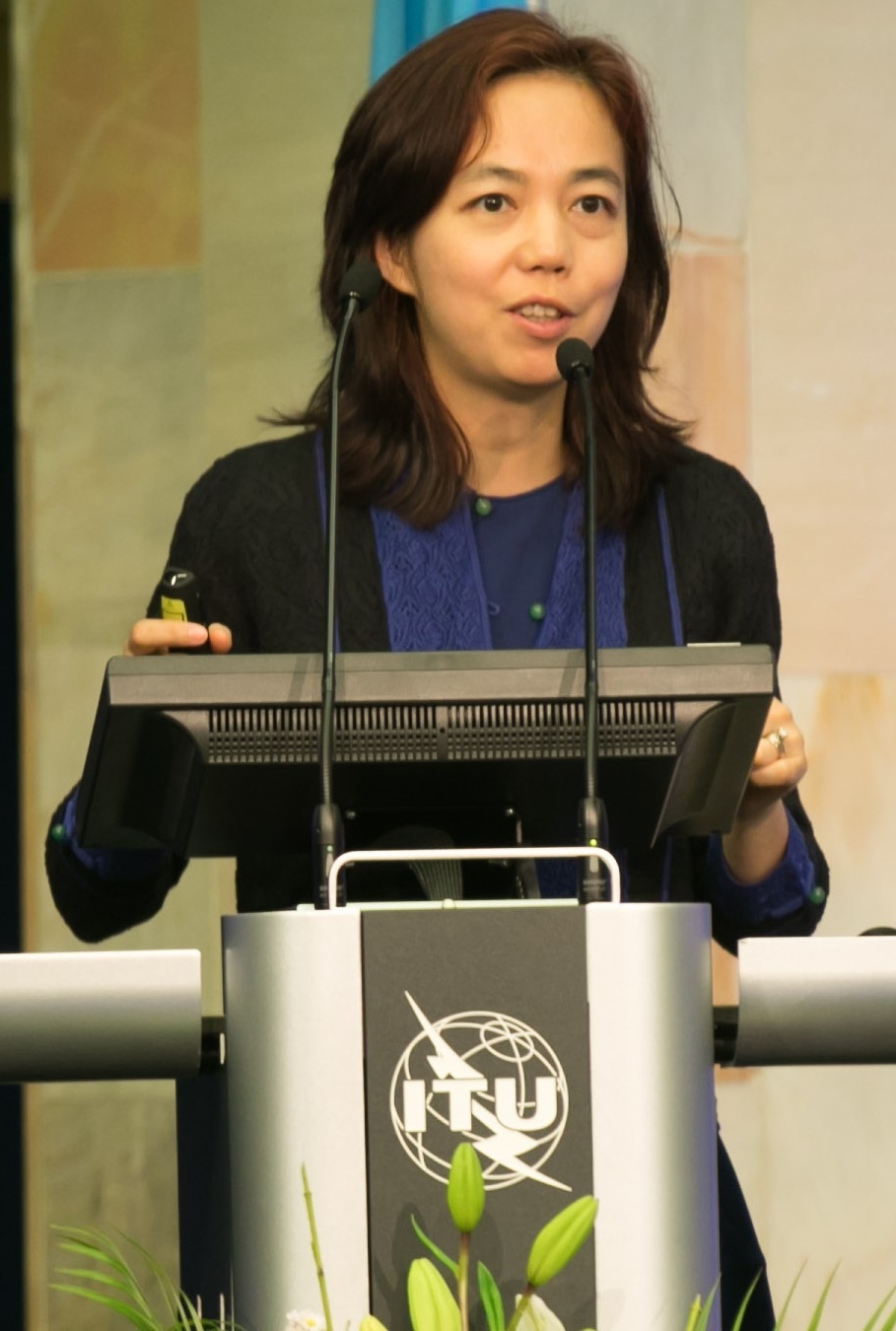
- Fei-Fei Li at AI for Good 2017, ITU Pictures / Wikimedia Commons. Photo © ITU/R. Farrell; cropped by AT; CC BY 2.0.
- Original photograph and license, ITU Pictures, Flickr. Original account license independently checked September 28: CC BY 2.0.
- Princeton honors Li at Alumni Day, Emily Aronson, Princeton University. February 26, 2024 institutional report; retrospective remarks.
- CLEVR: A Diagnostic Dataset for Compositional Language and Elementary Visual Reasoning, Justin Johnson and colleagues. 2016 preprint; controlled tests of visual reasoning.
- Theory of Space: Can Foundation Models Construct Spatial Beliefs through Active Exploration?, Pingyue Zhang and colleagues. February 4, 2026 preprint; experimental limitations, not a clinical or public-benefit claim.