
RACH Profiles · Artificial Intelligence
Geoffrey Hinton: The Question That Would Not Leave
From a detour into carpentry to the foundations of deep learning—and the unresolved responsibility of helping build a technology powerful enough to worry its pioneers.
- Current role
- University Professor Emeritus, University of Toronto; AI-safety public engagement through the Schwartz Reisman Institute.1, 29
- Focus
- Learning representations, neural networks, and the opportunities and risks of advanced AI.
- Evidence boundary
- Benchmark gains, deployed capabilities, preliminary research and future-risk scenarios are distinguished.
The question that would not leave
In a 2025 Nobel Prize conversation, Geoffrey Hinton recalled coming downstairs early and announcing to his teenage daughter that he thought he had worked out how the brain functioned. Her response, as he remembered it, was to point out that he had made this announcement before. The anecdote is his recollection, not a scene independently witnessed by RACH. It captures something the grander descriptions of his career often miss: the famous breakthroughs came from a person who kept returning to a question he had not finished answering.2
Hinton helped make it practical for computers to learn useful internal representations from examples. That contribution is different from solving the brain. It is also different from inventing artificial intelligence by himself. His papers repeatedly lead outward—to colleagues who supplied different expertise, students who made experiments work, and institutions that kept an unfashionable research programme alive.
By October 2026, his public role contains an unusually sharp tension. A University of Toronto emeritus professor whose research helped establish modern deep learning is now arguing that increasingly capable AI requires much stronger scrutiny. Understanding that turn means looking at the long career behind it, without treating either success or alarm as a substitute for evidence.1, 29
Why RACH recognizes Geoffrey Hinton
RACH stands for Recognizing the Achievements and Contributions to Humanity. We recognize Hinton for helping develop learning methods that other researchers and engineers could build upon: methods for discovering hidden structure, improving speech recognition, recognizing images, and transferring learned capabilities into more manageable models. His contribution includes training and collaborating with researchers whose work extended well beyond his own laboratory.8, 9, 16, 17, 22
The human value lies in usable knowledge, not the size of an award or the valuation of an AI company. Better ways of processing speech and images expand what people can investigate and build. Whether a particular deployment improves health, access, or working conditions requires its own evidence. We do not turn a benchmark result into a count of lives saved, or assume that every use of a powerful general-purpose technique benefits society.
This recognition is therefore critical rather than unconditional. Hinton’s collaborators deserve individual credit; the limitations of his experiments remain part of their meaning; and his forecasts about future intelligence remain forecasts. Taking his warnings seriously does not require presenting them as settled science. Nor does questioning them erase the documented research that made his voice influential.
An inheritance of questions, not a straight path
Hinton was born in London on December 6, 1947. The Nobel record places the beginning of a life that would cross psychology, computing, and physics well before it crossed the stage in Stockholm.3
His family background included mathematicians Mary Everest Boole and George Boole. But his own education was not a straight march toward computer science. As TIME reported, he tried physiology, physics, and philosophy at Cambridge before graduating in experimental psychology in 1970. A brief period working as a carpenter preceded his move into Edinburgh’s artificial-intelligence programme in 1972.4
In his interview with Valerie Pringle for Canada Files, Hinton traced the persistent question back to conversations with a clever school friend. Carpentry had represented a temporary departure from the intellectual problem, not its resolution. He described returning because he could not put the brain aside. He also emphasized what simulations had done for him: they allowed theories to fail, including many of his own.5
It is tempting to retell such a route as inevitable preparation. The record supports something less tidy and more useful. Changing subjects, leaving a path, and returning to a problem are not the same as knowing in advance which experiment will matter. The young researcher had a question before he had a convincing method.
A graduate student asking for another six months
In a June 2024 Edinburgh oral history, Hinton described arriving with an ambition to understand language without building an innate grammar into the machine. He remembered calling the proposed system LUDWIG. The plan soon ran into the more basic difficulty of getting neural networks to learn effectively. His account describes repeated disagreements with Christopher Longuet-Higgins over whether this approach was worth pursuing, and repeated requests for more time before abandoning it.6
That account also names a crucial helper: Steve Isard. Hinton credited Isard with suggesting a more tractable problem, recognizing handwritten characters, and with providing support when the larger programme was going badly. This is an important corrective to the lone-dissenter legend. Persistence depended partly on someone helping to reduce an overwhelming question to an experiment.
Hinton’s official biography dates his Edinburgh PhD to 1978. It then records postdoctoral work at Sussex and the University of California, San Diego, followed by five years at Carnegie Mellon. The sequence matters: the eventual breakthroughs grew through several research environments, not a single decisive moment of inspiration.1
Different architectures at the same table
Carnegie Mellon records Hinton’s faculty appointment from 1982 to 1987. In a later university account, Tom Mitchell recalled teaching a 1986 course on architectures for intelligence with Hinton and Allen Newell. Newell was a central figure in symbolic approaches to cognition; Hinton was developing the neural-network alternative. The course offers a better picture of scientific disagreement than a story in which one camp simply disappears. Researchers could argue over the organizing principles of intelligence while sharing an educational setting.7
The basic difficulty was not merely persuading people to like neurons. A model needed a way to change its connections so that useful structures emerged between its inputs and outputs. Those intermediate structures could not always be specified by a programmer beforehand. The problem was how to make a system discover a representation that helped it perform a task.
Hinton’s subsequent reputation rests in considerable part on this middle ground: neither manually listing every rule nor hoping that an arbitrary network would spontaneously become intelligent. Learning needed an explicit procedure, a measurable objective, and experiments showing what had actually been learned.
A beautiful idea with a practical obstacle
The 1985 paper A Learning Algorithm for Boltzmann Machines was written by David Ackley, Hinton, and Terrence Sejnowski. Drawing on statistical mechanics, it described networks whose connections could be adjusted to capture regularities in examples. Internal units could represent structure that was not directly supplied as an input or a desired answer. The paper explicitly connected this approach to John Hopfield’s earlier network model.8
Its authors also stated a substantial limitation: their learning procedure was very slow. They had a mathematical result and demonstrations on simple cases, not a ready-made engine for every practical problem. Keeping that qualification visible does not diminish the work. It explains why more invention was necessary.
In his Nobel podcast, Hinton described Sejnowski as an especially valuable collaborator because he brought knowledge of physics, biology, and the literature that Hinton did not possess. Their partnership illustrates a recurring feature of the story: the person whose name becomes shorthand for a field can depend on the person who knows what he does not.2
Learning what to represent
David Rumelhart, Hinton, and Ronald Williams published their influential Nature paper on back-propagating errors in October 1986. Its central demonstration concerned learning internal representations. A network’s output could be compared with a desired result, and information about the discrepancy used to adjust the connections across its layers. Intermediate units could thereby acquire useful features rather than relying entirely on features chosen in advance.9
In plain language, the procedure helps calculate how changing a connection would affect an error. Repeating those adjustments can improve performance on the training objective. This is not a machine feeling embarrassment or understanding a correction in a human sense; those are unnecessary metaphors for a mathematical process.
The celebrated paper should not be described as a sole invention by Hinton. It had three authors, and the method had predecessors. The later review by LeCun, Bengio, and Hinton situates backpropagation within a longer history of learning and optimization. It also explains why deeper networks can build successive levels of representation. Hinton’s importance lies in making a powerful research direction persuasive and productive, not in erasing everything that preceded it.10
Building places where the work could continue
Hinton joined the University of Toronto in 1987, with support from the Canadian Institute for Advanced Research. The appointment gave his work an institutional home that would become central to his career. A research programme needs more than a promising equation: it needs time, colleagues, students, and opportunities to test ideas that are not yet commercially compelling.37
From 1998 to 2001, he was founding director of UCL’s Gatsby Computational Neuroscience Unit. UCL names Peter Dayan, Li Zhaoping, and Zoubin Ghahramani alongside him in the founding group. The unit was supported by the Gatsby Charitable Foundation and designed to bring theorists into close contact. Hinton then returned to Toronto.11, 1
In 2004, CIFAR’s neural-computation programme brought Hinton, Yoshua Bengio, Yann LeCun, and other researchers into a sustained network of exchange. Its later title, Learning in Machines & Brains, captures the two-way intellectual ambition. These arrangements belong in the biography because they helped make continuity possible. They were not themselves proof that neural networks would prevail, but they created conditions in which the next tests could be attempted.12
2006: finding a workable route into deeper models
Hinton, Simon Osindero, and Yee-Whye Teh’s 2006 paper on deep belief nets proposed learning a multilayer model incrementally, one layer at a time, followed by further adjustment. The experiments included handwritten digits. Rather than presenting depth as a slogan, the paper offered a specific training procedure and reported its behavior under defined conditions.13
That same year, Hinton and Ruslan Salakhutdinov reported a method for reducing the dimensionality of data using neural networks. A model learned a compact representation from which it could reconstruct its input. Their experiments compared the approach with familiar alternatives for compression and visualization. It was a concrete way to ask whether a network could preserve useful structure while representing an example with fewer numbers.14
These projects changed what seemed worth trying, but they were not the final recipe for deep learning. In 2013, Ilya Sutskever, James Martens, George Dahl, and Hinton showed how careful initialization and momentum could make conventional optimization much more effective. The trajectory was not simply that one new technique replaced every old one. Researchers kept revising their account of why a network trained well, and which ingredients were actually necessary.15
When research began to change a familiar interface
Speech recognition supplied a particularly tangible test. People speaking into a device do not experience an algorithm; they experience whether their words are transcribed correctly. The technical route from sound to text nevertheless contains distinct components, and an improvement in one component should not be credited as the invention of the entire system.
A 2012 review by Hinton and ten colleagues documented advances in the acoustic-modeling stage. It brought together work from Toronto, Microsoft Research, Google, and IBM. Its authors included Li Deng, Dong Yu, George Dahl, Abdel-rahman Mohamed, Navdeep Jaitly, Andrew Senior, Vincent Vanhoucke, Patrick Nguyen, Tara Sainath, and Brian Kingsbury. Across several benchmarks, deep networks improved on carefully developed Gaussian-mixture alternatives.16
The names and institutions are not ornamental. Moving from an experiment to a usable speech system required engineering, data, evaluation, and work on other parts of the pipeline. The defensible achievement is a collaborative improvement in a real technical capability. Universal accuracy across accents, languages, recording conditions, or disabilities does not follow from the reported benchmark gains.
Alex made it work
The image-recognition breakthrough of 2012 is often compressed into one name: AlexNet. The original paper lists Alex Krizhevsky, Ilya Sutskever, and Hinton. It describes training a deep convolutional network on roughly 1.2 million images across 1,000 categories, using graphics-processing hardware and several techniques that made training practical.17
For the 2012 competition, the team’s combined-model entry achieved a top-five error rate of 15.3 percent, against 26.2 percent for the next-best entry. Top-five means the correct category could appear among five proposed answers. It does not mean the system understood an image as a human does, and the ensemble result should not be silently assigned to every individual version of the network.
The Computer History Museum’s 2025 account gives the division of labor more texture. Sutskever urged trying the large ImageNet task; Krizhevsky developed and repeatedly refined the implementation; Hinton advised them. Hinton’s own retrospective description playfully gives his students the decisive work and himself the later Nobel recognition. The museum account is especially valuable because it attaches the familiar legend to an artifact: source code preserved and released with Google’s cooperation.19
The people outside the author line
AlexNet also needed a problem large enough to expose the difference between approaches. ImageNet and its recognition challenge supplied images, labels, categories, evaluation procedures, and a common basis for comparison. The challenge’s detailed account by Olga Russakovsky and colleagues names a broader team including Jia Deng and Fei-Fei Li. Their work, and the labor of people who annotated images, belongs beside the model builders’ achievement.18
A benchmark is a carefully bounded instrument. It enables comparisons by defining what counts as a correct answer and keeping the task consistent. That strength is also a limitation. Success on a collection of labeled images is not evidence that a system is reliable in every setting where someone might deploy it.
This distinction matters to RACH’s recognition. Scientific progress becomes easier to see when common tests reveal a substantial improvement. Human benefit still depends on what follows: whose data are used, whose circumstances are represented, how errors are handled, and whether the application is appropriate. The supporting dataset community should neither disappear from the credit nor be asked to carry claims its benchmark never tested.
The move into an industrial laboratory
In March 2013, WIRED reported that Google acquired DNNresearch and hired Hinton, Krizhevsky, and Sutskever. Hinton could remain in Toronto and divide his time between the university and Google. The report did not disclose a purchase price; this biography does not supply one from rumor.20
The arrangement marks a change of setting rather than a clean break in intellectual interests. Hinton’s official biography records part-time Google work from 2013 through 2023, eventually as a vice president and engineering fellow. Those are historical positions, not his current titles.1
Industry offered a setting in which research could meet large operational systems. It also made the distinction between a scientific advance and a company’s decisions more important. A method can travel into many products without its original author designing every use. Conversely, being a researcher does not make a person’s institutional ties irrelevant. The Google chapter belongs in the story both as an avenue for translation and as context for the later public debate.
Making models less fragile and easier to use
The 2014 dropout paper was authored by Nitish Srivastava, Hinton, Krizhevsky, Sutskever, and Salakhutdinov. It addressed overfitting: a model can adapt so closely to its training examples that it performs poorly on new ones. Their method temporarily omitted units and their connections during training, reducing reliance on particular combinations. The paper reported improvements across multiple benchmark tasks.21
In 2015, Hinton, Oriol Vinyals, and Jeff Dean described another practical direction, knowledge distillation. A cumbersome ensemble can be useful for finding good predictions but expensive to operate. Their approach trained a more compact model using information from a larger teacher or ensemble. The authors expressly acknowledged earlier model-compression work by Rich Caruana and collaborators; this was an extension of an existing line of inquiry.22
These contributions are less cinematic than a competition victory, but they illuminate how technical usefulness accumulates. A system must do more than achieve a striking result once. It must generalize, fit practical constraints, and remain testable. Neither paper promises that a smaller or better-regularized model becomes fair, truthful, or safe simply because its predictions improve.
The ideas that remained investigations
Hinton did not stop questioning the architectures that had become successful. In 2017, Sara Sabour, Nicholas Frosst, and Hinton proposed dynamic routing between capsules—groups of units intended to represent properties of an object or its parts. Their experiments included recognizing overlapping handwritten digits. The proposal explored how parts could agree about a larger whole, not merely whether a feature appeared somewhere in an image.23
The limits are as important as the ambition. A result on digits does not establish robust understanding of an open-ended visual world. A full biography should retain experiments that posed useful questions without turning each into a revolution.
His 2022 Forward-Forward paper was even explicit in its subtitle: these were preliminary investigations. It proposed replacing the usual forward-and-backward training passes with two forward passes using positive and negative data. Hinton presented small-problem demonstrations as a reason for further study, not proof that backpropagation had been superseded.24
Across these projects, the recurring aim is visible: to find better explanations and mechanisms for learning. Success did not remove the unfinished problem that had first drawn him into research.
The prizes and the person beneath them
The 2018 ACM A.M. Turing Award, announced in March 2019, recognized Hinton jointly with Bengio and LeCun. The joint award matters because the field’s development involved complementary programmes rather than a single laboratory. The 2024 Nobel Prize in Physics then honored Hinton and John Hopfield for foundational contributions enabling machine learning with artificial neural networks.25, 3
In the Nobel first-reaction interview, Hinton described receiving the unexpected call while in a California hotel. He initially had to establish that it was not a spoof. He also hoped the attention would help people take AI-safety concerns seriously. An award that looked backward at foundational work immediately became part of his argument about what should happen next.26
Associated Press reporting offered a more personal observation from Nick Frosst, who emphasized Hinton’s playful curiosity and interest in fundamental questions. That recollection complements, rather than proves, the scientific record. It gives readers a glimpse of the working temperament colleagues encountered without claiming access to his private thoughts.27
Changing his mind about the consequences
The end of Hinton’s Google employment in 2023 made his warnings a major public story. It did not mean that every institution associated with him adopted an identical position. In a May 3 statement, the Vector Institute affirmed support for his concerns while arguing that ignoring risks or pausing all AI research would be unhelpful. It described his advisory work at that time as voluntary.28
This is an important distinction between research community and unanimity. People can agree that systems deserve serious scrutiny while disagreeing about forecasts, regulation, open access, or the best allocation of safety research. Hinton’s technical achievements give his analysis weight; they do not make a policy conclusion automatically correct.
For readers, the relevant questions are specific. What capability has been demonstrated? Under what conditions? What failure has actually occurred? Which claim describes a possible future rather than an observed event? The same standards that make the early learning experiments meaningful should remain in force when the subject changes to catastrophic risk.
What he is working on now — October 2, 2026
Hinton’s current institutional base is Toronto, where the university identifies him as a University Professor Emeritus. In January 2026, it announced a US$700,000 Good Ventures gift supporting his AI-safety advocacy and public engagement through the Schwartz Reisman Institute for Technology and Society. This is evidence of funded activity, not evidence that a particular safety problem has been solved.29
The freshest verified research item for this profile is a September 28, 2026 preprint, What if automating AI R&D triggers an intelligence explosion? Hinton is one of 22 authors, alongside Alan Chan, Christoph Winter, Andrew Barto, Jakub Pachocki, Eric Horvitz, Yoshua Bengio, Dawn Song, Sheila McIlraith, and others. The authors examine whether automating AI research could sharply accelerate further progress, discuss potential benefits and extreme risks, and propose policy responses.30
The question mark matters. The paper presents an assessment of a possible feedback process and its implications. Its forecasts are not observations of an accomplished intelligence explosion. The accessible abstract explicitly acknowledges uncertainty. Nor should the institutional diversity of the author list be mistaken for agreement by every researcher or organization associated with those authors.
A separate February 26, 2026 paper with Erik Cambria, Rui Mao, Nicola Bianchi, Amir Hussain, and Keith Oatley places AI within a philosophical account of humanity losing its assumed central position. It is an argument about self-understanding, not a laboratory demonstration of machine consciousness or universal superiority.31
In a September 24 interview with Hanna Rosin, Hinton acknowledged that there is no sound scientific procedure for estimating the catastrophic probabilities he discusses. That qualification deserves visibility alongside the warnings. A numerical forecast without a validated basis is not a measured risk rate.32
The official bibliography, institutional pages, recent paper records, and public interviews were checked for this update. The dynamic bibliography did not fully render through every access route, and the current X feed was inaccessible. No claim is made to have inspected private work, every social post, or a complete unpublished pipeline.33
Recognition without a final verdict
Hinton’s life does not end neatly with vindication. Some ideas worked far better than their early prospects suggested; others remain proposals or limited demonstrations. The original ambition to understand biological learning is not identical to the achievement of training useful digital systems. And the public consequences of those systems cannot be read directly from their training objectives.
The strongest case for recognizing him is also the most concrete: he helped produce methods and research communities that made new capabilities possible, worked with people whose contributions can be named, and continued exposing his ideas to tests. The scientific record gives that recognition substance without requiring a mythology of solitary invention.
His current warnings add a further question, not an automatic answer: what responsibilities follow when a successful research programme becomes a powerful social technology? The public needs that question discussed with evidence, disagreement, and humility. Hinton’s biography is compelling because it spans both sides of it—the long effort to make learning machines work, and the unfinished effort to decide how people should live with what now works.
Methodology, disclosure, and corrections
This independent biography was researched, written, and internally checked with AI assistance for RACH. No interview, contact, subject approval, or separate human editorial review is claimed. Personal episodes are attributed to published recollections; interpretive connections are RACH’s. No scenes, dialogue, private motives or emotions have been invented.
Reporting cutoff: October 2, 2026. Current personal and institutional profiles, the institutional bibliography, recent papers and preprints, and public interview records were checked. Some publisher and Nobel pages restricted direct retrieval; indexed primary passages and author-hosted papers were used where available. The September 28 preprint discussion is limited to its author record and abstract, not presented as a full technical audit. The September 24 Atlantic discussion uses accessible indexed transcript passages. The public X feed could not be inspected. This is not an exhaustive audit of unpublished research or financial interests.
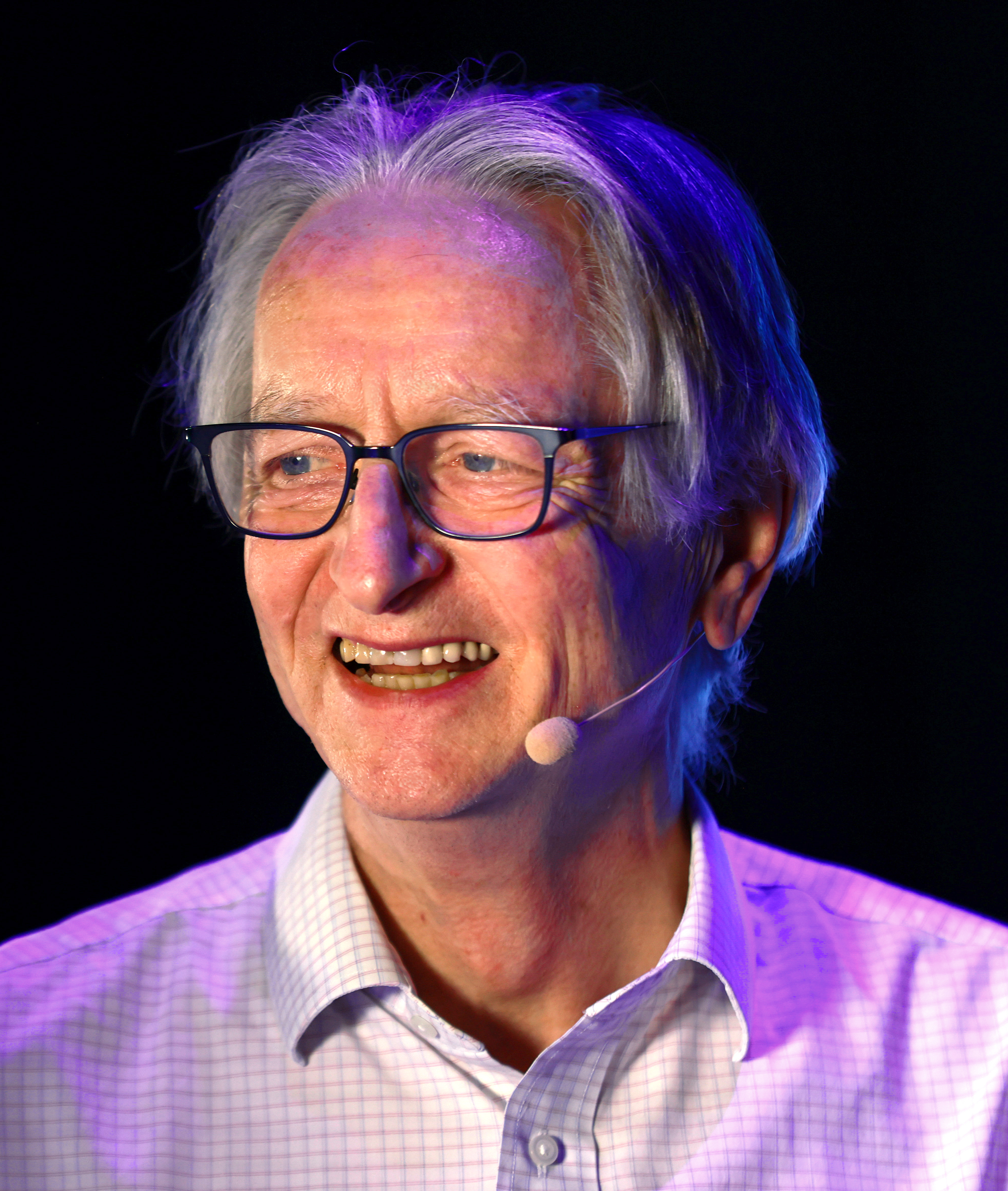
The original Collision photo page was directly checked for the CC BY 2.0 license, photographer credit and event date. The existing Commons derivative’s crop and color changes are disclosed above. The image license does not license this biography. Historical Google employment and current philanthropic support are reported as context, not endorsements. RACH recognition is not sponsorship, partnership or approval by the subject, his institutions or the photographer. No payment or endorsement was arranged.
Send documented corrections to info@rachorg.org. Material revisions will be dated. Narrative word count excludes navigation, citations, methodology and source records.
Sources
- Geoffrey Hinton — biography, University of Toronto. Current personal institutional page; checked October 2, 2026.
- Geoffrey Hinton — Nobel Prize Conversations, Nobel Prize Outreach / Adam Smith. May 15, 2025; attributed recollections, not independently witnessed scenes.
- Geoffrey Hinton — facts, Nobel Prize Outreach. Birth and 2024 award record.
- Geoffrey Hinton: TIME100 AI, TIME / Will Henshall. September 7, 2023; independent biographical reporting.
- Canada Files: Geoffrey Hinton, PBS / Valerie Pringle. May 20, 2025; public interview transcript.
- AI history interview with Geoffrey Hinton, University of Edinburgh / Vassilis Galanos. June 14, 2024; selected early-career passages, especially pages 1–3.
- Hinton Shares Turing Award for Deep Learning, Carnegie Mellon University. 2019 account; award year is 2018, announcement year 2019. Historical roles are not current titles.
- A Learning Algorithm for Boltzmann Machines, Ackley, Hinton and Sejnowski / Cognitive Science. 1985, volume 9, pages 147–169; introductory claims and explicit computational limitations.
- Learning representations by back-propagating errors, Rumelhart, Hinton and Williams / Nature. October 9, 1986; original scanned paper.
- Deep learning, LeCun, Bengio and Hinton / Nature. 2015 review; technical and historical context, not proof of universal social benefit.
- Gatsby Computational Neuroscience Unit — About, University College London. Founding date, faculty and director chronology.
- REACH 2019 — Turing Award honours, CIFAR. Historical account of the 2004 research programme.
- A Fast Learning Algorithm for Deep Belief Nets, Hinton, Osindero and Teh / Neural Computation. 2006; layerwise learning and handwritten-digit experiments.
- Reducing the Dimensionality of Data with Neural Networks, Hinton and Salakhutdinov / Science. July 28, 2006; compression and reconstruction experiments.
- On the importance of initialization and momentum in deep learning, Sutskever, Martens, Dahl and Hinton / ICML. 2013; optimization results qualify a simple pretraining-success narrative.
- Deep Neural Networks for Acoustic Modeling in Speech Recognition, Hinton and ten colleagues / IEEE Signal Processing Magazine. 2012 author-hosted proof; results from Toronto, Microsoft, Google and IBM.
- ImageNet Classification with Deep Convolutional Neural Networks, Krizhevsky, Sutskever and Hinton / NeurIPS. 2012; distinguish the competition ensemble result from individual-network results.
- ImageNet Large Scale Visual Recognition Challenge, Russakovsky and colleagues. 2014 preprint, subsequently published in IJCV; dataset and benchmark context.
- CHM Makes AlexNet Source Code Available to the Public, Computer History Museum. March 20, 2025; primary preservation announcement and attributed team recollections.
- Google Hires Brains that Helped Supercharge Machine Learning, WIRED / Robert McMillan. March 13, 2013; contemporary independent acquisition reporting.
- Dropout: A Simple Way to Prevent Neural Networks from Overfitting, Srivastava, Hinton, Krizhevsky, Sutskever and Salakhutdinov / JMLR. 2014; training method and benchmark evidence.
- Distilling the Knowledge in a Neural Network, Hinton, Vinyals and Dean. March 9, 2015 preprint; explicitly builds on earlier model-compression research.
- Dynamic Routing Between Capsules, Sabour, Frosst and Hinton. 2017; handwritten-digit results, not a general solution to perception.
- The Forward-Forward Algorithm: Some Preliminary Investigations, Hinton. December 27, 2022 preprint; expressly preliminary small-problem experiments.
- 2018 ACM A.M. Turing Award announcement, Association for Computing Machinery. March 27, 2019; joint recognition of Bengio, Hinton and LeCun.
- Geoffrey Hinton — interviews, Nobel Prize Outreach. October 2024 first-reaction interview and December 2024 interviews; recording and publication dates differ.
- Pioneers in artificial intelligence win the Nobel Prize in physics, Associated Press. October 8, 2024; independent reporting and Nick Frosst recollection.
- Public statement from the Vector Institute, Vector Institute. May 3, 2023; historical institutional response, not a fresh appointment announcement.
- Gift supports Geoffrey Hinton’s global AI safety mission, University of Toronto / David Goldberg. January 16, 2026; current institutional context and disclosed philanthropic support.
- What if automating AI R&D triggers an intelligence explosion?, Chan, Winter, Hinton and nineteen other authors. Submitted September 28, 2026; abstract and author record checked. Scenario and policy analysis, not experimental proof.
- Artificial Intelligence as the Fourth Decentering Revolution, Cambria, Mao, Bianchi, Hussain, Oatley and Hinton / Cognitive Computation. Published February 26, 2026; philosophical argument distinguished from empirical findings.
- The Godfather of AI on the Best Chance Humanity Has to Survive, The Atlantic / Hanna Rosin. September 24, 2026; accessible indexed interview passages, not a comprehensive transcript audit.
- Geoffrey Hinton — publications, University of Toronto. Checked October 2, 2026; indexed records used where dynamic page did not render fully.
- Geoffrey Hinton at Collision 2024 — original photograph, Collision Conf / Vaughn Ridley. Original photo record checked directly: CC BY 2.0; taken June 19, 2024.
- Geoffrey Hinton at Collision 2024 in Toronto (cropped), Wikimedia Commons. Existing crop and level/color adjustments by WikiPedant, October 9, 2024; provenance corroborated against the original.
- Creative Commons Attribution 2.0 Generic, Creative Commons. Portrait license; does not license the article or imply endorsement.
- UC Emeritus Professor Geoffrey Hinton wins Nobel Prize in Physics, University College, University of Toronto. 2024 institutional history confirms the 1987 Toronto appointment.