

RACH Profiles · Artificial Intelligence
Judea Pearl: A Life Asking What Would Happen If
From computer memories and scientific setbacks to Bayesian networks, causal reasoning and a family’s public work after loss: a life of questions that prediction alone cannot answer.
- Current role
- Chancellor’s Professor Emeritus, Computer Science, UCLA.1
- Focus
- Probabilistic reasoning, causality and the interpretation of evidence.
- Evidence boundary
- Mathematical contributions, research results and predictions about AI are distinguished.
A scientist who kept changing the question
When colleagues gathered at UCLA in September 2026 to celebrate Judea Pearl’s ninetieth birthday, Eric Horvitz recalled their first meeting more than forty years earlier. Pearl had read a paper by the young graduate student and sought him out. The encounter stayed with Horvitz: an established researcher taking a newcomer’s ideas seriously, and arguing with physical enthusiasm about probability and human reasoning. It is a recollection reported by UCLA, not a scene reconstructed by RACH.2
That encounter offers a useful entrance to Pearl’s life. The famous books and awards can make his career look inevitable. It was not. Before he became a central figure in artificial intelligence, he worked on computer memories whose technological prospects faded. Before his work reached readers outside mathematics, he had to turn intuitions into procedures other people could inspect. And alongside the scientific life came a public life shaped by the murder of his son, journalist Daniel Pearl.
Learning to disagree with the answer
Pearl grew up in the Tel Aviv area of British Mandate Palestine, in a Jewish family with roots in Poland. His childhood and education straddled the establishment of Israel. Carnegie’s biographical account describes a young man who served in the army, joined a kibbutz and then chose engineering over an anticipated agricultural life. It places his move to the United States in 1960.4
In a July 2026 interview with Ryan Peterman, Pearl recalled teachers who taught scientific discoveries as human struggles rather than as finished recipes. He also remembered a childhood disagreement about converting square kilometers into dunams: he believed the class and teacher were wrong, returned to insist on the calculation, and received an apology. That story remains his account, not an independently verified classroom record. Its value is the way he uses it to explain an intellectual habit: understanding an answer mattered more to him than accepting the authority that delivered it.3
The adult career would repeatedly expose the difference between being confidently contrary and being able to demonstrate why an argument works.
A route through engineering and physics
The formal chronology is clearer than some of the anecdotes. Pearl’s own UCLA biographical sketch records a bachelor’s degree in electrical engineering from the Technion in 1960, a master’s in physics from Rutgers in 1965, and a doctorate in electrical engineering from the Polytechnic Institute of Brooklyn that same year. These were not qualifications in the discipline for which he later became most famous.5
His early work concerned physical devices: superconductive components and storage at RCA’s laboratories, then advanced memory systems at Electronic Memories in California. He joined UCLA in 1970. The sequence matters because it resists a familiar retrospective illusion. Pearl did not spend an entire professional life executing an AI plan laid down in childhood. He crossed from the materials and circuits that store information to questions about what a machine could infer from information.
It is tempting to call every detour preparation. That would give the ending too much authority over the beginning. What the record establishes is a change of field, and the willingness to make it.
When a promising technology loses
Speaking with Martin Ford for Architects of Intelligence in 2018, Pearl described working in Jan Rajchman’s computer-memory group at RCA. Researchers were exploring alternatives to cumbersome magnetic-core memory. Superconductivity looked promising, but semiconductor approaches eventually overtook the technologies on which he had worked. He recalled having underestimated their prospects.6
In that interview, Pearl connected the industrial reversal with his eventual move into academia. He said UCLA offered room to pursue pattern recognition, image encoding and decision theory, and that games such as chess attracted him as a way to study intuition. These are retrospective explanations, not a complete employment record or a contemporaneous account of every hiring decision.
The episode is important without being polished into a motivational parable. A scientist can understand a physical phenomenon deeply and still misjudge which technology will prevail. Pearl’s later reputation for challenging prevailing assumptions did not exempt him from being surprised by other people’s progress. His career survived because its central questions could move beyond the particular device that first gave them a practical setting.
Making intuition answerable to mathematics
At UCLA, Pearl’s early AI work investigated heuristic search: ways of directing a search toward promising possibilities without exhaustively exploring every option. The word can sound like a concession to guesswork. In Pearl’s hands, it became an invitation to analyze when a shortcut helped, what it cost, and what guarantees could be made about it.
His 1984 book Heuristics was a major statement of that program. In announcing his Turing Award, ACM emphasized the insistence that even heuristic algorithms should be judged rigorously for correctness and performance. The award was the 2011 award, announced on March 15, 2012; the two dates describe different parts of the same recognition.7
For a general reader, the significance is not that intuition disappeared. It is that intuition became something a researcher could represent, examine and improve. A promising rule of thumb was no longer the end of an explanation. It was a starting point for asking how much work it saved and under what conditions it could mislead.
Giving machines a disciplined maybe
The next challenge was uncertainty. A rule-based system can be precise when a situation has clear premises and reliable consequences. Real observations are often incomplete, noisy or compatible with several explanations. Pearl’s work on Bayesian networks helped make probabilistic reasoning a practical and explicit part of AI.
A network represents variables and their dependencies in a structured way. Rather than treating every combination as an unrelated entry in one enormous table, the representation uses conditional relationships to organize what must be specified. Algorithms can then update beliefs as evidence arrives. This does not mean all probabilistic inference becomes easy: the structure of a particular problem still matters.
The American Academy of Arts and Sciences identifies this work as consequential across AI and statistics, including computational biology and error-control coding. Its account also places Pearl’s 1988 Probabilistic Reasoning in Intelligent Systems at the center of that contribution.8
The demonstrated achievement is a mathematical and computational foundation used by other researchers. It is not a claim that Pearl personally built every later product that employed probabilistic methods, or that the existence of an algorithm proves a benefit for every person subjected to it.
Seeing something is not the same as changing it
Pearl then pressed on a distinction that ordinary conversation handles more easily than statistical notation: observing a condition is different from imposing it. In A Probabilistic Calculus of Actions, a 1994 conference paper later deposited in arXiv, he distinguished ordinary conditioning from an operator representing deliberate intervention. The familiar “do” notation marks that change in the question.9
Consider a hypothetical building with many repair visits. The visits may be associated with breakdowns because trouble brings technicians to the building. That association alone does not show that sending a technician causes trouble. This is an illustrative example, not a claim about a particular construction project or a reported Pearl experiment.
The practical ambition was to reason about actions using both data and a stated account of the relationships involved. A policy question asks what would happen if something changed, not simply what tends to accompany it. Pearl helped supply a formal language for making that difference explicit. The language does not supply trustworthy assumptions automatically; it makes them part of the problem that must be defended.
A book that made assumptions visible
Causality, first published in 2000 and revised in 2009, consolidated a research program rather than offering a shortcut around scientific judgment. Pearl’s later overview describes structural causal models as a framework connecting graphical, potential-outcome, decision-analytic and structural-equation approaches. It also addresses counterfactuals: questions about what would have happened under a different action.5, 10
The attraction is partly organizational. A scientist can separate the causal question, the assumptions about the system and the evidence available to answer it. Those pieces are related, but they are not interchangeable. A large dataset cannot by itself settle every ambiguity about how it was generated.
This is also a boundary on the achievement. Causal inference is not a machine for extracting certainty from an arbitrary spreadsheet. Some questions cannot be identified from the information and assumptions supplied. A useful framework can tell a researcher that an answer is unavailable, or that only a range is justified. That restraint belongs to the contribution as much as the cases in which a calculation succeeds.
The other thing that might have happened
With Joseph Halpern, Pearl also investigated the definition of an actual cause. Their work used structural equations to represent counterfactuals and proposed ways to handle examples that had troubled earlier definitions. The collaboration sits at the meeting point of computer science and philosophy: not only how to calculate an effect, but what it means to say that a particular event caused another.11
The difference is worth pausing over. Asking whether a policy changes an average outcome is not identical to asking whether that policy caused a particular person’s result. The latter requires reasoning about alternatives that did not occur. A mathematical formulation can clarify the question without making the unobserved alternative directly visible.
Halpern belongs in this story as a coauthor, not as a background figure in someone else’s intellectual biography. So do the philosophers and scientists whose competing examples and definitions made the problem sharper. Pearl’s reach across disciplines depended on such exchanges. The existence of a proposed definition should not be mistaken for universal agreement about causation, moral responsibility or legal liability.
Ruth’s life was not a footnote
The family story also begins with an engineer. Ruth Pearl, born in Baghdad, met Judea at the Technion. They married in 1960 and moved to New Jersey for graduate study. USC Shoah Foundation’s remembrance describes her own electrical-engineering education and subsequent professional work, alongside the couple’s family life and move to California. She died in 2021.12
To introduce her only as the wife of a famous scientist or the mother of a murdered reporter would erase much of what she brought to the family and to its later public work. USC’s account, drawing on her recorded testimony, identifies her as the person who ran the Daniel Pearl Foundation. It also preserves her concern with dehumanization and the education of a younger generation.
The distinction matters to this biography’s accounting of contribution. Founding an organization and sustaining its everyday work are different kinds of labor. Both deserve names. Ruth’s role was not simply to support Judea’s scientific career or lend emotional weight to his public speeches; she had a profession, a history and an operational role of her own.
A private family becomes a public symbol
In 2002, Daniel Pearl was kidnapped and murdered while reporting in Pakistan for The Wall Street Journal. A September report by Tom Tugend described his parents trying to protect some privacy while building a foundation in his memory. The family wanted attention directed toward journalism, music and cross-cultural understanding; they were frustrated by coverage that repeatedly returned to their immediate feelings of grief.13
That reporting imposes an obligation on anyone retelling the story. The loss is a major fact in Judea Pearl’s life, but it is not permission to invent private conversations, reconstruct the family’s emotions or use violence as a dramatic device. Nor does it explain his earlier mathematical work, which had developed over decades.
The foundation created another form of responsibility. Pearl was learning to raise money and engage with journalists as a bereaved parent and public advocate, not simply as an academic explaining a theorem. The research life continued, but it now existed beside an undertaking with different demands, different measures of progress and no possibility of undoing the event that had prompted it.
Work that required another person across the table
By 2006, independent reporting described Pearl participating in public conversations with Akbar Ahmed, a Muslim scholar born in Pakistan. Their dialogue addressed divisions between Muslims and the West, and particularly between Muslims and Jews. Meg Barone’s Connecticut Post account also described the foundation’s musical events and Pearl’s view that music could create a form of nonverbal encounter.14
Ahmed’s participation is essential to the account. An interfaith dialogue is not the unilateral achievement of one speaker. Its existence depends on the other participant, organizers, audiences and institutions willing to make room for disagreement. Likewise, a concert depends on musicians and local communities, not just on the name under which it is dedicated.
The documented outcome is the creation of occasions for exchange. It would go beyond the evidence to declare that these events measurably eliminated hatred or resolved political conflict. Their more modest significance is still real: the family helped establish repeatable public activities around the interests Daniel had lived with, rather than allowing his name to be remembered only through the manner of his death.
Bringing why to readers outside the field
Pearl’s scientific books were followed by efforts to make causal reasoning accessible beyond specialist audiences. Causal Inference in Statistics: A Primer was coauthored with Madelyn Glymour and Nicholas Jewell. The Book of Why, published in 2018, was written with science writer Dana Mackenzie. These collaborations deserve more than a parenthetical acknowledgment: explanation itself is a form of work.5, 15
In an interview with Ron Wasserstein for Amstat News, Pearl described wanting the public to understand developments in causal inference that he believed remained insufficiently recognized. The project was not merely to circulate a technical vocabulary. It was to help readers notice when a question about evidence had quietly become a question about an intervention or an unrealized alternative.
That ambition also creates a tension for popular science. A clear narrative needs a recognizable argument; the underlying history contains rival methods, older traditions and unresolved disputes. Readers should be able to appreciate the force of Pearl’s explanation without assuming that a compelling account is the only legitimate map of the field.
Recognition without declaring the debate over
Guido Imbens’s 2020 essay in the Journal of Economic Literature compares graphical and potential-outcome approaches, including the arguments in The Book of Why. He examines their relevance to empirical economics and explains why much economic practice is closer to the potential-outcome perspective. His account explicitly recognizes the lineage through Donald Rubin and Jerzy Neyman.17
This is a substantive qualification to any story in which causal reasoning appears to have been invented by a single person. Pearl’s contribution can be foundational without absorbing the work of predecessors or colleagues using another language. Researchers may agree on the importance of causal questions and still disagree about which formulation best supports a particular investigation.
The fair conclusion is neither that criticism cancels his achievement nor that an award settles the criticism. It is that his work became important enough to change the terms of an ongoing argument. RACH’s recognition concerns that documented intellectual contribution. It does not certify every historical claim, policy opinion or methodological preference expressed in his books and interviews.
The critic inside artificial intelligence
In Kevin Hartnett’s 2018 Quanta interview, Pearl argued that successful pattern recognition was not a complete account of intelligence. He wanted systems able to reason about interventions and counterfactuals, not only classify what they had seen. He also acknowledged that deep learning had accomplished more through statistical learning than he had expected.16
Those remarks belong to 2018. They should not be repackaged as a fresh test of every system available in 2026. His predictions about human-level intelligence and machine agency remain predictions, not experimental findings established by that interview.
The larger research question has continued beyond any single exchange. Bernhard Schölkopf’s Causality for Machine Learning examines connections between causal inference and difficult machine-learning problems, describing a field beginning to build links that had long been limited.18
For Pearl’s biography, the important continuity is his refusal to let a successful answer close off a different question. Predicting an observation, choosing an intervention and explaining an outcome are related ambitions. They do not become identical because one system performs impressively on one of them.
The information that never reached the dataset
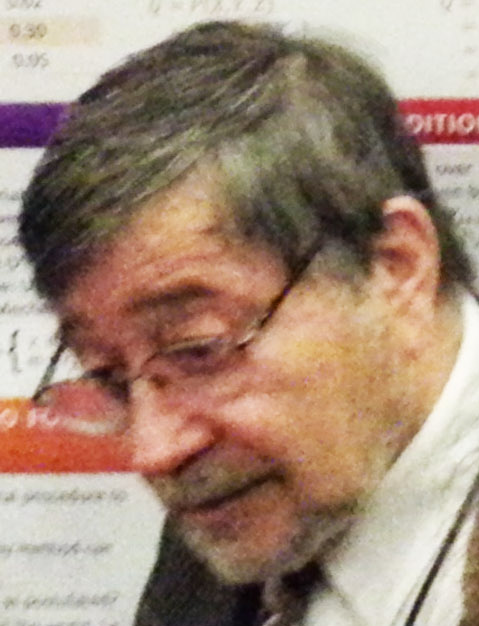
The photograph accompanying this profile was taken at a 2013 conference beside a poster about missing data. Its subject was collaborative work by Karthika Mohan, Pearl and Jin Tian. Their paper examined how graphical representations of the processes that make information disappear can help determine what remains recoverable.19, 28, 29
That is a less glamorous problem than building a machine that converses, but an important one. A dataset can be large and still systematically omit the people or events most relevant to a question. Missingness is not always a random inconvenience that more rows will cure.
In further work, Mohan and Pearl asked which assumptions in missing-data models could actually be tested with the incomplete information available. Recovering a quantity and checking a model are distinct tasks.20
This work also changes how the portrait is read. Pearl is not pictured alone against a symbolic backdrop of genius. He is at a research meeting, beside a shared result, in the ordinary environment through which technical ideas circulate. Mohan and Tian’s names belong beside his when the result is described.
When useful evidence comes from different worlds
With Elias Bareinboim, Pearl addressed another obstacle: evidence collected under different conditions. Their 2016 PNAS paper on data fusion asks how multiple datasets, populations and sampling regimes can contribute to a causal question. The point is not simply to place all records in a larger file. The conditions under which information can be combined must be understood.21
The distinction is consequential for readers far outside AI. A result obtained in one setting may not transfer unchanged to another. Differences can concern the population, the intervention or the process through which observations were selected. A formal account can help identify which differences matter and what additional information is needed.
The paper proposes a framework and develops methods; it is not a census of lives saved or a guarantee that combining any two datasets will improve a decision. Bareinboim’s coauthorship is also a reminder that Pearl’s later career is a story of researchers extending a program together. The contribution is transmitted through methods that other people can scrutinize and develop, not only through the visibility of a senior scientist.
What they are working on now — October 15, 2026
UCLA currently lists Pearl as Chancellor’s Professor Emeritus. His laboratory’s public bibliography remains active, but some entries describe submissions or older drafts. For this profile, those entries were checked against repository and proceedings records rather than treated as a definitive publication history.1, 22
A concrete 2026 result is Epsilon-Identifiability of Causal Quantities, published in the AISTATS proceedings under the names Ang Li, Scott Mueller, Xin Shu and Judea Pearl. The final author list differs from the older three-author manuscript linked by the lab. The work asks when a causal quantity that cannot be pinned down exactly can nevertheless be constrained within a useful narrow range, given suitable additional restrictions.23
The practical attraction is an alternative to either unjustified precision or complete silence. But this remains methods research: the mathematical conditions must fit the application. Publication does not by itself demonstrate improved outcomes for patients, consumers or a deployed AI system.
Another collaboration, with Shuai Wang, Yizhou Sun and Ang Li, studies machine-learning models for predicting bounds on probabilities of causation. The current arXiv version of Learning Probabilities of Causation with Mask-Augmented Data is dated February 10, 2026, following an initial May 2025 submission. Its reported evaluation uses structural causal models. The results are not evidence that the approach has delivered a measured public benefit in a live service.24
The repository also carries an administrative notice of text overlap with another arXiv paper. That notice is part of the public record and should be visible; it is not, on its own, a finding of plagiarism or misconduct. RACH has not adjudicated the overlap.
A third project, with Tianyuan Cheng, Ruirui Mao and Ang Li, addresses how many experimental and observational samples are required to estimate certain causal bounds with a desired margin of error. Its February 19, 2026 arXiv record describes a delta-method framework and simulation studies. The lab lists it as submitted, not as an established deployed tool.22, 25
Together, these projects show an active question becoming more specific: not merely whether causal reasoning matters, but how precisely a limited body of evidence supports a decision. They also show why collaborators and version dates cannot be left out of a current-work section.
The public-facing work is also being updated. Basic Books currently schedules a revised trade paperback of The Book of Why, coauthored with Dana Mackenzie, for October 20, 2026. The publisher describes a new preface and summary of recent advances. At this reporting cutoff it is forthcoming, not a book RACH has independently reviewed. Publication schedules can change; the listing documents planned work, not independent validation of its arguments.32
The public work continues, with limits to what is claimed
The Daniel Pearl Foundation’s current website describes journalism fellowships with Alfred Friendly Press Partners and its continuing music program. It also lists Maria Ressa as the 2026 recipient of its journalism award. These are documented activities, not independently measured reductions in intolerance. The organization’s reported aggregate reach should not be mistaken for an audited causal impact assessment.26
UCLA’s Burkle Center lists Evan Gershkovich for the October 5, 2026 Daniel Pearl Memorial Lecture. The event belongs to the current chapter of the family’s institutional work; this article does not claim to have watched the full recording or verified quotations from its machine transcript.27
Pearl also writes about Jewish identity, antisemitism, Israel and coexistence, including a collection of writings published in 2025. Those public positions are part of his life, not a reason to assume agreement with every argument he makes.5 Recognition of scientific contributions and documented dialogue work is not a blanket endorsement of political views. Nor can a mathematical framework settle the moral judgments involved in a conflict.
Why RACH recognizes Judea Pearl
RACH stands for Recognizing the Achievements and Contributions to Humanity. We recognize Pearl for helping build the foundations of probabilistic and causal reasoning in AI, and for making the distinction between prediction and intervention more explicit across scientific disciplines. The contribution is an improved capacity to pose and examine consequential questions, not a claim that he alone created modern AI or solved human decision-making.
The people around the work remain part of the recognition: coauthors, students, critics, earlier statisticians and the practitioners who determine whether a method is appropriate in a real setting. Ruth Pearl, Akbar Ahmed, journalists, musicians and participating communities likewise belong in the account of the family’s public initiatives.
His life contains technological disappointment, intellectual conflict, bereavement and sustained collaboration. None needs to be converted into a triumphal ending. At ninety, the interesting fact is not that every question has been answered. It is that a career spent formalizing uncertainty still has room for new questions—and for other people to improve the answers.
Methodology, disclosure, and corrections
This independent public-record biography was researched, written and internally fact-checked with AI assistance. No interview, outreach, subject approval or separate human-editor review is claimed. Reporting cutoff: October 15, 2026. Recollections are attributed and interpretive connections are RACH’s. No private scenes, dialogue or motives were invented.
Current institutional, laboratory, publication and public-event records were checked. The public social account linked by Carnegie could not be read in this session; no new social posts are claimed as checked.31 Some archives restricted browser access. Direct PDF retrieval recovered the Ford interview and ACM announcement; the PNAS discussion relies on accessible indexed abstract material. The 2026 research summaries use repository abstracts and proceedings records, not independent reproductions of experiments. The text-overlap notice is disclosed without alleging misconduct. No claim is made of an exhaustive financial-interest or litigation audit.
Recognition is not a partnership, endorsement of every view, clinical recommendation or certification of an AI product. The portrait’s license was verified on its original Flickr page and cross-checked against Commons provenance. The image license does not apply to this article’s prose. Send documented corrections to info@rachorg.org. Material revisions will be dated. Narrative count includes section headings and excludes navigation, citations, methodology and sources.
Sources
- Judea Pearl faculty profile, UCLA Samueli. Current Chancellor’s Professor Emeritus title, checked October 15, 2026.
- At 90, UCLA’s Judea Pearl is still asking the big questions, UCLA Newsroom. September 11, 2026 account of September 6 celebration; attributed recollections.
- Turing Award Winner: Early AI, LLM Predictions, Causality, Ryan Peterman interview. July 27, 2026 transcript. Childhood anecdote is Pearl’s recollection, not independently witnessed.
- Judea Pearl, Carnegie Great Immigrants. 2020 biographical account; historical, not current-title authority.
- Biographical sketch, Judea Pearl / UCLA. Education dates, books and interests.
- Interview in Architects of Intelligence, Martin Ford / Packt. 2018 published interview, pp. 357–372. Direct PDF retrieved after browser-tool access failed.
- Judea Pearl wins ACM A.M. Turing Award, Association for Computing Machinery. March 15, 2012 announcement of the 2011 award; direct PDF read. Institutional assessment, not an outcomes audit.
- Judea Pearl, American Academy of Arts and Sciences. Research significance and cross-disciplinary influence; historical role wording.
- A Probabilistic Calculus of Actions, Judea Pearl / UAI. 1994 conference paper deposited in arXiv in 2013; those dates are not interchangeable.
- Causal Inference, Judea Pearl / PMLR. 2010 proceedings of the 2008 workshop; structural causal-model framework.
- Causes and Explanations: A Structural-Model Approach, Part I: Causes, Joseph Halpern and Judea Pearl. Version history 2000–2005; proposed definition of actual cause.
- Iraqi Survivor Ruth Pearl, 85, Fostered Harmony and Understanding, Julie Gruenbaum Fax / USC Shoah Foundation. 2021 remembrance drawing on Ruth’s testimony; her engineering and foundation work.
- From Private Grief to Public Good, Tom Tugend / Jerusalem Post. September 25, 2002 independent reporting preserved by the foundation. Historical fundraising and teaching figures are not used as current facts.
- Slain journalist’s father working to create dialogue, end hatred, Meg Barone / Connecticut Post. November 15, 2006 independent reporting preserved by the foundation.
- Judea Pearl interview, Ron Wasserstein / Amstat News. 2018 discussion of The Book of Why and communicating causal reasoning.
- To Build Truly Intelligent Machines, Teach Them Cause and Effect, Kevin Hartnett / Quanta Magazine. May 15, 2018 independent interview; predictions and opinions are attributed and dated.
- Potential Outcome and Directed Acyclic Graph Approaches to Causality, Guido Imbens / Journal of Economic Literature. 2020 comparison; abstract and bibliographic record checked.
- Causality for Machine Learning, Bernhard Schölkopf. 2019 manuscript, subsequently a chapter in the 2022 ACM collection; research perspective, not proof of AGI.
- Graphical Models for Inference with Missing Data, Karthika Mohan, Judea Pearl and Jin Tian / NeurIPS. 2013 conference paper; published abstract checked.
- On the Testability of Models with Missing Data, Karthika Mohan and Judea Pearl / PMLR. 2014 work distinguishing recovery from testability.
- Causal inference and the data-fusion problem, Elias Bareinboim and Judea Pearl / PNAS. 2016 paper; indexed abstract accessible, archive sometimes presents a browser challenge.
- Publications, submissions, and working papers, UCLA Cognitive Systems Laboratory. Checked October 15, 2026; contains older drafts and submission claims, cross-checked against proceedings and arXiv.
- Epsilon-Identifiability of Causal Quantities, Ang Li, Scott Mueller, Xin Shu and Judea Pearl / PMLR. AISTATS 2026 proceedings: final author list includes Xin Shu; not just the older three-author lab manuscript.
- Learning Probabilities of Causation with Mask-Augmented Data, Shuai Wang, Yizhou Sun, Judea Pearl and Ang Li / arXiv. Preprint, first submitted May 22, 2025; version 2 February 10, 2026. Repository includes a text-overlap notice; no misconduct determination inferred.
- General sample size analysis for probabilities of causation: a delta method approach, Tianyuan Cheng, Ruirui Mao, Judea Pearl and Ang Li / arXiv. February 19, 2026 preprint; simulation-based methods research.
- Daniel Pearl Foundation, Daniel Pearl Foundation. Current programs and event announcements checked October 15, 2026; organization’s own claims, not independent impact measurement.
- The 2026–27 Daniel Pearl Memorial Lecture, UCLA Burkle Center. Event listing for October 5, 2026. Recording and imperfect machine transcript are not treated as independently verified quotations.
- Judea Pearl at NIPS 2013, Better Than Bacon / Flickr. Original photographer page retrieved October 15, 2026; its ImageObject license points to CC BY 2.0.
- Judea Pearl at NIPS 2013, cropped, Wikimedia Commons. Existing lossless crop by Jochen Burghardt, February 29, 2020; original photographer Better Than Bacon, December 6, 2013.
- Attribution 2.0 Generic, Creative Commons. Portrait license; attribution, link and change disclosure supplied.
- Public professional account linked by Carnegie, Judea Pearl / X. Account identity cross-linked by Carnegie; feed unavailable to this research session. No recent post is claimed to have been reviewed.
- The Book of Why — revised trade paperback, Basic Books / Hachette. Publisher lists October 20, 2026 release, with a new preface and summary of recent advances. Forthcoming at reporting cutoff; not independently reviewed by RACH.