RACH Profiles · Longevity and Biotechnology
Katalin Karikó: The Long Road from a Lab Bench to a New Kind of Medicine
From everyday chemistry in Hungary to modified mRNA, a shared Nobel Prize, and a new research chapter whose promise still has to be tested.
- Current roles
- Adjunct Professor of Neurosurgery, Penn; Professor, University of Szeged; Chief Scientific Officer, Repeat Therapeutics.4, 26, 29
- Focus
- RNA biochemistry, therapeutic development, and experimental neurodegeneration research.
- Evidence boundary
- Cell and animal studies, human vaccine trials, and early investigational drug programs are distinguished. No treatment recommendation or claim that aging has been reversed.
The scientist and the broken centrifuge
Addressing Johns Hopkins graduates in May 2026, Katalin Karikó remembered returning home from the laboratory with a broken benchtop centrifuge for her husband to repair. In a speech delivered after the Nobel Prize, she chose to acknowledge the practical support behind the work: a partner who accepted difficult moves, weekends interrupted by experiments, and a daughter who encouraged her. The recollection brings a vast scientific story back to the scale of a household.1
It is an apt starting point for a life often compressed into a morality tale about perseverance. Karikó did persist. But the path from laboratory RNA to useful medicine required more than persistence, and considerably more than one person. It required a molecule that behaved differently, colleagues with different expertise, delivery systems, clinical volunteers, and organizations capable of producing medicines.
This biography follows that longer path. Its central achievement is not that Karikó predicted every eventual application. It is that she helped make a difficult biological message more usable—and continued asking what else it might do.
Chemistry before the laboratory
Born in Szolnok in 1955, Karikó would build a career across Hungary, the United States, and Germany.20
Karikó grew up in Kisújszállás, Hungary, in a household where making and reusing things were ordinary necessities. In her memoir, she describes a home without indoor running water, a father who worked as a butcher, and the rhythms of growing, preparing, and preserving food. These were not laboratory demonstrations, but they supplied questions about how living material changed.2
One memorable figure in that account is a woman who made soap from collected fat. Looking back as a biochemist, Karikó recognized the chemical transformation inside an everyday task. The episode is valuable precisely because it does not require a childhood prophecy. The adult scientist supplies the interpretation; the child encountered a material becoming something else.2
RACH has not reconstructed conversations in the family kitchen or assigned private motives to her parents. The documented connection is simpler: curiosity developed close to useful work. Chemistry could be encountered in something that cleaned a household, not only in something presented as science.
Learning to ask why
In her EMBO interview, Karikó traced an early fascination with biology to schoolwork on classifying organisms. Learning the names was part of learning that nature had patterns worth investigating. She also described the importance of reading earlier scientific work rather than treating the present as the beginning of an idea.3
Her formal training took place in Szeged. Penn's faculty record lists a biology degree from József Attila University in 1978 and a doctorate in biochemistry in 1982. The educational sequence matters: the later medical applications grew out of sustained biochemical training, not a sudden switch into vaccines during a pandemic.4
It is easy to read those dates backward from Stockholm and imagine a straight route. A degree can establish preparation without fixing a destination. In Karikó's case, the question of how to make nucleic acids useful would survive changes of institution, country, collaborator, and proposed disease target. The continuity was in the problem, not in a secure job description.
An invitation into RNA
Her early research included work with lipids and nucleic-acid delivery at Szeged's Biological Research Center. In a PNAS interview, she described the transition into a group studying short RNA molecules and the difficulty of getting promising compounds into cells. Funding for that line of work eventually ran out. A research problem had become an employment problem as well.5
The early work is important without being presented as an embryonic COVID vaccine. A lipid experiment, an antiviral compound, and a later messenger-RNA medicine are not interchangeable. Their connection lies in the practical challenge of bringing biologically active material to the place where it can act.
This distinction gives the apprenticeship its real weight. Karikó was learning how an attractive molecular idea can fail when confronted with delivery, stability, or limited resources. The frustrations were not interruptions of scientific training. They were part of discovering what a therapeutic claim would eventually have to survive.
A family crosses the Atlantic
In 1985, Karikó moved to the United States with her husband and young daughter to work with Robert Suhadolnik at Temple University. Her PNAS recollection includes the now-famous detail of savings concealed in her daughter's teddy bear after the family sold its car. The money was a buffer for starting over, not a symbol invented after the Nobel award.5
The anecdote is striking, but migration should not be reduced to an ingenious hiding place. It altered the setting in which she could work and the practical arrangements around that work. The family, not just the scientist on a future prize citation, made the transition.
Her subsequent route included the Uniformed Services University of the Health Sciences before Penn. In her public interviews, these moves appear as opportunities pursued under pressure, not stops in a carefully financed master plan. The broad chronology is clear; this account does not embellish it with unverified private exchanges or contested employment allegations.6
A result on a printer
Messenger RNA is a template that cells read to make proteins. Researchers could produce it in the laboratory, opening the possibility of supplying instructions for a desired protein. But the message had to survive, reach cells, and be read without an unacceptable biological reaction.20
At Penn, work with cardiologist Elliot Barnathan provided an early demonstration that synthesized messenger RNA could produce a useful cellular result. Recalling experiments involving the urokinase receptor in her JCI interview, Karikó remembered the excitement of reading the output from a dot-matrix printer. The emotional description is hers; the scientific point was that the message had led to functional protein production.6
That is a smaller claim than curing disease, but an indispensable kind of evidence. A therapeutic program cannot begin with the clinical result it hopes to obtain. It has to establish intermediate steps: whether the message arrives, whether the cell reads it, and whether the resulting protein does what the experiment requires.
The printer belongs in the life story because it captures what can sustain a researcher before outside recognition arrives. The reward was not a headline. It was a piece of evidence that a proposed mechanism might work, inviting the next experiment rather than ending the investigation.
A career that did not look like success
Independent reporting by Times Higher Education describes Karikó's demotion at Penn in 1995 amid difficulty obtaining research funding. Her scientific commitment and her institutional position were moving in different directions. Colleagues interviewed by the publication discussed the challenges of advancing an unfamiliar approach and the importance of professional networks and persuasion.7
The same report included Penn's expression of pride in the work while noting that university leaders did not provide detailed answers about the earlier decisions. That leaves room for criticism of how promising research is supported, but not for inventing a definitive account of every administrator's motives.7
A Nobel Prize makes the earlier decision look dramatically different in retrospect. It does not make it possible to identify every future breakthrough in advance. The institutional question is how to maintain room for evidence-producing work that is not yet fashionable. Karikó's experience gives that question a human cost: uncertain status while the experiments still demand concentration.
The experiment that would not cooperate
Not all of the projects worked. In the JCI conversation, Karikó described efforts with neurosurgeon David Langer involving nitric oxide synthase and the hope of improving blood-vessel function in a stroke-related setting. She said the desired effect could not be demonstrated reliably enough to produce the paper they wanted.6
That recollection prevents the biography from becoming a sequence of discoveries waiting for a skeptical world to catch up. Sometimes the obstacle is not an inattentive funder. Sometimes the experiment does not support the hoped-for result.
Her interview in Issues in Science and Technology emphasizes the value of experiments that expose mistaken assumptions and of prioritizing meaningful research over publication counts.9 Applied to the unsuccessful project, the lesson is not that determination guarantees a positive result. It is that determination can be directed toward finding out what is true. Abandoning an unsupported conclusion and continuing a broader line of inquiry can be compatible acts.
Two problems meet at a photocopier
Karikó and immunologist Drew Weissman began talking while using a photocopier at Penn. In her interview with Joe Walker, she was careful about the date: 1997 or 1998, rather than a perfectly remembered moment. Weissman's interest in vaccines and her experience making RNA created a reason to test something together.8
The modest setting has become famous because the later result was so large. But the encounter was useful because the two researchers brought different problems to it. Making an RNA molecule and understanding how immune cells respond to that molecule are connected tasks, not the same expertise.
There is no need to invent the exact dialogue or make chance do all the explanatory work. The meeting opened a collaboration; accumulated knowledge made the collaboration productive. In a biography crowded with individual decisions, it marks the point where the central scientific story becomes explicitly shared.
Why did some RNA provoke less alarm?
The collaboration faced a fundamental complication: the body's defenses could react strongly to laboratory-made RNA. A molecule intended to instruct cells could also trigger inflammatory signaling. That response was not simply an inconvenience to be ignored; it was part of the biology the researchers had to understand.10
Karikó described a revealing comparison in her Issues interview. Transfer RNA, which naturally contains numerous modified building blocks, behaved differently in their tests. The clue encouraged attention to the chemical details of RNA, not merely the sequence of instructions it carried.9
The conceptual turn was subtle. Rather than asking only which protein a message should encode, the researchers asked how the message's own chemistry affected its reception. The eventual answer would not remove every challenge of RNA medicines. It would address one obstacle with an experimentally testable change.
The 2005 paper, read at its actual scale
The 2005 Immunity paper was authored by Karikó, M. Buckstein, H. Ni, and Weissman. It reported that incorporating certain modified nucleosides reduced recognition by Toll-like receptors and altered immune-cell activation. These were experiments about molecular recognition and cellular responses, not a trial showing that a vaccine prevented disease in people.10
That boundary is essential to understanding the achievement. The paper did not contain all the components of a future commercial vaccine. It offered evidence that an important inflammatory obstacle could be changed through the chemistry of the RNA itself.
For a research program repeatedly confronting the question of whether synthetic RNA could become useful, this was consequential progress. It turned a general hope into a more specific design strategy. It also created work for others: to reproduce the behavior, understand its consequences, improve production, and find out which applications could benefit. Discovery opened a path; it did not complete the journey.
More than quieting an immune response
A 2008 Molecular Therapy paper examined pseudouridine-containing mRNA in cells and mice. The team reported improved protein production and biological stability, alongside reduced inflammatory responses under the experimental conditions. Its authors included Hiromi Muramatsu, Frank Welsh, János Ludwig, Hiroki Kato, Shizuo Akira, Karikó, and Weissman.11
Those findings added another dimension to the earlier work. An RNA medicine needs more than reduced unwanted signaling: enough of the intended protein must be made for long enough to serve the proposed purpose. The new experiments connected chemical modification with that practical requirement.
They still did not establish universal safety or effectiveness. A mouse experiment does not answer every question about dosing, repeated exposure, different tissues, or human disease. The importance of the paper lies in making the platform more plausible through measured results, not in granting every later RNA application a presumption of success.
The message was not the only thing in the sample
Manufacturing introduced another problem. A 2011 study by Karikó, Muramatsu, Ludwig, and Weissman investigated contaminants in laboratory-transcribed RNA, including double-stranded RNA. Purification using high-performance liquid chromatography reduced unwanted immune activation and improved translation in the studied systems.12
The result complicates a tidy account in which replacing one chemical component solves everything. The intended molecule can be well designed while the preparation around it still interferes with its performance. In this work, chemical design and product quality were separate, necessary questions.
This is one of the less theatrical chapters of invention. Purification does not have the narrative simplicity of a chance encounter or a prize announcement. Yet it helps explain how biological ideas become reproducible tools. The sample has to be characterized, unwanted material recognized, and the method tested again. A promising message is only part of a usable preparation.
Other inventors, another indispensable problem
RNA also needs an effective way to reach cells. Elie Dolgin's independent Nature history places Karikó and Weissman's contribution within a much wider development effort. Lipid-delivery researchers, including Pieter Cullis, Thomas Madden, and Ian MacLachlan, belong in that account rather than in a footnote beneath a single heroic inventor.13
A 2015 study led by Norbert Pardi, with collaborators including Muramatsu, Karikó, Barbara Mui, Ying Tam, Madden, Michael Hope, and Weissman, investigated modified mRNA delivered in lipid nanoparticles in mice. Different routes of administration produced different patterns and durations of protein expression.14
That is a concrete demonstration of why delivery is not merely packaging added after the important science. Where a preparation goes and how long its activity lasts help determine what it can do. The biography therefore recognizes a contribution within a chain of invention, without converting shared technological development into exclusive ownership of the whole field.
An opportunity in Mainz
Karikó joined BioNTech in 2013. The company's Nobel statement recalls a visit arranged around a trip connected with her daughter's rowing, during which she met Uğur Şahin and encountered an organization deeply interested in RNA. The account describes a meeting of scientific interests, not an already guaranteed route to a pandemic vaccine.15
Her work there connected with that of Şahin, Özlem Türeci, and teams developing RNA-based approaches. BioNTech's history also records her return to Pennsylvania in 2022 and a subsequent consulting relationship as of its October 2023 statement. RACH does not recycle her former senior executive title as a verified current appointment.15
The move changed the institutional setting around the science. A company could bring different development resources and objectives, but also different pressures and commercial interests. It was another transition in a career whose underlying interest remained the use of RNA, rather than loyalty to a single organization or disease target.
Before COVID, a different virus
In 2017, a multi-institutional team led by Pardi reported protection against Zika-virus challenge using a nucleoside-modified mRNA vaccine in animal experiments. Karikó and Weissman were among the authors. The study included mice and nonhuman primates, moving the question beyond whether a cell could manufacture a protein to whether vaccination could protect an organism in a controlled challenge.16
That was important preclinical evidence. It was not proof of a licensed human Zika vaccine, and this profile does not describe it as one. The distinction is not an editorial technicality: species, exposure conditions, safety requirements, and population-level use all matter when a candidate moves toward people.
The work nevertheless helps explain why the later response to SARS-CoV-2 was not science starting from nothing. Researchers had already been testing components, delivery strategies, and immune responses against other targets. What looked sudden to the public rested on a much longer experimental history.
When the evidence reached people
The pivotal Pfizer–BioNTech randomized trial reported in December 2020 supplied a different kind of evidence. In its primary analysis, investigators recorded eight COVID-19 cases in vaccine recipients and 162 in placebo recipients beginning at least seven days after the second dose, corresponding to 95 percent efficacy under the trial's conditions. Fernando Polack and a large clinical team authored the report.17
The Moderna trial, reported by Lindsey Baden and colleagues, enrolled 30,420 volunteers and found 94.1 percent efficacy against symptomatic COVID-19 in its original analysis. These figures belong to the initial trials, their follow-up periods, and the virus circulating then. They are not estimates of an individual's protection in September 2026.18
The difference from the earlier laboratory chapters is decisive: these were randomized human comparisons measuring disease. They give the recognition a demonstrated medical basis. They also widen the circle of credit to trial participants, clinical investigators, laboratory and manufacturing teams, and the organizations that translated molecular research into tested products.
Benefit does not mean the absence of risk
Recognition of the vaccine contribution should not erase safety findings. In June 2025, the FDA required updated labeling concerning myocarditis and pericarditis after mRNA COVID-19 vaccination. Its communication identified the highest observed risk in younger males and described continuing uncertainty about the long-term significance of some follow-up findings.19
This does not turn a biography into guidance about whether a particular person should receive a particular product. It establishes a narrower editorial obligation: do not translate successful trials into a claim that all risks were removed or that early scientific results settled every later clinical question.
Similarly, RACH does not assign a precise number of lives saved to Karikó personally. Benefits arise through vaccines, delivery systems, public-health services, and individual decisions, not through a single discoverer's actions alone. A contribution can be essential to a larger result without being identical to the whole result. That is the basis for serious recognition rather than mythology.
A shared prize and an unfinished field
The 2023 Nobel Prize in Physiology or Medicine was awarded jointly to Karikó and Weissman for discoveries concerning nucleoside-base modifications that enabled effective mRNA vaccines against COVID-19. The award's wording is specific. It does not say that they discovered messenger RNA or independently invented every component of the vaccines.20
The distinction protects both the achievement and the people around it. It identifies what was transformed while leaving room for prior discoveries and later engineering. The prize changed Karikó's public visibility; it did not change the requirement that subsequent experiments be judged on their own evidence.
Award ceremonies offer a convenient ending to a life story. In this case they are better understood as a change in scale: a researcher long accustomed to defending a line of work became someone whose experiences could influence students, institutions, and public expectations. The scientific field remained open, including applications that might succeed and others that might not.
The ambition was never only vaccination
A 2021 Science paper led by Christina Krienke explored a different use of RNA: reducing harmful immune responses in mouse models of experimental autoimmune encephalomyelitis. Its collaborators included Laura Kolb, Elif Diken, Karikó, Türeci, and Şahin. The approach used a noninflammatory message to encourage tolerance rather than provoke the defensive response sought by an infectious-disease vaccine.21
This was animal research, not an established treatment for human multiple sclerosis. It belongs here because it illustrates the range of questions the platform made possible, not because it guarantees that those questions have been answered clinically.
The contrast is revealing. The same broad technology can be used toward different biological aims, but each aim brings its own tests. An effective vaccine cannot simply donate its clinical credibility to a proposed autoimmune therapy. The new application must earn evidence in its own right, including evidence about safety, benefit, and durability in the people it is intended to help.
A correction belongs in the record
In July 2025, Nature published an author correction to a 2021 BNT162b2 immunology paper that Karikó coauthored. The authors reported contamination in two lots of assay peptides, affecting apparent pre-existing T-cell responses. They removed affected data and associated statements and revised figures. The notice states that the overall results and conclusions remained the same.22
This was a correction to that particular immunology study, not a retraction, not a correction of the 2005 Immunity discovery paper, and not the pivotal Polack efficacy trial. Those distinctions prevent both minimization and exaggeration.
The episode belongs in a recognition profile because publication does not make a record immune to revision. The responsible response is to identify what changed and where the reader can inspect it. A reputation should not be used to dismiss a correction; a correction should not be used to claim that unrelated findings have disappeared.
Putting recognition back into circulation
The University of Szeged's August 2026 account describes Karikó using some of her Nobel prize money to establish the JATE Award, recognizing students, researchers, and teachers. Its first recipients included Márton Czikkely, Mihály Ilia, and Ágota Tóth. The same report describes her online participation in a Cluj-Napoca student-support event and the donation of copies of her memoir. Online participation should not be rewritten as a visit.23
Her June 29, 2026 Lindau lecture record presents RNA medicine through a history extending back decades and involving many contributors. Its abstract treats the recent success as the product of accumulated discoveries rather than an isolated act of insight.24
These activities are distinct from clinical outcomes, but they add a public chapter to the biography. A scientist can use recognition to explain how knowledge accumulates and to make other people's work more visible. That is a different contribution from a medicine, and worth describing without confusing the two.
What they are working on now — September 27, 2026
Penn currently lists Karikó as Adjunct Professor of Neurosurgery, while the University of Szeged continues to identify her as a professor. Repeat Therapeutics lists her as Chief Scientific Officer. Its Chief Executive Officer is Susan Francia, her adult daughter; its medical leadership includes Gábor Tamás Szabó. These are current institutional and company listings, not titles inferred from older award biographies.4, 26, 29
Repeat's investigational programs seek to address neurodegeneration associated with repeat-expansion disorders, with an initial focus on C9orf72-associated ALS. The company describes RTX-101 and RTX-111 as oral small-molecule combinations. They are not mRNA vaccines, and Karikó's vaccine achievements do not establish that these different candidates will work.26, 27
A December 2025 announcement reported first dosing in an Australian Phase 1 study assessing safety, tolerability, and pharmacokinetics, with expansion into people with ALS described as planned. That announcement is not a new September result and does not demonstrate clinical benefit.27
The linked Australian registry, ACTRN12625001215415, was checked for this article. Its last posted update is May 11, 2026; it still lists recruitment as ongoing. The detailed study parts concern healthy volunteers receiving single or repeated ascending doses. Some anticipated dates have already passed without corresponding actual completion dates. RACH therefore does not infer completion, patient efficacy, or a successful ALS treatment from the calendar or the company's aspirations.28
A BioXconomy interview published September 23 offers a fresh account of her scientific outlook. Karikó recalls teachers who asked students to explain why leaves changed color, and describes the satisfaction of interpreting an experimental result as more important to her than an award. This is a newly published interview about a long career, not evidence of a newly announced therapy. The podcast includes commercial sponsorship.25
Publication searches, the institutional bibliography, recent talks, and public search-visible LinkedIn material were also reviewed. The bibliography is selective and social visibility incomplete; this article does not claim access to every post or unpublished project. The recent indexed author search surfaced the 2025 correction, not a basis for inventing a 2026 discovery. The clearest verified current research chapter is the early-stage company program, with its uncertainty intact.30, 31, 34
Why RACH recognizes Katalin Karikó
RACH recognizes Karikó for helping establish a chemical strategy that made messenger RNA more useful for medicine, and for sustaining the experimental work that connected an uncertain research idea to technologies with demonstrated human benefit. The recognition rests on the papers and subsequent clinical evidence, not on the assumption that a Nobel laureate's every new project must succeed.
Her story is compelling because its details resist a polished résumé: soap made from fat, a family's migration, a result on an old printer, a project that would not yield reliable evidence, and a conversation beside a copier. The support around the work matters as much as the difficulties. In her Walker interview, Karikó credits the practical importance of childcare in Hungary; her Hopkins speech makes family support explicit. Persistence was exercised within a network of help, not outside society.1, 8
Weissman, Muramatsu, Barnathan, Langer, the other coauthors, delivery researchers, development teams, and trial volunteers all belong in that network. Their presence makes the biography more accurate and more useful. It shows readers how contributions become consequential through connection.
The unfinished chapter is not a reason to withhold recognition. It is a reason to define it carefully. Karikó helped change what medicine could attempt. What any particular new treatment actually achieves remains a question for evidence.
Methodology, disclosure, and corrections
This independent public-record biography was researched, drafted, and internally checked with AI assistance for RACH under standing publication authorization. RACH did not interview or contact Karikó, colleagues, family members, institutions, or companies. No separate human medical or legal review is claimed. Published recollections are attributed; connective analysis is RACH's editorial interpretation, not an account of unobserved scenes or private motives.
Current institutional and company profiles, recent interviews and talks, publication and preprint searches, and the linked trial registry were checked September 27, 2026. The publicly visible LinkedIn material was used only for leads; a complete social-feed audit was not possible. The selected institutional bibliography and indexed author search are not exhaustive records. The trial registry's May update may lag present operations. No unreported results are inferred. This article is educational, not medical advice.
RACH means Recognizing the Achievements and Contributions to Humanity. Recognition is an editorial judgment, not a formal award, commercial recommendation, partnership, sponsorship, or subject endorsement. No payment, interview, or endorsement was arranged. Karikó's company role is disclosed; RACH has not independently audited her holdings or compensation. Internal selection scores and business relevance are not part of the public recognition rationale.
Send documented corrections to info@rachorg.org. Material revisions will be dated. Narrative word count excludes navigation, citations, methodology, and sources.
Sources
- 2026 commencement: success is never achieved alone, Johns Hopkins University. May 21, 2026; published recollections, not a RACH interview.
- On her Hungarian childhood, Katalin Karikó, Literary Hub / Breaking Through. Memoir excerpt; memories attributed and sparingly paraphrased.
- Delivering the right message, Adam Gristwood, EMBO. October 2023 interview; scientific formation and public responsibility.
- Faculty biography, University of Pennsylvania. Current appointment and degrees checked September 27, 2026; page updated February 2025.
- QnAs with Katalin Karikó, Prashant Nair, PNAS. 2021 interview; migration and early research. Author discloses promotional work for the Vilcek Foundation.
- A conversation with Katalin Karikó, Ushma Neill, Journal of Clinical Investigation. 2021 interview; laboratory recollections and unsuccessful stroke experiments.
- How academia shunned the science behind the Covid vaccine, Paul Basken, Times Higher Education. February 2021 independent reporting; includes institutional response and colleagues' perspectives.
- Katalin Karikó interview, Joe Walker. Long-form public interview; copier date uncertain, childcare and funding context.
- Interview with Katalin Karikó, Issues in Science and Technology. 2024 interview; experimental method and the tRNA clue.
- Suppression of RNA recognition by Toll-like receptors, Karikó, Buckstein, Ni, and Weissman, Immunity. 2005 primary research; cellular immune responses, not a human efficacy trial.
- Incorporation of pseudouridine into mRNA, Karikó and colleagues, Molecular Therapy. 2008 primary research; cells and mice.
- Generating the optimal mRNA for therapy, Karikó, Muramatsu, Ludwig, and Weissman, Nucleic Acids Research. 2011 purification paper; preclinical evidence.
- The tangled history of mRNA vaccines, Elie Dolgin, Nature. 2021 independent history; distributed invention and delivery researchers.
- Expression kinetics of nucleoside-modified mRNA delivered in lipid nanoparticles, Norbert Pardi and colleagues, Journal of Controlled Release. 2015 primary research; delivery experiments in mice.
- Statement on Karikó and Weissman's Nobel Prize, BioNTech. October 2, 2023 company history; former executive role not treated as current.
- Zika virus protection by a single low-dose nucleoside-modified mRNA vaccination, Norbert Pardi and colleagues, Nature. 2017 animal research; not evidence of an approved human Zika vaccine.
- Safety and efficacy of the BNT162b2 mRNA Covid-19 vaccine, Fernando Polack and colleagues, NEJM. Original 2020 randomized trial; historical conditions and follow-up.
- Efficacy and safety of the mRNA-1273 SARS-CoV-2 vaccine, Lindsey Baden and colleagues, NEJM. Original randomized trial; published online December 2020.
- Updated warning regarding myocarditis and pericarditis, U.S. Food and Drug Administration. June 25, 2025 safety communication; not individual medical advice.
- 2023 Nobel Prize in Physiology or Medicine, Nobel Assembly. Official award rationale and scientific context.
- A noninflammatory mRNA vaccine for experimental autoimmune encephalomyelitis, Christina Krienke and colleagues, Science. 2021 mouse research; not a treatment established for human multiple sclerosis.
- Author Correction: BNT162b2 vaccine induces neutralizing antibodies and poly-specific T cells in humans, Şahin and colleagues, Nature. July 16, 2025 correction to a 2021 immunology paper; not a retraction or correction of the 2005 discovery paper.
- Katalin Karikó's story continues to inspire the world, University of Szeged. August 31, 2026 institutional report; online participation distinguished from travel.
- Development of mRNA for therapy, Lindau Nobel Laureate Meetings. June 29, 2026 lecture record and abstract; not a claim to have reviewed the entire video.
- Dose of Discovery: Katalin Karikó, Søren Hough and Ayokunmi Ajetunmobi, BioXconomy. Published September 23, 2026; sponsored podcast interview, not independent clinical validation.
- Team and pipeline, Repeat Therapeutics. Checked September 27, 2026; chief scientific officer role and investigational programs.
- First-in-human study announcement, Repeat Therapeutics. December 2025 announcement; healthy volunteers and planned patient expansion.
- ACTRN12625001215415, Australian New Zealand Clinical Trials Registry. Checked September 27, 2026; last updated May 11, 2026, listed Recruiting. Detailed parts concern healthy volunteers.
- University of Szeged — current institutional page, University of Szeged. Checked September 27, 2026; continuing university affiliation corroborates current professor title.
- Public professional profile, Katalin Karikó, LinkedIn. Public search-visible posts used as leads only; not a complete feed audit.
- Selected scientific publications, University of Szeged library. Historical selected bibliography; not an exhaustive 2026 publication list.
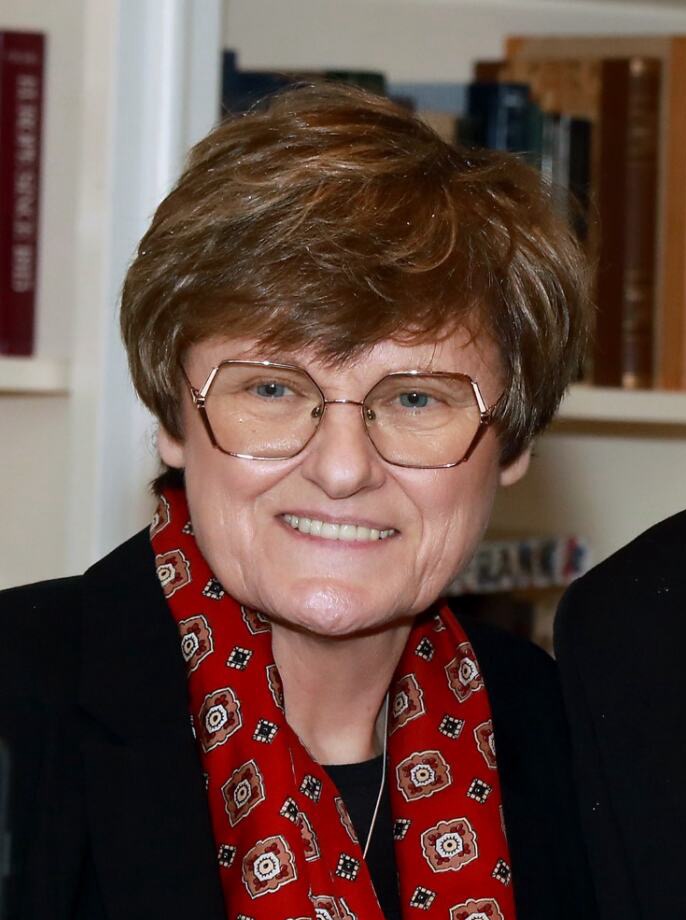
- Katalin Karikó at the U.S. Embassy Sweden Nobel reception — crop, US Embassy Sweden / Wikimedia Commons. 2023 reception; cropped by Ooligan in March 2024; CC BY 2.0.
- Original reception photograph, US Embassy Sweden, Flickr. Original photographer-account license verified September 27, 2026 as CC BY 2.0.
- Recent indexed author records, Europe PMC. Author/date search checked September 27; machine-readable record, not proof of absence of other work.