
RACH Profiles · Technology
Vint Cerf: A Life Connecting What Was Separate
From a teenage friendship and network-breaking experiments to TCP/IP, public institutions, space communications, and a new chapter in AI-agent accountability.
- Current role
- Advisory Council member, Known (formerly Innovation Labs). Former Google vice president and chief Internet evangelist.24, 25
- Focus
- Internetworking, open technical cooperation, access, and accountable digital infrastructure.
- Evidence boundary
- Historical implementations, personal recollections, policy arguments and current proposals are distinguished.
A career built between systems
As teenagers, Vint Cerf and Steve Crocker wanted access to a computer at UCLA badly enough to improvise when they found the building locked. In Crocker’s recollection to IEEE Spectrum, Cerf spotted an open upstairs window, climbed in with his friend’s assistance, and opened the door. It is a remembered episode, not a scene RACH witnessed. Long before the statesman in a three-piece suit, there was a young person impatient to reach a machine.1
The mature achievement was almost the reverse: finding ways for people to enter a shared system without improvising a separate entrance every time. Together with Robert Kahn and an international community of collaborators, Cerf helped establish the technical agreements that let different computer networks exchange information. The Internet became possible not because every system became identical, but because differences could be accommodated.
That question remains present in his work. In 2026, after leaving Google, he joined an advisory effort concerned with identifying who stands behind autonomous AI agents. His latest chapter is neither a second Internet already delivered nor a ceremonial retirement. It is another attempt to address the difficult space between independently operated systems.24, 25, 28
Why RACH recognizes Vint Cerf
RACH means Recognizing the Achievements and Contributions to Humanity. We recognize Cerf for a specific, collaborative contribution: helping design and develop the architecture and protocols that made internetworking practical, and helping sustain institutions through which that infrastructure could spread. His achievement is not ownership of the Internet, invention of every component, or authorship of the World Wide Web.4, 5, 6
The distinction matters because the public benefit is unusually distributed. A shared communication system can support a research collaboration, a family conversation, a small business, or access to a public document. Those possibilities require physical networks, software, operators, affordable service, and people able to use them. Cerf supplied important foundations; countless others made those foundations useful.
Recognition must also leave room for consequences the pioneers did not solve. Connectivity can carry fraud and surveillance as readily as knowledge. A successful protocol does not decide who has power, whose voice is heard, or whether personal information is protected. Cerf’s biography joins a demonstrated engineering contribution to an unfinished argument about responsibility. RACH’s admiration is for the work that can be documented, not a blanket endorsement of every employer, prediction, or commercial initiative associated with him.
Curiosity, friendship, and mathematics
Cerf was born in New Haven, Connecticut, on June 23, 1943. His formative computing experiences unfolded in California. He later recalled visiting a SAGE air-defense computer installation as a teenager, encountering machinery on a scale very different from a personal computer. Friendship with Crocker connected that fascination to opportunities to program. At Stanford, he studied mathematics before increasingly turning toward computing; he graduated in 1965.1, 2
It would be misleading to make this a childhood destiny story. In his 1990 oral history, Cerf described uncertainty about what he would ultimately do and a desire to work before returning to school. Mathematics, programming, employment, and further study were alternatives he tested rather than steps in a plan already complete. The later reputation can make those decisions look more inevitable than his own account suggests.2
Friendship is a more reliable thread than destiny. Crocker would appear again at UCLA, where the two became part of an emerging research community. This was not simply the networking of accomplished professionals after success. It was a relationship that helped open educational and technical opportunities before anyone could know what the resulting work would become. The Internet’s social history begins, in part, with people who could introduce one another to a useful question.
Knowing what was missing
At IBM in Los Angeles, Cerf worked on Quiktran, an interactive time-sharing service. His job brought him into the operating system itself: maintaining it, understanding its behavior, and proposing changes. In the Smithsonian interview, he remembered the satisfaction of having changes approved, but also the realization that practical experience had exposed gaps in his theoretical preparation.2
Returning to graduate school was not a retreat from useful work. It was a response to it. The distinction matters in a career often summarized as invention followed by acclaim. Some of its direction came from recognizing a limit. Being able to repair a program was not the same as understanding the broader principles governing the machine.
He entered UCLA’s graduate environment with that experience behind him. Gerald Estrin became his dissertation adviser; Leonard Kleinrock’s network research offered another setting for applying his skills. Cerf completed his doctorate in 1972 and joined Stanford’s computer science and electrical engineering faculty that year. The movement from industry to graduate work to teaching placed him at several points in the relationship between abstract design and working systems.3, 4
It also helps explain why a biography of computing cannot consist only of celebrated papers. An education happens through maintenance, uncertainty, and the decision to learn what a job has revealed one does not yet understand.
Learning by making a network fail
At UCLA, Cerf worked on the ARPANET’s measurement and host software. ARPANET was a research network, not yet the global network of networks familiar today. Testing meant generating traffic, measuring responses, and discovering what happened when assumptions stopped holding. In his IEEE oral history, Cerf recalled working closely with Kahn, then at Bolt Beranek and Newman, to provoke failures that required changes in the network’s operation.3
The partnership began with something less photogenic than a breakthrough: finding ways to make a system stop working. That corrects the familiar image of invention as a single inspired sketch. A network that succeeds under friendly conditions can still fail when traffic becomes awkward, equipment behaves differently, or too many requests arrive together. Reliability requires learning from those conditions before users discover them.
Crocker, Jon Postel, Robert Braden, Kleinrock, Estrin, and the BBN engineering community belong in this background. They were not merely an audience for Cerf’s ideas. The environment gave him experience with protocols, operating systems, measurement, and collaboration across sites. By the time Kahn approached him about linking unlike networks, Cerf had encountered communication problems from the inside of a working host computer.3, 5
The problem was difference
Kahn’s internetworking effort confronted a practical difficulty: packet radio, satellite communication, and the ARPANET did not behave alike. A method suited to one network could not simply be assumed to work on another. In 1973, he and Cerf began developing a way for computers to communicate across those boundaries. Their approach was published in 1974, after discussion within an international research community.5
The essential move was to avoid demanding that every underlying network be rebuilt around the same internal design. Interconnection would depend on common rules at the boundaries and in the communicating computers. In ordinary language, an agreement about exchanging a message need not dictate every detail of the machinery carrying it. That separation allowed different networks to become parts of a larger system.
It was not an idea without predecessors or competitors. The Computer History Museum places France’s CYCLADES, Britain’s National Physical Laboratory network, University College London, and Xerox PARC in the story. Louis Pouzin’s work and other European experiments influenced the developing approach. Cerf and Kahn’s importance becomes clearer, not smaller, inside that exchange: they helped turn a shared research problem into an architecture that could be implemented, revised, and adopted.6
The names on the specification
The December 1974 specification carries three names: Vinton Cerf, Yogen Dalal, and Carl Sunshine. RFC 675 described an Internet Transmission Control Program. Its historical language matters: the design was still evolving, and it is not an unchanged description of every modern Internet protocol. The document contains the detailed machinery that a broad architectural idea needs before independent programmers can build compatible implementations.7
A specification is an unusual kind of collaborative promise. It must be precise enough that people working separately can agree about what a message means and what to do when something goes wrong. Sequence numbers, acknowledgments, connection handling, and retransmission are not glamorous biography material, but they are part of the work behind a message arriving intact.7
Public documentation changes who can participate. A design others can examine is open to implementation and criticism beyond its original team. The later Internet did not emerge simply because one group wrote persuasive prose. Other groups had to test that prose against software, expose ambiguities, and push revisions. Credit to Dalal and Sunshine is more than a courtesy: it makes visible the labor between the initial proposal and a usable technical agreement.
The van and the people outside the frame
The November 1977 demonstration is often remembered through an image of a van carrying packet-radio equipment around the San Francisco Bay Area. The important result was communication across three kinds of network. Radio, satellite, and the ARPANET became parts of a working experiment involving participants on both sides of the Atlantic.8
The museum’s account makes the workforce visible. Virginia Strazisar Travers wrote gateway software and helped install it at the necessary sites. Jim Mathis and Dave Retz worked on the client; Ray Tomlinson and Bill Plummer on the server; Peter Kirstein and Pål Spilling contributed to satellite networking. The packet-radio community included Radia Perlman, Barbara Denny, and many others. Cerf and Kahn supplied central architectural leadership, not every piece of the apparatus.8
For a biography, the van is a useful test of perspective. A photograph might isolate a vehicle; the achievement was a coordinated system extending beyond it. Nor did the successful experiment instantly produce a mature public Internet. It showed an important approach could work. Operational adoption, commercial access, and institutions for continued development remained separate tasks. The distance between demonstration and durable public infrastructure is one of the defining distances in Cerf’s career.
From a research result to a working obligation
Cerf moved from Stanford to DARPA in 1976, taking on a role in the continued development of Internet technology. The program needed more than an attractive architecture: computers with different operating systems had to support it, and existing users needed a path from older protocols. The record therefore includes management and coordination alongside design.4, 10
Jon Postel’s November 1981 transition plan set January 1, 1983 as the target for moving the ARPANET from NCP to IP/TCP. It assigned implementation work to host organizations and addressed applications including remote access, file transfer, and mail. It provided relay services for the period when old and new systems coexisted. This was deliberate transition work, not a magical overnight replacement.9
That makes the familiar birthday of the Internet less tidy and more instructive. Standards become useful when organizations do the work required to support them. Compatibility has to survive a mixed environment, not merely a clean laboratory test. Cerf’s legacy rests partly on participating in that less visible stage, while Postel and the host administrators deserve credit for the operational detail through which adoption could happen.
There is a lesson here for any account of technical change: a successful new method does not erase the obligations to people already relying on the old one.
The commercial chapter
In the 1980s Cerf took connection into commercial communications. At MCI, he led engineering work on MCI Mail, then moved to the Corporation for National Research Initiatives, where his work included information infrastructure and digital libraries. He later returned to MCI. These changes placed him in the evolving relationship between research infrastructure and commercial services.10
The Internet Society’s participant history describes commercial expansion as a broader transition involving government-funded networks, private providers, and changing infrastructure. Cerf’s movement between those environments is part of that history, not a sufficient explanation for the entire transformation. Public investment and private development were intertwined rather than mutually exclusive origin stories.5
Sending a message between people on different services now seems unremarkable. It is worth pausing over the institutional change such communication requires. A provider must support interaction with systems it does not control, sometimes operated by a competitor. The value to the sender comes precisely from crossing that boundary. Interoperability is therefore a business decision as well as an engineering property.
The commercial Internet had many builders: service providers, equipment manufacturers, developers, investors, public institutions, and customers. No defensible biography can assign that transition to one executive. Cerf’s role was important because he worked at several interfaces through which it happened. Those positions also placed him inside commercial incentives, a context readers should retain when considering his later public advocacy.
An Internet needs institutions
The Internet Society formally began in 1992, following an announcement the previous year associated with Cerf, Kahn, and Lyman Chapin. Cerf became its founding president. Its history records standards activity and training: an early developing-country workshop grew into a program teaching people to build and operate networks. Participants were future operators and local experts, not passive recipients of an American invention.11
Cerf later chaired ICANN’s board from 2000 to 2007. ICANN coordinates important naming and numbering arrangements; that differs from controlling everything people do online. Its public farewell emphasized his work with a consensus-oriented community. This tribute is an institutional assessment, not independent proof that every decision during his chairmanship was correct.12, 13
These roles expose another kind of engineering problem. A technically coherent system still requires people with different interests to maintain common arrangements. Disagreement cannot always be resolved with a faster processor or a cleaner algorithm. Someone must explain choices, listen to objections, and keep a process functioning when participants share neither an employer nor a government.
Institutions are part of the achievement, but also a limit on the heroic version of it. They must outlast individual participants. The strongest evidence of useful leadership is not permanent dependence on the leader; it is a community able to continue after the chair changes.
The invention he did not make
The Internet and the World Wide Web are often folded into one story. CERN’s history supplies a necessary separation: Tim Berners-Lee invented the Web in 1989 while working there. The Web made linked information accessible through an application built on existing network infrastructure. Cerf’s work helped provide that infrastructure, but it does not make him the inventor of the Web.14
This is more than correcting names. It explains a consequence of general-purpose infrastructure: designers of one layer do not need to anticipate every application later built on it. Other people can discover a use that changes the significance of what came before. Part of Cerf’s achievement was making room for inventions that were not his.
In a retrospective interview, he acknowledged that he had not anticipated the scale of content the Web would bring or the resulting need for search engines. The admission is valuable precisely because it comes from someone with extraordinary technical experience. Building a foundation and predicting its entire future are different abilities. His career supplies strong evidence of the former without requiring us to grant him the latter.16
Access and memory
Cerf joined Google in 2005 and became widely known as its chief Internet evangelist. In a 2018 company interview, he recalled proposing the title “archduke” before accepting the more descriptive one. The humor accompanied a serious concern: accessibility. Having used hearing aids since adolescence, he connected his interest in accessible products to lived experience, while also crediting the company’s accessibility team.15
This does not establish the accessibility of every Google product or turn one person’s experience into a universal account of disability. It shows why access cannot mean only that a cable reaches a building. A person must be able to perceive, operate, and understand the service at the other end. Infrastructure that exists but cannot be used leaves part of its promise unfulfilled.
Another concern was digital preservation. Reporting in 2015 described his warning that old files might survive while the software needed to interpret them disappeared. His later discussion of Digital Vellum similarly focused on preserving meaning rather than merely saving bits.19, 15
For a man associated with moving information across space, this adds a different boundary: time. A document delivered successfully today can still become unreadable to a future researcher. Connection and preservation are related public goods, but neither happens automatically. They require continuing decisions about formats, tools, institutions, and who will maintain them.
Security, privacy, and disagreement
Cerf’s retrospective assessment of TCP/IP includes the early design’s limited address space and insufficient attention to security. He described the difficulty of distributing cryptographic keys in the original setting and his later wish for stronger end-to-end protection. These are his judgments about historical engineering constraints, not evidence that every modern security failure can be traced to one decision.16
His public thinking has faced substantive disagreement. In 2013, privacy scholar Omer Tene challenged his characterization of privacy as a possible historical anomaly. Tene argued that privacy has deep roots and should not be dismissed as a temporary byproduct of industrial society. Contemporary reporting also noted that Cerf’s broader remarks addressed the difficulty of securing connected devices without requiring consumers to become experts.17, 18
Those positions should not be collapsed into a claim that Cerf opposed all privacy protection. Nor should authority as an Internet pioneer make historical or political judgments immune to criticism. The dispute illustrates a recurring tension: describing how technology changes behavior differs from deciding what rights people ought to retain.
RACH’s assessment is that an account of contribution must preserve that distinction. A network can become indispensable while remaining unsafe in important ways. A pioneer can deserve recognition and still be challenged on power, consent, and protection. Public benefit requires institutions and safeguards beyond a protocol.
When familiar assumptions break
Space communication presents another boundary. Long delays and interrupted links can make assumptions from terrestrial networking impractical. Cerf coauthored the 2007 Delay-Tolerant Networking Architecture with Scott Burleigh, Adrian Hooke, Leigh Torgerson, Robert Durst, Keith Scott, Kevin Fall, and Howard Weiss. It described a message-oriented overlay using storage to cope with disconnection. The document was informational research, not itself an Internet Standard.20
NASA tested elements of disruption-tolerant networking on the EPOXI spacecraft in October 2008. Its present overview describes continuing integration into communications services and a phased ambition for a Solar System Internet. Tested technology and operational integration are evidence of progress; planned lunar and Mars capabilities remain plans until delivered.21, 22
The intellectual connection to Cerf’s earlier work is clear, but differences matter. A delayed message cannot be made instantaneous by a better slogan. Systems must acknowledge the environment in which they operate. The point is to organize communication around real constraints rather than assume they will disappear.
This work again resists a solitary-inventor narrative. Authors, NASA engineers, mission teams, standards participants, and operators contribute different pieces. Cerf’s role belongs to a continuing program, not a claim that he has connected every planet. The project’s unfinished nature is part of the story, not an embarrassment to edit away.
What he is working on now — October 3, 2026
Cerf’s Google role is historical. His July 2026 appointment to Innovation Labs’ advisory council was followed by a September 22 announcement that the initiative had become Known, an independent company spun out of Identity Digital. The newer announcement still names him as an adviser. This is the current role verified here; older biographies continuing to call him a Google vice president should not override dated evidence.24, 25, 28
Known is developing DNSid, an approach to linking AI agents with accountable organizations across system boundaries. Its September announcement identifies Allie Kline as interim chief executive and other advisers including David Conrad, Paul Sagan, Teresa Shea, Corey Thomas, Charles Ryan, and Vinh Nguyen. Identity Digital remains a strategic investor and founding partner. This is a commercial initiative, not a disinterested public standards authority.25
The underlying record checked for this article is Naveed Ihsanullah’s individual Internet-Draft, version 01, dated June 29, 2026. Intended standards-track status is an aspiration within a process, not proof of IETF adoption. Cerf is an adviser, not the draft’s named author. Independent July coverage described the effort but does not establish reduced real-world harm.26, 27
Identification can help a recipient ask who is responsible for an agent. It cannot alone guarantee that an output is true, an action authorized, or a remedy available when damage occurs. Those are separate questions for deployment evidence, governance, and enforcement. The biographical interest lies in Cerf returning to cooperation between independent systems; the public value of this proposal remains to be demonstrated.
A shared achievement, still incomplete
The International Telecommunication Union estimated that six billion people used the Internet in 2025, while 2.2 billion remained offline. These are dated global estimates, not Cerf’s personal impact score or a new October 2026 count. They show both the reach of the infrastructure and the scale of exclusion that survives its success.23
They make the meaning of contribution harder and more useful. Cerf did not install every network, teach every user, or build every application. He helped create arrangements that made others’ work possible. Kahn, Crocker, Postel, Dalal, Sunshine, Travers, Kirstein, Pouzin, and the engineers and communities around them belong inside that recognition.
A life story built around connection must retain the boundaries never fully crossed: people still excluded, information that cannot be trusted, insecure systems, and disagreements about rights that technical ingenuity cannot settle. The lesson is not that connection automatically improves the world. Useful common infrastructure expands what people can do together, while maintaining its human value requires work long after an invention is celebrated.
That is why RACH recognizes Vint Cerf: not as the owner of a finished miracle, but as a consequential participant in a shared, revisable undertaking. His life runs from learning how computers behave to asking how increasingly independent systems should behave toward one another. The work has changed form. The need for careful cooperation has not.
Methodology, disclosure, and corrections
This independent public-record biography was researched, written, and internally checked with AI assistance for RACH. No interview, outreach, subject approval, or separate human editorial review is claimed. Recollections are attributed; interpretive connections are RACH’s. No scenes, dialogue, emotions, or private motives have been reconstructed.
Reporting cutoff: October 3, 2026. Institutional biographies, company announcements, the current IETF draft record, technical histories, public interviews and NASA records were checked. Older Google titles remain online and are treated as historical. Google’s old research bibliography returned an error, Known’s website was not accessible through the research reader, and a complete authentic social feed and comprehensive current publication list could not be audited. No exhaustive review of unpublished work or financial interests is claimed. The September company announcement is the dated primary source for the current advisory role.
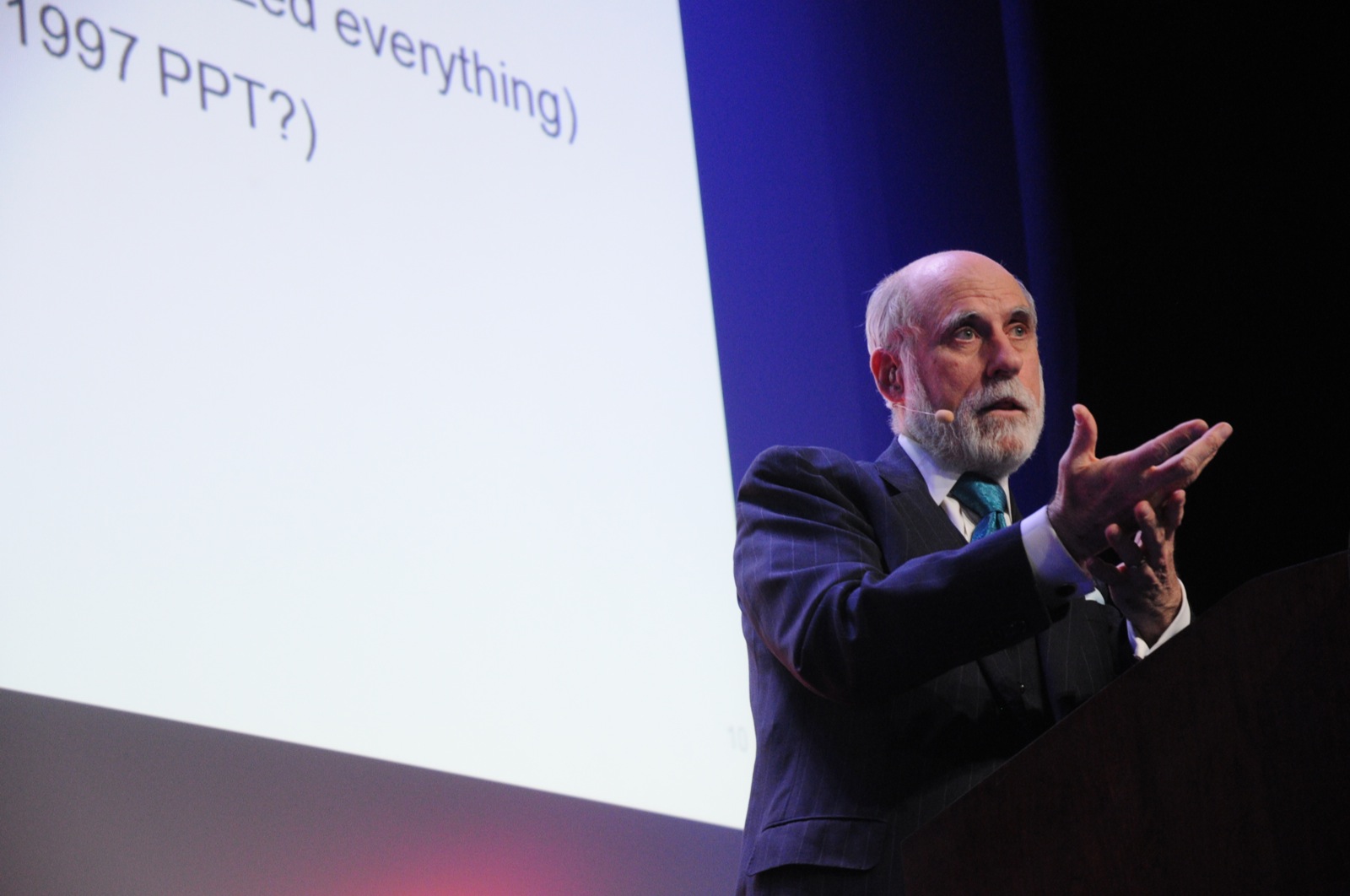
The original Flickr page was checked directly for CC BY 2.0, with Commons photographer metadata corroborating provenance. The image license does not license this biography. Recognition is not sponsorship, partnership, or endorsement by the subject, institutions, company, or photographer. No payment or endorsement was arranged. Commercial affiliations are context, not recommendations.
Send documented corrections to info@rachorg.org. Material revisions will be dated. Narrative word count excludes navigation, citations, methodology, and source records.
Sources
- Meet Mr. Internet: Vint Cerf, IEEE Spectrum / Tekla S. Perry. 2023 interview profile; historical titles.
- Vinton Cerf oral history, Smithsonian / Judy O’Neill. April 24, 1990 interview.
- Oral History: Vinton Cerf, IEEE History Center / David Hochfelder. May 17, 1999; factual paraphrase, no direct quotation.
- Vint Cerf, Stanford Engineering. Historical education and faculty record; Google title outdated.
- A Brief History of the Internet, Leiner, Cerf, Clark, Kahn, Kleinrock, Lynch, Postel, Roberts and Wolff / Internet Society. 1997 participant history.
- Inventing the Internet, Computer History Museum. International precedents and implementations.
- RFC 675, Cerf, Dalal and Sunshine / RFC Editor. December 1974 specification; historical, not the present TCP standard.
- Born in a Van, Marc Weber / Computer History Museum. November 22, 2017 retrospective and participant credits.
- RFC 801: NCP/TCP Transition Plan, Jon Postel / RFC Editor. November 1981 implementation plan.
- Official Biography: Vint Cerf, Internet Hall of Fame. Historical employment; Google present-tense title superseded by 2026 records.
- Our History, Internet Society. Institutional founding and training history.
- ICANN Community Thanks Vint Cerf, ICANN. October 31, 2007 institutional assessment.
- Vinton G. Cerf, ICANN. Historical board-chair record, 2000–2007.
- The birth of the Web, CERN. Credits Tim Berners-Lee; Web distinguished from Internet.
- Meet the man who helped build the Internet, Elisabeth Leoni / Google. April 19, 2018 interview; accessibility and preservation interests.
- Vint Cerf on 3 Mistakes He Made in TCP/IP, Tekla S. Perry / IEEE Spectrum. 2023 retrospective interview.
- Vint Cerf is Wrong. Privacy Is Not An Anomaly, Omer Tene / Stanford Center for Internet and Society. November 22, 2013; attributed criticism of a public position.
- Do Smart Devices Need Regulation?, Amadou Diallo / Forbes. November 23, 2013 contemporary reporting.
- Why the Father of the Internet Thinks You Should Print Out Your Photos, TIME. February 14, 2015 preservation warning.
- RFC 4838: Delay-Tolerant Networking Architecture, Cerf, Burleigh, Hooke, Torgerson, Durst, Scott, Fall and Weiss. April 2007 informational research architecture, not an Internet Standard.
- DTN tested on spacecraft, NASA. Historical October 2008 EPOXI experiment.
- Delay/Disruption Tolerant Networking, NASA. Checked October 3, 2026; demonstrated work and future roadmap separated.
- Facts and Figures 2025 announcement, International Telecommunication Union. November 17, 2025 estimates, not October 2026 measurements.
- Internet Architect Vint Cerf Joins Innovation Labs, Identity Digital / GlobeNewswire. July 15, 2026 primary appointment announcement.
- Identity Digital Spins Out Known, Known / GlobeNewswire. September 22, 2026 current advisory council and structure.
- DNS-Anchored Durable Identity for AI Agents, Naveed Ihsanullah / IETF Datatracker. Version 01, June 29, 2026 individual Internet-Draft; not adopted standard.
- Agentic ID? Vint Cerf Joins Project, John Koetsier / Forbes. July 17, 2026 coverage; goals not validated outcomes.
- The Father of the Internet is finally retiring, TechCrunch. June 30, 2026; used narrowly for Google departure.
- Vint Cerf — original photograph, Ivo Näpflin / Lift Conference. February 27, 2009; original license directly checked October 3, 2026.
- Vint Cerf (3330995755).jpg, Wikimedia Commons. Photographer metadata corroborated against original Flickr license.
- Attribution 2.0 Generic, Creative Commons. Portrait license, not article license or endorsement.