

RACH Profiles · Artificial Intelligence
Yann LeCun: A Life Spent Teaching Machines to See
From homemade synthesizers and handwritten digits to world models: a life of building learning systems, sustaining collaborators, and testing convictions against evidence.
- Focus
- Visual learning, representations, world models and research communities.
- Evidence boundary
- Operational uses, research experiments, personal recollections and forecasts are distinguished.
Why RACH recognizes Yann LeCun
Yann LeCun’s most durable contribution began with a modest-looking problem: reading marks made by people. A handwritten digit is easy for a person to recognize and surprisingly difficult to describe as an exhaustive set of instructions. LeCun helped show that a machine could learn useful visual representations instead. The consequences reached beyond handwriting into the foundations of modern computer vision.1, 6
RACH—Recognizing the Achievements and Contributions to Humanity—recognizes that enabling work, his contributions to shared research resources, and his role in sustaining a scientific community. The recognition is not a claim that he invented artificial intelligence alone, that every application of computer vision is beneficial, or that his newest company has already delivered its promised future.
His biography is a story of building: circuits, learning systems, laboratories, and places where researchers could exchange ideas. It is also a story about the limits of conviction. Persistence helped an unfashionable approach become useful. Whether his current convictions about intelligence and safety will prove equally productive remains an open question, to be answered by evidence rather than reputation.
Before the laboratory, the synthesizer
LeCun grew up outside Paris in a family where making things was familiar. Carnegie Corporation’s 2025 account describes his father as a mechanical engineer and inventor. The young LeCun built synthesizers for his high-school band, then became interested in programming. He bought a primitive single-board computer and taught himself to use it.2
That sequence gives the later career a less abstract beginning than the phrase “AI pioneer” suggests. Electronics had an audible purpose: making music. Programming offered another way to construct something that behaved according to a design. His interests expanded toward the origins of intelligence, but they did not require abandoning the satisfaction of getting a device to work.
In the same Carnegie account, he recalled finding a small community pursuing related questions, particularly in North America. The story was not simply one of solitary insight. A young researcher had to discover people with whom an unusual ambition could become a serious line of work. The eventual move abroad connected an intellectual search to the practical geography of laboratories and jobs.
A mentor outside mathematics
In his Heidelberg Laureate Forum oral history, LeCun singled out a music teacher as an important mentor. He recalled joining a group playing Renaissance and Baroque music at about fourteen, and said that performing helped him become more comfortable appearing before an audience. This is his retrospective account, not a scene reconstructed from school records.3
It is a revealing detail for someone whose later career would include lectures and forceful public arguments. Expertise and the ability to communicate it are different skills. A classroom outside the expected scientific subjects could contribute to the second without being credited with producing the first.
The recollection also prevents the childhood from becoming a checklist of signs that a famous scientist was destined to emerge. Music mattered as an activity in its own right. Its later usefulness does not need to have been its original purpose. The person who would spend decades defending learning machines was also learning what it meant to stand in front of other people.
Engineering, then a question about learning
LeCun trained at ESIEE in Paris and pursued doctoral study at Université Pierre-et-Marie-Curie, now part of Sorbonne Université. He completed his PhD in 1987. A postdoctoral period in Toronto brought him into Geoffrey Hinton’s research environment before he joined Bell Labs in 1988.4, 5, 1
Engineering and research offered complementary demands. Building a working system exposed the inadequacy of an elegant idea that could not run; studying learning raised questions that no fixed circuit alone could answer. His subsequent work occupied the space between those demands, combining mathematical methods with experiments and the software needed to conduct them.
Toronto also made a lasting professional relationship possible. Hinton would later share the Turing Award with LeCun and Yoshua Bengio, but their connection began before that retrospective grouping had a name. The academic move mattered because it placed him among people already testing related ideas. The international network was a working environment before it became part of a celebrated history.
The collaborator who brought an interpreter
LeCun’s oral history includes a vivid account of meeting Léon Bottou near the end of his doctorate. Both used Commodore Amiga computers. LeCun wanted an interpreter for a neural-network simulator; he recalled Bottou returning with an implementation within weeks. The software became part of their experimental toolkit.3
It is an unusually concrete origin for a long collaboration. The connection was not only agreement about a theory. It involved producing a tool that let them try things. Later papers would put Bottou’s name alongside LeCun’s on document recognition and image compression, making the collaboration visible in the published record rather than only in a founder’s recollection.9, 11
The anecdote helps explain why software belongs inside the scientific story. An experiment that is easy to propose can be difficult to execute without the right machinery. In computational research, the machinery may be code. Building it can alter which questions a team can ask, how quickly it can test them, and who can participate in the work.
A small image, a consequential experiment
The 1989 paper on handwritten ZIP-code digits named LeCun, Bernhard Boser, John Denker, Donnie Henderson, Richard Howard, Wayne Hubbard, and Lawrence Jackel. Their system learned the recognition process from a normalized image to a classification. Its design incorporated constraints suited to images instead of treating every possible connection as equally useful.6
That combination was important. The researchers did not abandon engineering judgment and let data solve everything. They used knowledge about the task to shape the machine, then used training to determine how it should respond. Learning and design were partners.
A digit also provided a manageable test. The desired output was limited and the input could be standardized, allowing methods to be compared. Success did not show that a machine understood language, society, or the physical world. It established something narrower and valuable: a trainable system could solve a real recognition problem. That modest scale was a strength, because the claim could be tested without relying on a distant promise about general intelligence.
The invention had ancestors
LeCun’s contribution is easier to understand when its predecessors remain visible. Kunihiko Fukushima’s 1980 neocognitron paper described a layered pattern-recognition model intended to tolerate shifts in position. David Rumelhart, Hinton, and Ronald Williams published influential work on learning internal representations through backpropagation in 1986.7, 8
These were not identical systems. A model architecture specifies how information moves through a network; a learning procedure determines how its adjustable components change. Combining suitable architectural constraints with effective training was central to the practical advances associated with LeCun and his collaborators.
The difference matters historically. Calling someone the inventor of a field compresses distinct problems, solutions, and contributors into one ownership claim. LeCun deserves credit for particular conceptual and engineering advances, not for erasing the work that made them possible. Conversely, identifying predecessors does not make his results inevitable. A promising idea still had to become a system that could be trained, measured, and improved. That work, much of it collective, is where an intellectual lineage became a usable technology.
When recognition left the benchmark
The document-recognition program eventually moved beyond isolated experimental digits. LeCun, Bottou, Bengio, and Patrick Haffner’s 1998 paper brought together convolutional networks and broader trainable systems for document recognition. ACM’s account specifically credits Bengio’s sequence-model work within the AT&T/NCR check-reading system. Independent reporting in IEEE Spectrum confirms that the approach entered bank-check processing.9, 1, 18
This is a firmer public-impact claim than a prediction about future automation: a method was used in an operational task. Even here, a biography should not invent a total for money saved, jobs changed, or people helped. The sources establish deployment, not a complete social accounting.
Nor was a trained network the whole product. Document processing requires handling imperfect inputs, interpreting sequences, detecting uncertainty, and fitting into an institution’s workflow. The achievement therefore belongs to researchers, engineers, and implementation teams, not only to the person whose name became most recognizable. For LeCun, the practical systems provided an answer to skepticism that abstract enthusiasm could not: the approach had uses outside the laboratory.
A common test other people could use
MNIST became another part of that legacy. Its primary description credits LeCun, Corinna Cortes, and Christopher Burges and specifies 60,000 training examples and 10,000 test examples of handwritten digits. The separation allows a method to learn from one collection and be evaluated against examples held aside from training.10
A shared dataset changes a scientific conversation. Instead of comparing impressions from unrelated demonstrations, researchers can examine results on a common task. Students can also work with a problem whose inputs and labels are manageable enough to inspect. The resource is not the achievement of one model; it supports comparisons among many models, including those developed by other people.
There is a boundary to that usefulness. High performance on a controlled digit dataset does not establish reliability in a hospital, on a road, or across an unfamiliar population. The contribution is a common experimental starting point, not a universal examination for intelligence. Recognizing it means valuing research infrastructure while resisting the temptation to turn a convenient score into a measure of every capability that matters.
Making a page easier to share
Not all of LeCun’s important work was about recognizing an object. The 1998 DjVu paper, authored with Bottou, Haffner, Paul Howard, Patrice Simard, and Bengio, addressed the transmission of scanned color documents over limited connections. Its approach separated text and drawings from smoother backgrounds and pictures, allowing different parts of a page to be compressed differently.11
The practical motivation was straightforward: a scan could preserve appearance yet remain expensive to store or slow to retrieve. Treating every part of the page in the same way wasted an opportunity. Text needed crisp detail; other regions could tolerate a different representation.
The paper reported compact files and a browser decoder, providing an engineering contribution to sharing documents. That does not mean its authors alone digitized libraries or made every historical collection accessible. Scanning, cataloging, preservation, and institutional decisions remained other people’s work. It does show a less famous side of LeCun’s career: applying a close understanding of information to remove a practical obstacle between a document and its reader.
A career does not advance in one direction
By the late 1990s and early 2000s, neural networks were no longer the fashionable center of machine learning. IEEE Spectrum’s historical account identifies LeCun among the researchers who continued pursuing them. Persistence should not be confused with having every answer; methods still needed better results, useful tools, and reasons for others to adopt them.18
His institutional path changed too. NEC Laboratories records his fellowship at its Princeton research institute in 2002–2003. In 2003 he joined NYU, where he could develop a research program within a university rather than remain solely inside an industrial laboratory.12, 5
This period complicates the familiar biography of a visionary vindicated by an award. The relevant question was not merely whether he believed in neural networks. It was how a line of work could continue when its standing weakened. Jobs, collaborators, students, and support for experiments supplied the conditions under which conviction could remain productive. Without those conditions, being certain about a direction would not itself have produced a scientific result.
The laboratory behind the name
NYU’s historical laboratory pages make that collective work concrete. Projects in object recognition involved Koray Kavukcuoglu, Kevin Jarrett, Y-Lan Boureau, Rob Fergus, and LeCun. Work on sparse representations also named Karol Gregor and Arthur Szlam. Other projects explored autonomous navigation and learning from video.13
The shared question was how a machine could acquire useful features instead of relying entirely on features designed by hand. Different projects approached it through different data and objectives. The laboratory was not a single idea repeatedly demonstrated; it was a setting in which related ideas could be compared, modified, and sometimes abandoned.
Those archived pages also serve as a check on celebrity. Students and colleagues did not merely assist an already finished discovery. They were participants in developing methods and testing their limits. A professor’s contribution includes helping sustain that environment, but the resulting papers retain their own authorship. RACH’s recognition follows that distinction: institutional leadership matters, and so does the work of the people whose careers cannot be reduced to a famous mentor’s biography.
The breakthrough that was not his paper
A major turning point for convolutional networks came with the 2012 work of Alex Krizhevsky, Ilya Sutskever, and Hinton. Their ImageNet paper combined a large network with an efficient graphics-processor implementation and methods to improve training. LeCun was not one of its authors.14
Including that absence is important. A biography can acknowledge that later work built on a direction he helped establish without transferring the later achievement to him. The team that implemented and evaluated the system deserves its own credit, as do the people who made the underlying data and computing resources available.
The result changed the context in which older work was understood. Convolutional networks were no longer only associated with relatively constrained recognition tasks. They could perform strongly on a much larger visual-classification problem. This was not a machine acquiring unrestricted understanding, but it was powerful evidence that a once-marginal approach could scale. LeCun’s long commitment gained new relevance through an advance made by other researchers—a reminder that scientific vindication is often delivered collaboratively, not personally.
Creating room for a field
As representation learning gained momentum, it needed places to meet. The first International Conference on Learning Representations was scheduled for May 2–4, 2013, in Scottsdale, Arizona. Its announcement named Bengio and LeCun as general chairs and described a gap: researchers interested in learning useful representations lacked a common venue.15
That is a different kind of contribution from a new algorithm. A conference creates opportunities to compare approaches, criticize methods, form collaborations, and give less established researchers an audience. Its value depends on the participants and the quality of the exchange, not only on the prestige of its founders.
LeCun also became the founding director of NYU’s Center for Data Science. These roles place institution-building alongside his technical work.23 A field needs more than successful demonstrations. It needs settings in which the next generation can learn what was done, ask different questions, and challenge the assumptions it inherits. Helping create those settings is a contribution to a community, not ownership of what everyone in it subsequently produces.
Inside a very large company
In December 2013, WIRED reported Facebook’s recruitment of LeCun to lead a new AI research laboratory. He continued his NYU duties. The appointment moved his work into a company whose products could turn a research technique into a large-scale feature or system.16
NYU’s current retrospective distinguishes his founding FAIR directorship from his later period as Meta’s chief AI scientist. These are past roles, not his October 2026 job title.5 The distinction is necessary because older institutional biographies still circulate online with outdated descriptions.
Industrial scale created both opportunity and responsibility. Research can benefit from substantial computing resources and specialized engineering teams. Its applications also raise questions about whose data are used, who is affected by automated decisions, and how much power concentrates inside a platform. This profile does not attribute every Meta product or controversy to LeCun. It does not treat the size of an employer as proof of humanitarian benefit either. His scientific record and the consequences of particular deployments require separate examination.
Explaining what deep learning changed
LeCun, Bengio, and Hinton’s 2015 Nature review explained deep learning in terms of representations learned through multiple processing layers. The method could discover useful structure in data rather than depend entirely on a person to specify the features that mattered. The review described advances across visual recognition, speech, and other domains.17
For a reader outside computing, a representation is a way of making information usable for a task. A picture starts as measurements of light. A recognition system needs patterns that help distinguish one category from another. Learning several stages of transformation can make those patterns easier to use at the final decision.
The practical change was not the elimination of human judgment. Researchers still chose data, architectures, objectives, evaluations, and deployment conditions. The review’s importance was to describe a powerful way of distributing the learning across a system. Its authors were interpreting a field larger than their own laboratories, with support acknowledged from public research agencies and CIFAR. The public story is therefore one of a method and a research ecosystem, not a machine teaching itself without people.
An award is not a safety certificate
The 2018 Turing Award, announced in 2019, recognized LeCun, Bengio, and Hinton for the foundations and engineering of deep learning. It was a milestone in recognition of their work, not an assessment of every future use of that work.1
A contemporaneous Nature Machine Intelligence editorial made a useful distinction. Deep learning was becoming important in science as well as consumer technology, but high-stakes applications required attention to rights, discrimination, and interpretability. The editorial discussed the argument that an interpretable model may be preferable to a difficult-to-explain one when decisions affect people’s lives.19
This is a substantive limitation, not a ceremonial caveat. A model can perform well on an aggregate measure while failing people in ways the measure conceals. Recognition of an enabling technique should not remove scrutiny from the systems built with it. Nor should prospective applications in medicine or clean energy be counted as completed human benefits merely because they are promising. The quality of a research contribution and the justification for a particular deployment are related questions, but they are not the same question.
Three laureates, no single view of the future
LeCun has argued that current language models lack important ingredients of human-level intelligence and that public fears of uncontrollable superintelligence are overstated. In his March 2024 conversation with Lex Fridman, he emphasized learning about the physical world, planning, and the value of broadly available AI systems. These are his positions, not conclusions established by his earlier recognition work.20
Bengio and Hinton have taken a different position. With colleagues including Dawn Song, Stuart Russell, and Gillian Hadfield, they argued in a 2024 Science policy paper for stronger technical and governance preparation for extreme risks. Their concerns included misuse and loss of control over increasingly autonomous systems.21
The disagreement cannot be resolved by counting awards. Predictions about future capabilities are uncertain, and policy decisions must consider both evidence and the consequences of being wrong. LeCun’s skepticism deserves to be described accurately; so do the reasons other experienced researchers disagree. RACH recognizes his demonstrated contributions without asking readers to adopt his forecast, dismiss his critics, or assume that confidence substitutes for a safety case.
Open to whom, and on what terms?
LeCun’s advocacy of open AI reflects a concern about concentrating powerful tools in a small number of companies. In the Fridman interview, he connected wider access with a diversity of applications and viewpoints. That is an argument about how technology should be governed, not simply a description of a file available for download.20
The terminology deserves scrutiny. The Open Source Initiative’s report on its AI definition distinguished systems that satisfied its criteria from those that did not; Llama 2 was among the latter. Its framework considered the ability to use, study, modify, and share a system, including access to relevant components.22
Releasing model weights can be valuable without settling every question about openness. Training-data information, licensing restrictions, reproducibility, and the practical resources needed to use a system all matter. The disagreement is not evidence that LeCun’s contributions lack value. It is a reason to examine the terms behind a favorable label. A public biography should neither turn “open” into automatic praise nor confuse a company’s description with an uncontested standard.
A new organization, an old question
By October 6, 2026, LeCun is executive chairman of Advanced Machine Intelligence, or AMI Labs, and the Jacob T. Schwartz Professor at NYU. Tandon’s May announcement dates his AMI appointment to January; NYU’s September seminar record confirms both current roles.23, 5
Le Monde reported the company’s large financing round in March and identified Alexandre LeBrun as chief executive. The investment supplied resources, not proof that the research strategy would work.25 AMI’s own site names a wider team, including Laurent Solly, Michael Rabbat, Min Lin, Pascale Fung, and Saining Xie, alongside LeBrun and LeCun.24
The company proposes systems that learn representations of the physical world and use them to anticipate consequences and plan. It lists industrial automation, robotics, healthcare, and other prospective applications. Those remain aims in this profile, not verified customer outcomes. LeCun’s executive role also creates a commercial interest in the success of this approach. That context belongs beside his arguments, without implying that a financial interest either proves or disproves a scientific claim.
Predicting something other than every pixel
The intellectual direction predates AMI. The 2023 I-JEPA paper, led by Mahmoud Assran with Quentin Duval, Ishan Misra, Piotr Bojanowski, Pascal Vincent, Michael Rabbat, LeCun, and Nicolas Ballas, explored learning image representations by predicting representations of hidden regions from visible context.26
The distinction is subtle but consequential. A system need not reproduce every visual detail to learn something useful about an image. Predicting in a learned representation space can direct training toward information that matters for downstream tasks. The paper evaluated the approach experimentally, including classification, object counting, and depth-related tasks.
This was not evidence that a machine had acquired human common sense. It was a method for learning useful features without the same kind of manually supplied category supervision. For LeCun, it connected a long-standing interest in representations with a more specific experimental program. For the biography, the author list is indispensable: an architectural vision became evidence through work performed by a team, with each paper answering a narrower question than the surrounding debate about intelligence.
From still images to actions
The 2025 V-JEPA 2 paper extended the program into video and action-conditioned prediction. Assran, Adrien Bardes, David Fan, Quentin Garrido, and a large group of collaborators, including LeCun, Rabbat, and Ballas, combined video learning with robot-interaction data. The report included action-understanding benchmarks and pick-and-place experiments using Franka robot arms in two laboratories.27
A laboratory robot demonstration is meaningful, but its meaning is bounded. It can show that a planning method works under specified conditions. It does not establish that the system can safely handle arbitrary household situations, operate a construction site, or make clinical decisions. Those settings contain different hazards, people, and requirements.
The work nevertheless provides a concrete bridge between recognizing a scene and acting within one. Prediction becomes useful when it helps compare possible actions. That is a continuation of LeCun’s concern with learning representations, now tested against interaction rather than only classification. The unanswered question is how reliably such methods can generalize beyond the situations in which their performance has been measured.
What he is working on now — October 6, 2026
Current primary records show a combination of company-building and continuing collaborative research. AMI’s site describes world models, memory, planning, and controllability as its agenda. It does not, in the material reviewed, establish broad real-world safety or demonstrated benefits in healthcare or industrial deployment.24
One recent technical thread concerns simplifying representation learning. Randall Balestriero and LeCun’s LeJEPA manuscript was first submitted on November 11, 2025. It proposes a theoretically motivated training objective with a regularization method intended to shape the learned representations and reduce reliance on multiple training heuristics. The authors report experiments across datasets and architectures.28
The distinction between theory, an implementation, and a social outcome is essential. A cleaner training recipe may make a line of research easier to investigate. Its mathematical claims have assumptions, and its empirical results have evaluation conditions. Neither category of evidence establishes general intelligence. The paper is part of his current research direction, not a new discovery announced on the date of this profile.
The 2026 work: keeping spatial detail
V-JEPA 2.1, first submitted March 15, 2026 and revised most recently on June 11 in the record checked, investigates richer visual features for images and video. Its authors include Lorenzo Mur-Labadia, Matthew Muckley, Amir Bar, Assran, Koustuv Sinha, Rabbat, LeCun, Ballas, and Bardes.29
The approach trains representations to retain spatial and temporal structure rather than only a single overall description of a scene. The authors report improvements on action-related benchmarks and a twenty-percentage-point improvement in robot-grasping success against the specified V-JEPA 2-AC comparison.
That result is not a twenty-point improvement in every robot or every environment. It is an experimental comparison within the study. The distinction preserves the useful finding while preventing it from becoming a marketing claim. It also identifies the practical issue behind the technical language: a system deciding where and how to act needs information about local details, not merely a correct general label for what a camera sees. How much detail to preserve, and how to learn it efficiently, remains an active research problem.
A lighter route from vision to control
A more recent preprint, Patch Policy, was first submitted July 20, 2026. Gaoyue Zhou, Zichen Jeff Cui, Ada Langford, Bowen Tan, LeCun, and Lerrel Pinto describe a way for robot policies to use dense visual patch representations without requiring the full computational machinery of a large vision-language model.30
The authors report evaluations across four simulated and three real-world environment suites. Their abstract describes stronger performance than selected comparison methods while using a relatively small model. These are reported research results; this profile does not treat them as independently replicated field performance or a general guarantee of safe robot behavior.
The project returns to a question present throughout LeCun’s career: which representation makes a difficult task tractable? A handwriting system, a compressed page, and a robot controller need different information, but each benefits from identifying what must be preserved and what can be simplified. The latest paper is therefore a substantive continuation of the life’s work, not merely another item on a publication list. Its future usefulness will depend on further testing and on what other researchers can build with it.
The latest verified papers
The September 30 preprint Learning Functional Subspaces for Neural Network Compression addresses the cost of running large models. Massimo Bini, Anders Christensen, Stephan Alaniz, Judah Goldfeder, Ole Winther, LeCun, Ravid Shwartz-Ziv, and Zeynep Akata investigate learning which parts of a model’s computations can be discarded while preserving useful behavior. Their comparisons concern particular language and vision models, not guaranteed savings for every application.35
Another collaboration, SCOPE, was submitted September 29 and revised October 1. Ruichen Xu and colleagues—including Siyao Wang, Fang Wan, Jiacheng Qiu, Wenhan Gao, Jiaxing Zhang, Linsey Pang, Shwartz-Ziv, Prakhar Mehrotra, LeCun, and Yuefan Deng—study reconstructing physical fields from sparse observations. The authors report numerical experiments across five partial-differential-equation settings.36
Both are recent preprints, not established deployment outcomes. They show that his current work extends beyond public arguments about language models: one project examines computational efficiency, another inference from incomplete physical measurements. Publication dates and author lists are verifiable; eventual practical impact remains to be demonstrated.
Still a builder
Asked about hobbies in his IEEE Spectrum interview, LeCun described returning to hands-on airplane-building with family during visits to France. The recollection offers a quieter counterpoint to the public arguments: making things remained part of his life after research leadership became his profession.18
His record now contains several kinds of construction. There are methods that helped machines read images, resources that helped other researchers compare results, and institutions that gave a growing field places to work. There are also experiments whose eventual value is not yet known.
RACH’s recognition rests on the first set without pretending the second has already succeeded. The most useful lesson is not that an outsider who persists must eventually be right. It is that conviction becomes valuable when it produces tools, collaborations, and claims that can be tested. LeCun helped make a once-disputed approach practical. The next chapter deserves the same demanding standard that gives the earlier achievement its weight.
Methodology, disclosure, and corrections
This independent public-record biography was researched, written, and internally checked with AI assistance. No interview, outreach, subject approval, or separate human editorial review is claimed. Personal recollections are attributed; interpretive connections are RACH’s. No private scenes, dialogue, emotions, or motives were invented. Reporting cutoff: October 6, 2026.
NYU’s recent role records, AMI’s official site, historical laboratory pages, research-paper records, public interviews, and the public LinkedIn profile were checked. The personal homepage and MNIST page had direct-access failures; indexed primary text was consulted where noted. The 1998 IEEE publisher page presented a robot challenge, so no full-text review is claimed. An October 1 Fortune report and several inaccessible or mismatched search results were not used to support substantive claims. Social-feed access was incomplete; no exhaustive social-media audit or complete current bibliography is claimed.
LeCun’s executive position at AMI and past Meta employment are relevant commercial context. This is not an audit of his complete financial portfolio. No payment, partnership, endorsement, interview, or other arrangement with the subject or these organizations was arranged. Recognition does not endorse a company, product, investment, or prediction about AI safety.
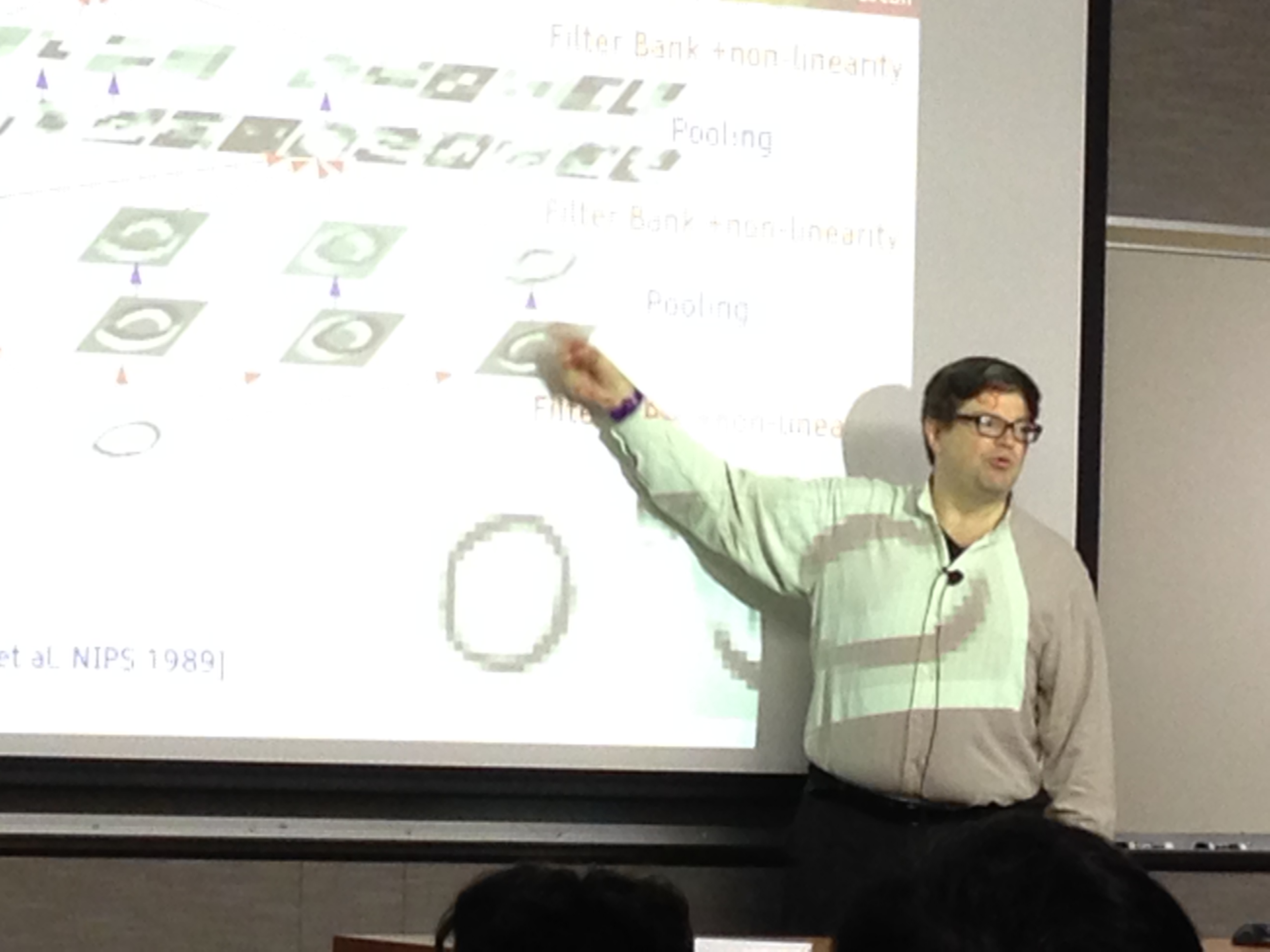
Portrait provenance was checked against the photographer’s own-work declaration, original uploading account, same-day file history, camera metadata, and the university’s speaker archive. The image and display adaptations are CC BY-SA 3.0; that license does not apply to this article. Send documented corrections to info@rachorg.org. Material revisions will be dated. Narrative word count excludes navigation, citations, methodology, and sources.
Sources
- 2018 Turing Award announcement, Association for Computing Machinery. March 27, 2019 primary announcement distributed by ACM; historical roles only.
- Great Immigrant: Yann LeCun, Carnegie Corporation. August 19, 2025; public recollections and immigration history, not a current job-title source.
- The HLF Portraits: Yann LeCun, Heidelberg Laureate Forum / TIB AV-Portal. Oral-history transcript accessed through the portal’s public transcription endpoint; recollections attributed, names checked separately.
- Biography and publications, Collège de France. Historical education and laboratory chronology; automatically translated page contains outdated employment wording.
- CILVR Seminar: Yann LeCun, New York University. September 9, 2026 event record; current AMI and NYU roles checked October 6.
- Backpropagation Applied to Handwritten Zip Code Recognition, LeCun and colleagues / Neural Computation. 1989 paper abstract and complete author list; DOI 10.1162/NECO.1989.1.4.541.
- Neocognitron, Kunihiko Fukushima / Biological Cybernetics. 1980 primary paper record; indexed record consulted when the research reader returned an empty page.
- Backpropagation publications, Geoffrey Hinton / University of Toronto. Primary bibliography identifies the 1986 Rumelhart, Hinton and Williams papers.
- Gradient-based learning applied to document recognition, LeCun, Bottou, Bengio and Haffner / Proceedings of the IEEE. 1998 publication record; publisher robot challenge prevented full-text review. Deployment corroborated by ACM and IEEE Spectrum.
- The MNIST database, Yann LeCun, Corinna Cortes and Christopher Burges. Primary dataset description consulted through indexed text; direct access timed out.
- High Quality Document Image Compression with DjVu, Bottou and colleagues / Journal of Electronic Imaging. 1998 paper abstract on coauthor’s website; compression results are paper-specific.
- Yann LeCun at NEC, NEC Laboratories America. Institutional record identifies the 2002–2003 fellowship.
- Research projects, past and present, NYU Computational and Biological Learning Lab. Historical laboratory project record; its “present” labels are not treated as 2026 statuses.
- ImageNet Classification with Deep Convolutional Neural Networks, Krizhevsky, Sutskever and Hinton / NIPS 2012. Primary proceedings abstract; LeCun is not an author.
- International Conference on Learning Representations 2013, ICLR. Founding conference announcement and chairs.
- Facebook taps deep-learning researcher for new lab, Cade Metz / WIRED. December 9, 2013 independent contemporary reporting.
- Deep learning, LeCun, Bengio and Hinton / Nature. May 27, 2015 review; abstract, author record and acknowledgements consulted.
- Yann LeCun on deep learning, Lee Gomes / IEEE Spectrum. 2015 interview and independent introduction; historical deployment, working methods and hobbies.
- A prize for discoveries past, present and future, Nature Machine Intelligence. May 13, 2019 independent editorial on benefits, scientific applications and high-stakes limitations.
- Yann LeCun interview transcript, episode 416, Lex Fridman Podcast. March 7, 2024 public interview; views attributed, not presented as settled scientific conclusions.
- Managing extreme AI risks amid rapid progress, Bengio, Hinton and colleagues / Science. Author manuscript of the 2024 policy paper; argument about prospective risks, not proof of inevitable harm.
- Open Source AI Definition: final board report, Open Source Initiative. Historical definition and validation record; Llama 2 did not satisfy its criteria.
- Yann LeCun will address the class of 2026, NYU Tandon. May 4, 2026 announcement confirms Jacob T. Schwartz professorship and January AMI appointment.
- AMI Labs, Advanced Machine Intelligence. Company research aims and named team checked October 6, 2026; promotional claims treated as goals.
- Yann Le Cun raises funding for France-based AI start-up, Le Monde. March 10, 2026 independent reporting; funding is not evidence of technical or human outcomes.
- Self-Supervised Learning from Images with a Joint-Embedding Predictive Architecture, Assran and colleagues. 2023 I-JEPA primary paper abstract and author list.
- V-JEPA 2, Assran and colleagues. 2025 primary research record; video benchmarks and limited robot experiments.
- LeJEPA, Randall Balestriero and Yann LeCun. First submitted November 11, 2025; theory and empirical claims attributed to authors.
- V-JEPA 2.1, Mur-Labadia and colleagues. First submitted March 15, 2026; latest listed revision June 11, 2026.
- Patch Policy, Zhou, Cui, Langford, Tan, LeCun and Pinto. Preprint first submitted July 20, 2026, not a new October release; experimental claims only.
- Yann LeCun at the University of Minnesota, Runner1928 / Wikimedia Commons. Creator’s own-work upload on October 20, 2014; same-day file history, camera metadata and location corroborated.
- Photographer account, Runner1928. Original uploading account and public file-history identity checked.
- Attribution-ShareAlike 3.0 Unported, Creative Commons. Portrait license; attribution, change disclosure and share-alike apply.
- Cray Distinguished Speaker Series, University of Minnesota. Institutional archive independently lists LeCun in its 2014–15 speaker series.
- Learning Functional Subspaces for Neural Network Compression, Bini and colleagues. Preprint submitted September 30, 2026; primary abstract, authors and submission record checked October 6.
- SCOPE: Observation-Conditioned Full-Target Prediction for Sparse PDE Inference, Xu and colleagues. First submitted September 29, 2026; version 3 dated October 1. Primary abstract and author list checked.